Leaving Cert Art Study Notes
Official Visual Studies Framework Dashboard
Use this dashboard before every movement, artist or artwork. It turns the specification into a repeatable thinking routine: What was created? How was it created? Why was it created?
Before the period / movement
Describe and discuss the historical, social, political, economic and ideological context that led into the period or movement.
The period / movement
Explain the artists, artworks, ideas, media, formal qualities and innovations that define the period or movement.
After the period / movement
Explain the effect on later artists, design, culture and ideas. Show how influence travels across time.
The six framework lenses
Context
Who had power? What beliefs, politics, economics or technologies shaped the work? How did patrons, galleries or agencies affect value and visibility?
Artists and Artworks
Know recognised artists and works. Study their intentions, influences, audience, location, patronage and impact.
Analysis
Start with evidence: what is going on, what do you see, and how does that evidence support your interpretation?
Art Elements and Design Principles
Use line, colour, tone, form, texture, space, composition, rhythm, balance, contrast, scale, pattern and emphasis as proof.
Media and Areas of Practice
Consider painting, sculpture, print, architecture, craft, design, fashion, photography, film, UX, digital media and mixed media.
Innovation and Invention
Connect new materials, media, tools, processes and ideas to changes in art, society and visual culture.
Visual Studies Exam Response Builder
Use this scaffold for Higher or Ordinary level. It keeps the answer evidence-based rather than just descriptive.
Answer the command word
Analyse, discuss, compare, evaluate or explain. The action verb decides what your answer must do.
Set context quickly
Name the movement, period, artist, artwork, date range, location and social/political background where relevant.
Use visual evidence
Refer to composition, line, colour, light, scale, materials, technique, symbols and presentation.
Interpret meaning
Connect what you see to intent, audience, patronage, belief, identity, innovation or social commentary.
Make links
Compare to another artist, Irish/European context, Today’s World, practical work or later influence.
Conclude with judgement
State why the artwork, artist or movement is significant. Avoid repeating the introduction.
Useful sentence starters
“This is evident in...”
“The choice of media affects the reading of the work because...”
“In comparison...”
“The context is important because...”
“A viewer might interpret this as...”
“This links to Today’s World through...”
Action Verb Bank
Leaving Cert Art questions use precise action verbs. Use this bank to decode what the examiner is asking you to do.
Analyse
Break the work down into parts, identify relationships and use evidence to reach conclusions.
Discuss
Offer a balanced review with clear arguments, factors and evidence.
Compare
Give similarities between two or more items and refer to both throughout.
Evaluate
Make a judgement based on evidence, strengths, limitations and relevance.
Explain
Give a detailed account including reasons or causes.
Justify
Support your point with valid reasons or visual/contextual evidence.
Interpret
Use knowledge and observation to recognise meaning and draw conclusions.
Respond
React critically, emotionally, aesthetically or contextually to a stimulus.
Full revision list of high-value action verbs
Today's World
Context / main ideas: This section connects Visual Studies to living artists, design, media and society. It asks why art matters now: how artists think, how they make work, how images comment on power and identity, and how art responds to place, climate, technology and public life.
Study structure for this section
Students should understand and be able to describe and discuss the context that informed and led to the chosen period/movement using the six elements listed below.
Students should understand and be able to describe and explain the period/movement using the six elements listed below.
The framework is structured around six elements:
Today's World focuses on contemporary art, design, craft, architecture, film, animation, digital media and public art. It asks students to understand how artists and designers think, make, communicate, respond to society and respond to the environment.
1. Artists: Theory and Thinking
Context / main ideas: This theme begins with the idea that artists are thinkers as well as makers. Their work often starts from research, personal experience, politics, science, memory or philosophy, so the final object becomes evidence of an idea, question or argument.
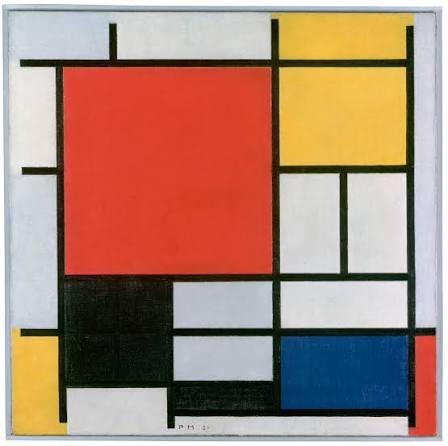
- Meaning and intention: Artists and designers begin with ideas. Their work may investigate identity, place, politics, memory, technology, environment, consumer culture or personal experience.
- Research: They gather visual, historical, social and material research before making decisions about form, media and audience.
- Critical thinking: Students should be able to explain why a work was made, what question it asks, what viewpoint it presents and how visual choices support that meaning.
- Audience: Contemporary work often asks the viewer to interpret, question or participate rather than simply observe.
Legacy / influence: Concept-led practice influenced later art by making planning, research and intention as important as technical finish. It supports contemporary installation, conceptual art, public art, socially engaged art and design-led problem solving.
2. Artists: Processes and Media
Context / main ideas: This theme focuses on how materials, tools and processes shape meaning. Traditional media, digital tools, industrial fabrication, performance and installation all affect how an audience reads a work and how the artist communicates ideas.
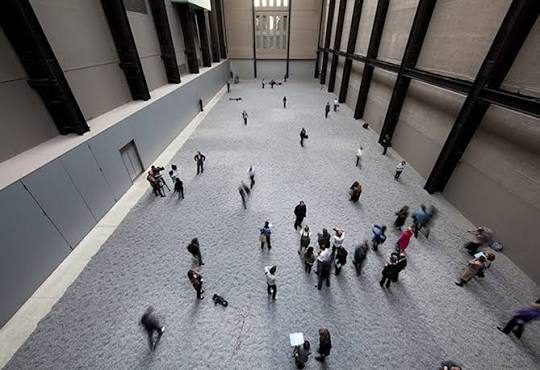
- Process: Processes include drawing, planning, experimenting, photographing, filming, editing, constructing, casting, printing, assembling, coding, performing and installing.
- Media: Today’s World includes traditional media such as paint, clay, metal, fibre and print, as well as found objects, digital tools, video, sound, animation, product design, graphics and architectural materials.
- Materials and meaning: The chosen material can carry meaning. Recycled materials may suggest sustainability, industrial materials may suggest mass production, and digital media may suggest communication or technology.
- Documentation: For performance, public art, environmental art and temporary installations, photographs, video and written documentation may become part of how the work is studied.
Legacy / influence: Experimentation with process influenced later art by breaking down boundaries between disciplines. It helped artists combine craft, design, technology, performance, photography, video and found materials in new hybrid forms.
3. Art as Social Commentary / Commentator
Context / main ideas: Social commentary art responds to injustice, conflict, inequality, consumer culture and public debate. It often uses direct imagery, irony, humour, shock or familiar visual language so that complex social issues become immediate and memorable.
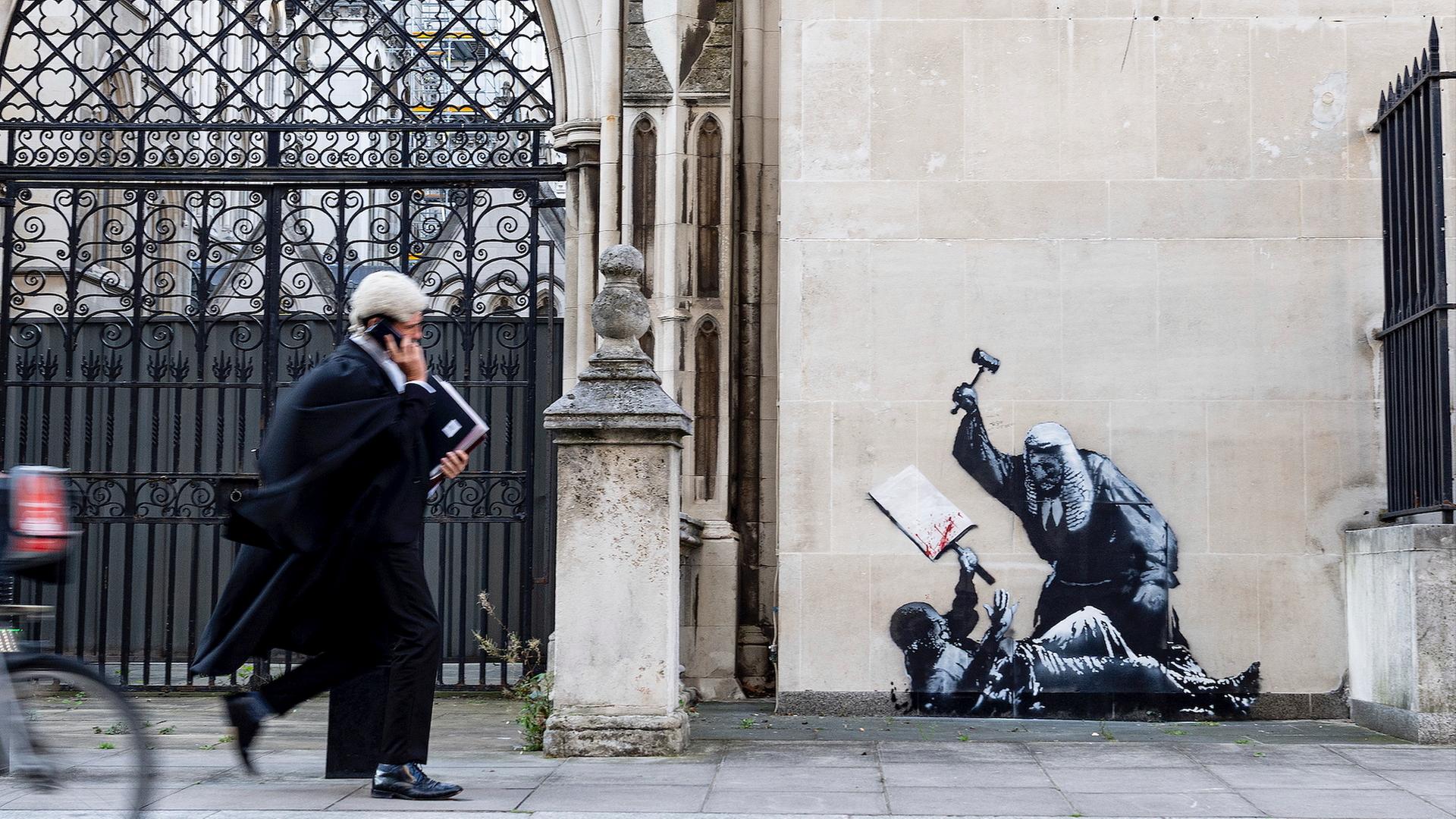
- Purpose: Art can comment on social, political and cultural issues. It can challenge inequality, conflict, consumerism, racism, censorship, climate change or the misuse of power.
- Visual strategies: Artists use irony, symbolism, scale, contrast, text, public placement, appropriation and shock value to communicate a message.
- Public audience: Street art, posters, murals, public monuments and digital campaigns often reach audiences outside traditional galleries.
- Exam focus: A strong answer should connect the issue, the artist’s viewpoint, the chosen media, the audience and the visual impact of the work.
Legacy / influence: Social commentary influenced later art by bringing activism and public voice into visual culture. It shaped street art, feminist art, protest graphics, political installation, documentary practice and online image-making.
4. Art and the Environment
Context / main ideas: Environmental art asks how people relate to landscape, materials, climate and place. Artists may work outdoors, use natural or recycled materials, question consumption or make viewers aware of ecological damage and responsibility.
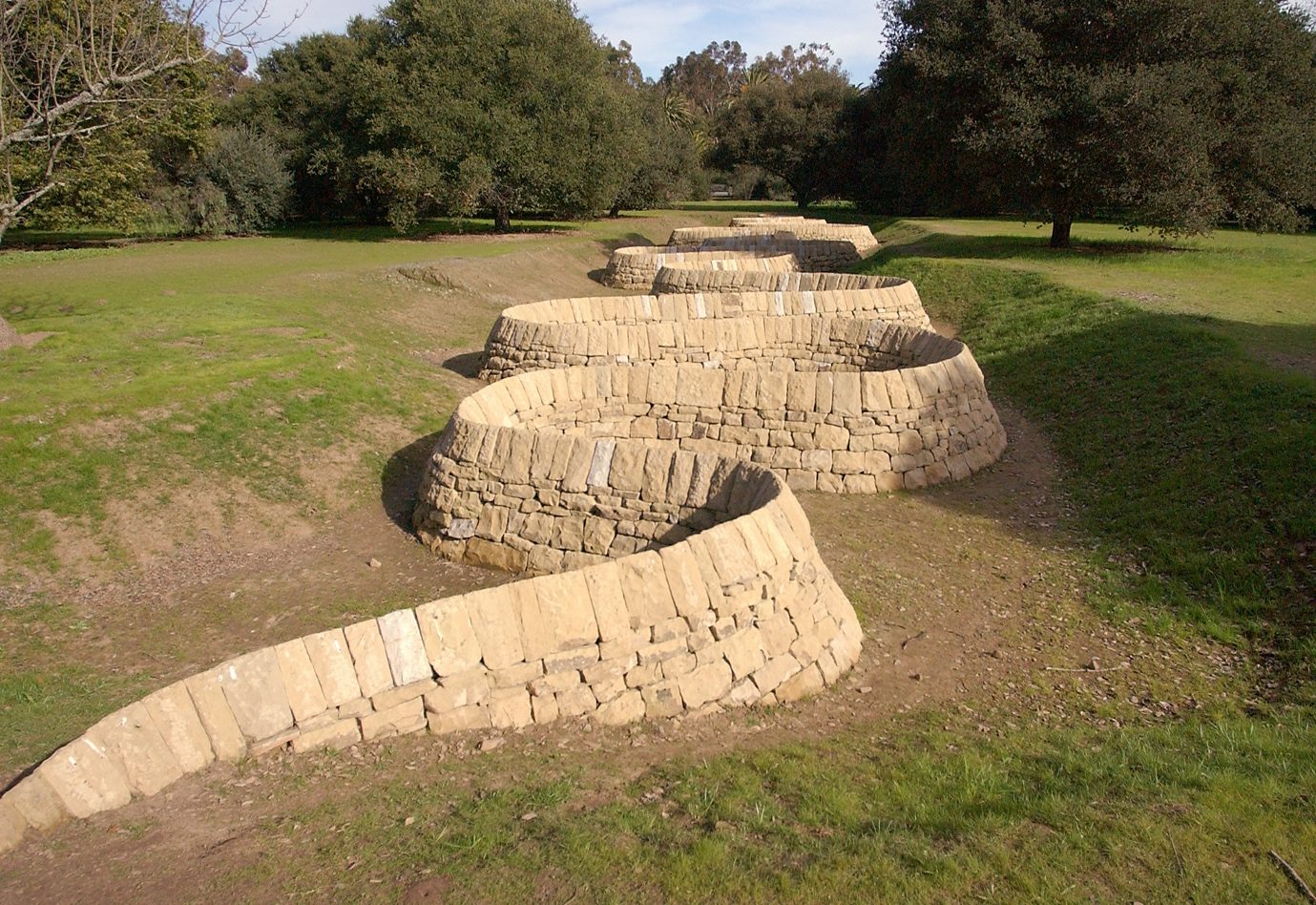
- Environmental theme: Artists and designers can respond to climate change, land use, ecology, waste, sustainability, biodiversity and the relationship between people and nature.
- Site-specific practice: Environmental art may be made for a particular place. The location, weather, materials and audience experience can all become part of the artwork.
- Sustainable design: Designers may consider renewable materials, repair, reuse, recycling, low-energy production and long-term impact.
- Temporary and changing work: Some environmental works are temporary, seasonal or altered by natural forces, so students should discuss documentation and process as well as the final appearance.
Legacy / influence: Environmental practice influenced later art by making sustainability, site-specificity and climate awareness central concerns. It continues to shape land art, public sculpture, installation, architecture, design and community projects.
Artist, Artwork and Artefact Analysis
Tinker Hatfield — Air Jordan 3
Key artist note: Tinker Hatfield trained as an architect before designing footwear, which explains his interest in structure, function and storytelling. At Nike he helped turn trainers into cultural objects, combining sport technology with identity, branding and celebrity. His Air Jordan designs are useful for discussing design process and audience.
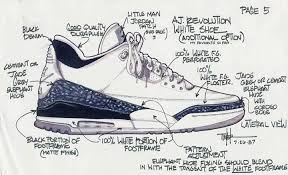
Look closely: Subject: trainer design as cultural object. Style: athletic, architectural and graphic. Technique: sketching, leather, rubber and visible Air technology. Composition: strong panels, logo and elephant-print detail. Meaning/Context: sport performance becomes identity, branding and celebrity storytelling.
Hatfield approaches the Air Jordan 3 as a designer solving both a practical and a cultural problem: the shoe had to perform for Michael Jordan while also expressing a distinct identity. His architectural training can be seen in the way the design is built from clearly organised structural zones rather than surface decoration alone. The visible Air unit makes cushioning technology part of the visual language, while elephant-print panels and the Jumpman mark turn performance features into recognisable symbols. This is also social design: the trainer sits at the meeting point of professional sport, celebrity, advertising, fashion and consumer identity. Hatfield’s practice depends on drawing, prototyping, material testing and collaboration with athlete and manufacturer. The result demonstrates how industrial design can shape not only an object’s function but also the meanings and communities that grow around it.
Liam McCormick — Modern Irish Church Architecture
Key artist note: Liam McCormick was one of Ireland’s most important modern church architects. He used modern materials and simple forms while responding carefully to landscape, light and worship. His buildings are interesting because they connect international modernism with Irish place, community and spiritual experience.
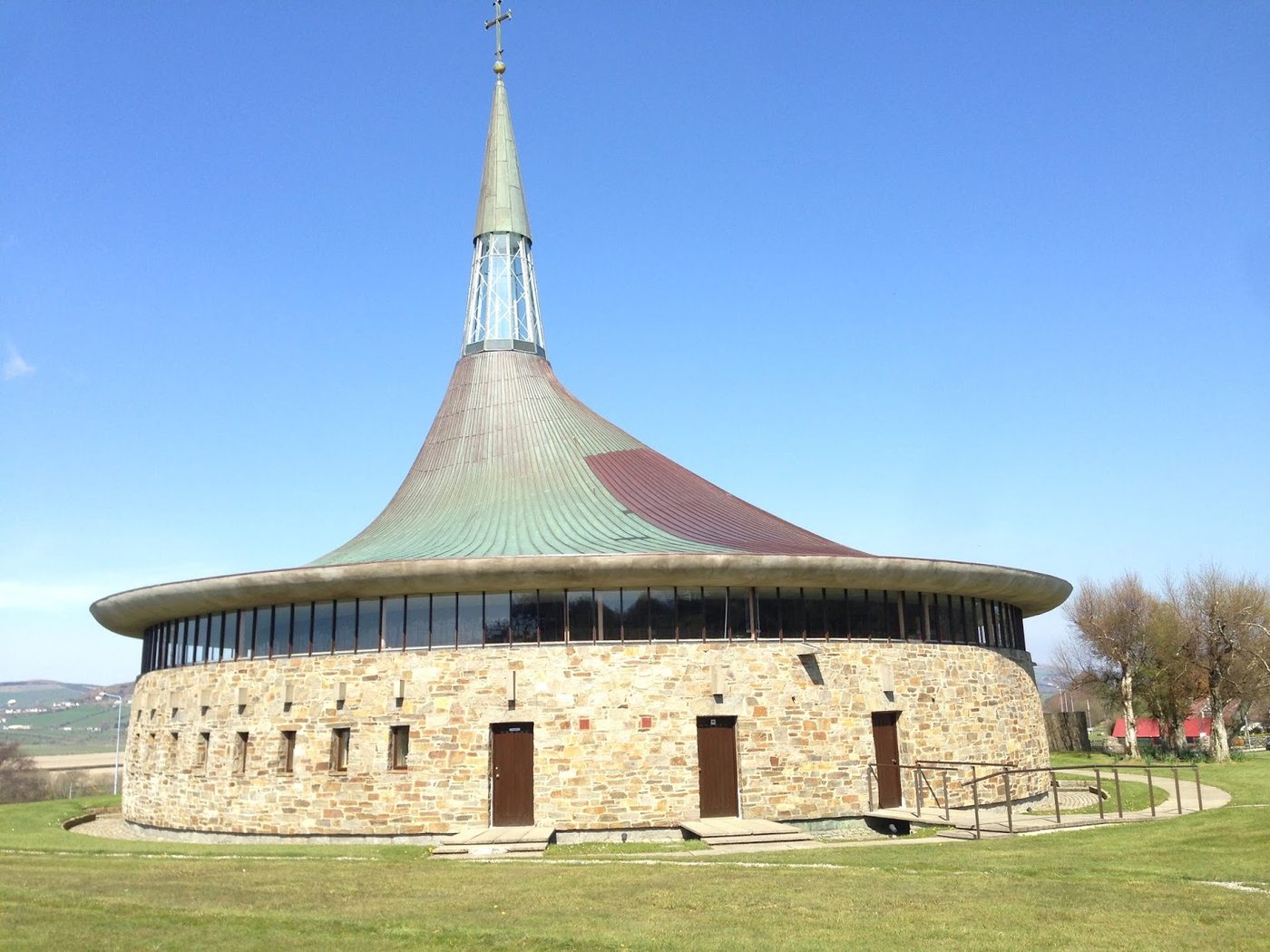
Look closely: Subject: modern Irish church design. Style: simplified, sculptural and site-sensitive. Technique: modern materials arranged for worship and gathering. Composition: clear massing and focused interior space. Meaning/Context: shows post-war Irish architecture adapting sacred tradition to modern design.
McCormick’s church architecture is best understood as an attempt to make modern design respond to place rather than simply imitate an international style. He reduces historic church ornament and allows mass, material, light and the movement of the congregation to carry meaning. Stone, concrete, timber and glass are treated as architectural experiences: weight and enclosure can suggest shelter, while controlled daylight gives the interior a changing spiritual atmosphere. His thinking is therefore both social and environmental. The church is conceived for a worshipping community, but it is also positioned in dialogue with the Irish landscape, local building traditions and the conditions of its site. McCormick’s practice shows that modern architecture can be experimental without becoming detached from locality; structure, landscape and liturgical function are brought together to create a contemporary sacred environment.
Maurice Harron — Hands Across the Divide / Reconciliation
Key artist note: Maurice Harron is an Irish sculptor known for public artworks that deal with memory, conflict and reconciliation. His figures often use gesture and scale to communicate emotion clearly in shared spaces. He is useful for discussing how public sculpture can support reflection, identity and civic dialogue.
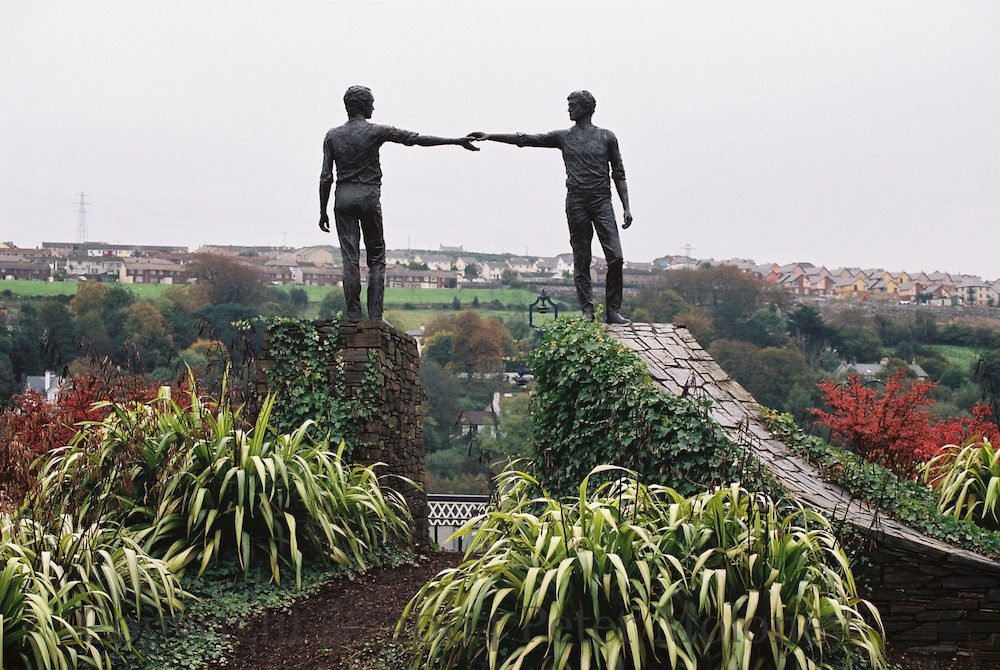
Look closely: Maurice Harron — Hands Across the Divide / Reconciliation
Harron turns the political idea of reconciliation into a physical relationship between two bodies. The figures lean towards one another across a gap, so the sculpture does not present peace as something already achieved: the unclosed distance keeps division visibly present while the extended arms suggest the possibility of contact. Installed in Derry in 1992, near the Craigavon Bridge, the work gains meaning from a city profoundly shaped by the Troubles and from a site associated with crossing and separation. Its social commentary is therefore carried by gesture, location and public encounter rather than by written explanation. Harron uses recognisable human figures because their body language can be understood immediately by a broad audience. As public practice, the sculpture asks viewers moving through the city to confront memory, division and the difficult work of reconciliation in a shared civic space.
Paula Scher — The Public Theater Posters
Key artist note: Paula Scher is a major American graphic designer associated with expressive typography and public visual identity. She treats letters as images, rhythm and voice, not just information. Her theatre posters are strong examples for discussing communication, branding, urban energy and the emotional power of design.
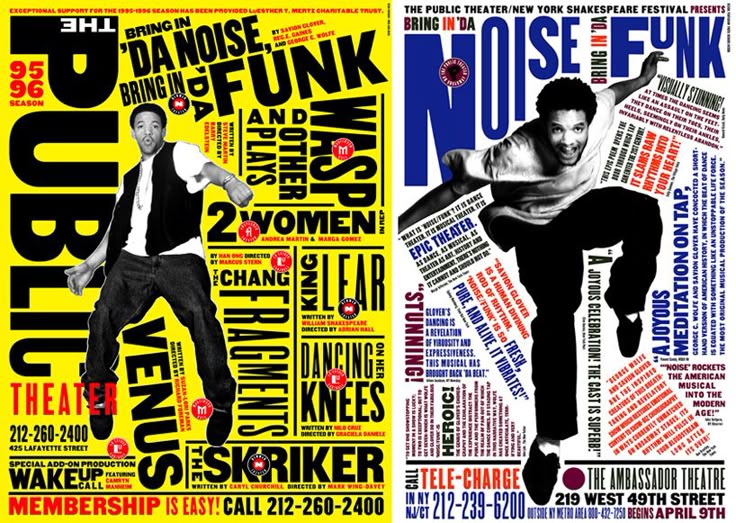
Look closely: Subject: theatre publicity and urban culture. Style: bold, energetic typography. Technique: graphic design, scale, colour and text hierarchy. Composition: letters become visual rhythm. Meaning/Context: posters turn information into identity, audience appeal and contemporary cultural branding.
Scher treats graphic design as a public voice rather than a neutral container for information. In her work for the Public Theater, typography performs: changes in scale, weight, angle, density and spacing create the visual equivalent of noise, rhythm and theatrical energy. The posters must advertise individual productions, but Scher also uses a recurring typographic language to make the institution recognisable across New York streets, theatre architecture, print and digital media. That makes the work a form of social communication: design competes within the crowded visual environment of the city while supporting the Public’s identity as an accessible cultural institution. Her practice is systematic as well as expressive. A flexible identity is developed, tested and adapted across many formats, showing that contemporary graphic design is not a single image but an evolving visual system shaped by audience, place, reproduction and use.
Banksy — Street Art and Social Commentary Works
Key artist note: Banksy is an anonymous street artist whose work uses stencil, humour and surprise to comment on politics, inequality, war and consumer culture. The mystery around the artist adds to the public impact. His work is useful for analysing authorship, audience, protest and art outside galleries.
Look closely: Banksy uses stencil, site and dark humour to challenge power, law and violence. The public wall becomes the artwork’s audience and message.
Banksy’s practice depends on the idea that the street is not merely a background for art but part of its argument. Stencils allow images to be produced quickly and with sharp graphic clarity, while familiar symbols, irony and visual jokes make political ideas readable without specialist knowledge. Works dealing with war, policing, surveillance, migration, inequality or consumer culture often borrow the language of advertising and public signage, then reverse its message. This creates social commentary through contradiction: an image may initially appear humorous or simple before exposing a more uncomfortable relationship of power. The urban environment is crucial because the work encounters people outside the controlled space of a gallery and can respond directly to a wall, boundary or neighbourhood. Anonymity, unauthorised placement and reproducibility are therefore not separate from Banksy’s practice; they shape questions about ownership, authority, audience and who is allowed to speak in public space.
Yayoi Kusama — Infinity Mirror Rooms
Key artist note: Yayoi Kusama is a Japanese contemporary artist known for repetition, dots, mirrors and immersive rooms. Her work connects personal experience, psychological intensity and popular spectacle. She is useful for discussing installation, audience participation, infinity, identity and how private visual language can become a shared public environment.
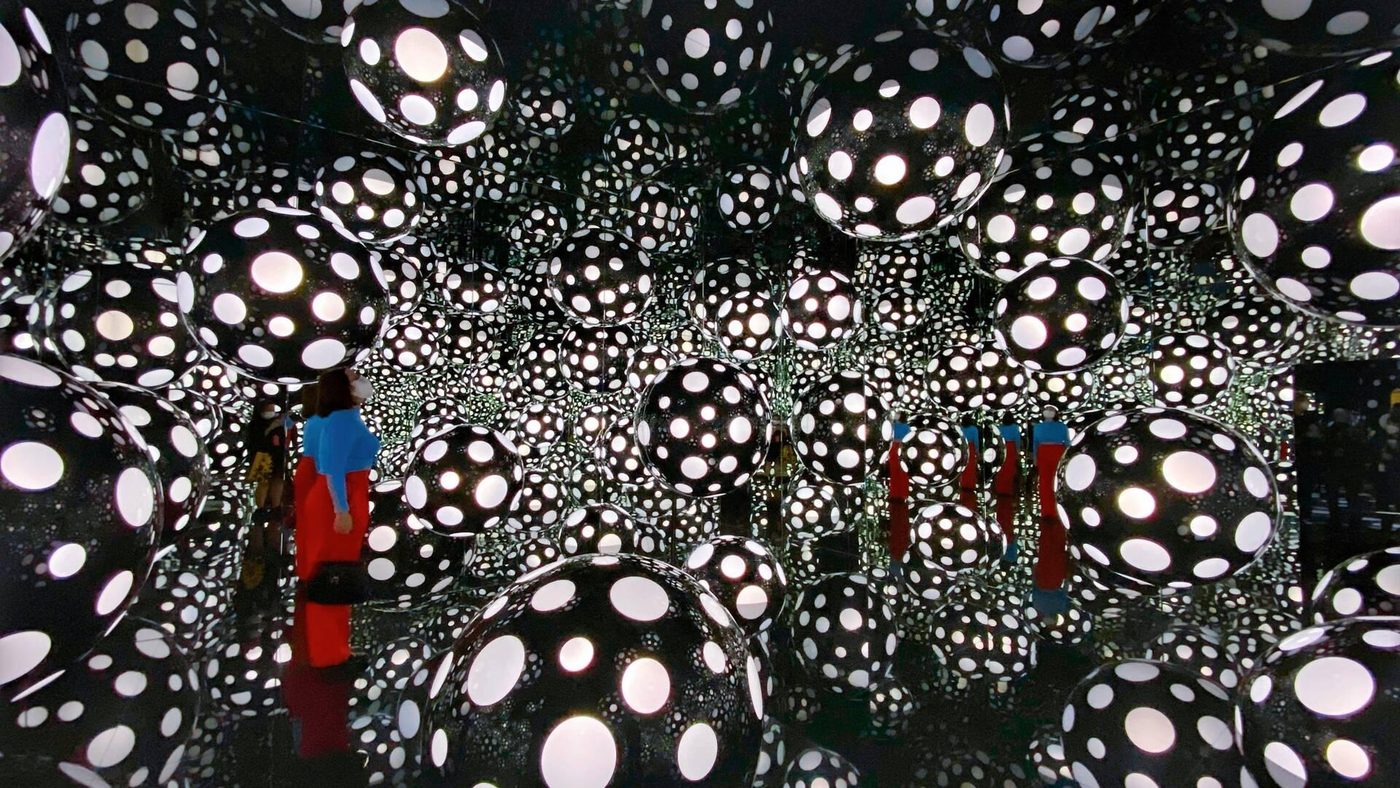
Look closely: Subject: immersive space, reflection and repetition. Style: Pop, installation and optical experience. Technique: mirrors, lights and repeated forms. Composition: endless reflections surround the viewer. Meaning/Context: explores infinity, self-loss and audience participation in contemporary art.
Kusama’s Infinity Mirror Rooms turn a recurring personal language of dots, repetition and endless accumulation into an environment that physically surrounds the viewer. Mirrors multiply lights, objects and bodies until the boundaries of the room become difficult to locate. This connects to Kusama’s idea of ‘self-obliteration’: the individual appears to dissolve into a field that seems to continue beyond ordinary space. The work is therefore not simply an optical spectacle. Its theory depends on repetition as a way of questioning the stability and separateness of the self. Installation is essential to her practice because meaning is produced through the viewer’s bodily presence, movement and reflection rather than through observation from a distance. The mirrored environment also creates a tension between intimate psychological experience and highly shared contemporary spectacle, since each visitor becomes both participant and image within the work.
Christo and Jeanne-Claude — The Gates
Key artist note: Christo and Jeanne-Claude created temporary environmental artworks using fabric, scale, planning and public space. Their projects required engineering, permissions and collaboration, so process was part of the work. They are useful for discussing site-specific art, temporary experience, documentation and the transformation of familiar places.
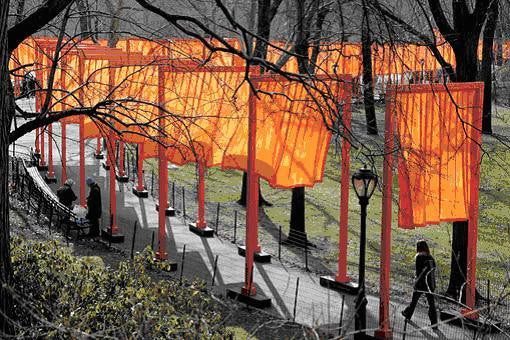
Look closely: Subject: temporary public installation in the landscape. Style: site-specific and monumental. Technique: fabric, modular structures and planning. Composition: repeated gates create rhythm through space. Meaning/Context: transforms ordinary movement into shared public experience.
For Christo and Jeanne-Claude, the artwork was not only the finished installation but the long process of imagining, negotiating, engineering and temporarily transforming a real public place. In The Gates, repeated saffron-coloured structures followed the paths of Central Park, making existing routes newly visible while fabric moved with wind and passing bodies. Their theory of temporary art is important: because the installation would disappear, ownership of the experience could not depend on possessing a permanent object. The environment remained recognisable, but colour, repetition and movement changed how visitors noticed distance, weather, season and one another. The project was also social practice on a civic scale, requiring permissions, fabrication, labour and public debate. Their method shows that contemporary art can operate through planning and collective experience as much as through traditional studio making, with documentation preserving a work whose physical life was deliberately limited.
Anish Kapoor — Cloud Gate
Key artist note: Anish Kapoor is a British-Indian sculptor known for polished surfaces, voids, scale and optical effects. His work often makes viewers aware of their bodies and surroundings. He is useful for discussing material, reflection, public interaction and how sculpture can alter perception of space.
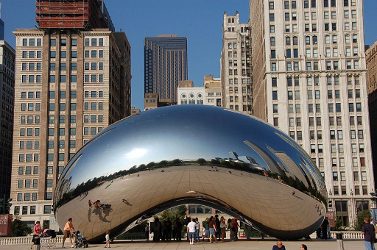
Look closely: Subject: reflective public sculpture. Style: smooth, abstract and monumental. Technique: polished stainless steel. Composition: curved form distorts city, sky and viewer. Meaning/Context: makes public space interactive and turns reflection into meaning.
Kapoor’s Cloud Gate uses a highly engineered object to make the surrounding environment unstable and newly visible. Its polished stainless-steel skin reflects Chicago’s skyline, sky and visitors, but the curved surface stretches, compresses and reverses those reflections. The sculpture therefore shifts attention away from a fixed object and towards perception: what viewers see changes continuously as they move. Kapoor’s practice often explores voids, reflective surfaces and forms that seem to exceed their material limits, and here the apparently seamless finish suppresses evidence of fabrication so that a massive metal structure can appear fluid and almost weightless. In social terms, the work succeeds through public participation rather than distant monumentality; people gather beneath it, touch it, photograph it and see themselves incorporated into the cityscape. The urban environment is not scenery around Cloud Gate—it becomes the changing visual material of the sculpture itself.
Olafur Eliasson — The Weather Project
Key artist note: Olafur Eliasson is a Danish-Icelandic artist who uses light, weather, mirrors, water and perception to create immersive experiences. His work often connects science, environment and viewer participation. He is useful for discussing installation, climate awareness, sensory experience and the active role of the audience.
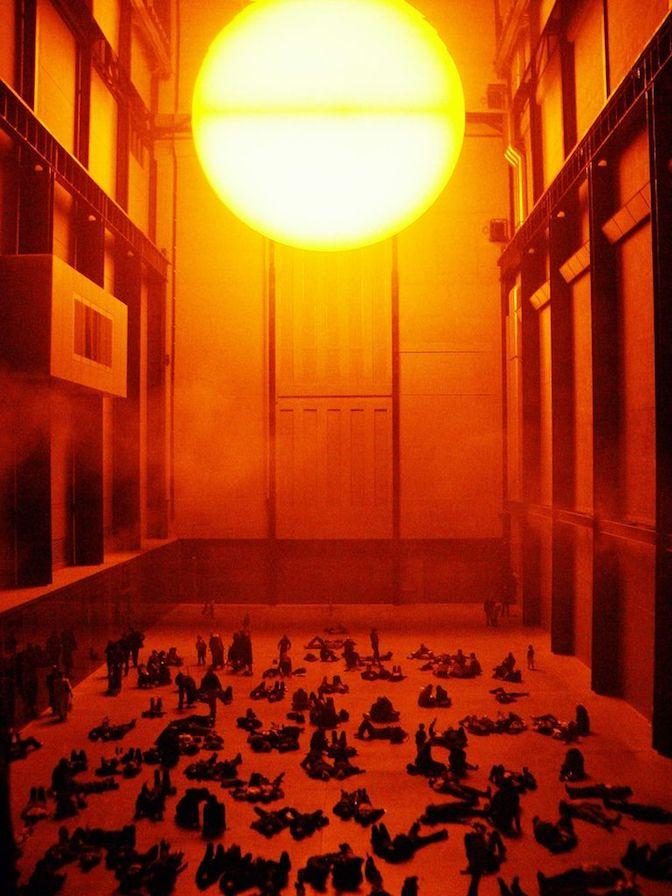
Look closely: Subject: artificial sun and atmosphere. Style: immersive installation. Technique: light, mist, mirror and scale. Composition: viewers gather inside a glowing environment. Meaning/Context: questions nature, perception, climate and shared public experience.
Eliasson treats perception as something constructed rather than passive. In The Weather Project, lamps, mist and a vast mirrored ceiling produced the impression of a glowing sun inside Tate Modern, but the installation did not try to hide its artificiality. That tension is central to the work: viewers experience something that feels atmospheric and natural while remaining aware that it has been technologically manufactured. Eliasson’s practice frequently combines art, architecture, science and environmental phenomena to make audiences notice how light, weather and space affect behaviour. The social dimension emerged as visitors gathered, lay on the floor and watched their reflections become part of a temporary crowd in the mirror above. The Turbine Hall was therefore changed from a circulation space into a shared environment. Rather than illustrating climate or nature, the work asks how contemporary urban life mediates our experience of both.
Andy Goldsworthy — Environmental Art
Key artist note: Andy Goldsworthy is a British environmental artist who works directly with natural materials such as leaves, ice, stone and wood. His work is often temporary and documented through photography. He is useful for discussing process, place, time, change and the relationship between art and nature.
Look closely: Subject: nature, change and place. Style: organic, temporary and site-specific. Technique: arranging natural materials by hand. Composition: pattern and contrast emerge from the landscape. Meaning/Context: shows process, time and environmental awareness as the artwork.
Goldsworthy’s practice begins with close attention to a specific place, material and moment. Instead of treating leaves, ice, stone, water or branches as neutral art supplies, he works with their existing properties—weight, colour, brittleness, temperature, growth and decay. The making process becomes a form of investigation: arranging, balancing or joining material reveals what the landscape will permit, while wind, rain, melting and erosion continue the work after the artist stops. This challenges the idea that an artwork must be permanent or protected from change. Many pieces survive primarily through photography, but the photograph records an encounter rather than cancelling the importance of the temporary object. Goldsworthy’s environmental thinking is therefore grounded in process and time. Human intervention is visible, yet it remains dependent on natural systems, encouraging the viewer to understand landscape as active, changing and materially specific rather than as passive scenery.
Agnes Denes — Wheatfield – A Confrontation
Key artist note: Agnes Denes is a pioneering conceptual and environmental artist. Her work often combines ecology, philosophy, mapping and public action. Wheatfield – A Confrontation is especially useful because it placed a field of wheat in Manhattan, creating a striking contrast between land, value, food and urban power.
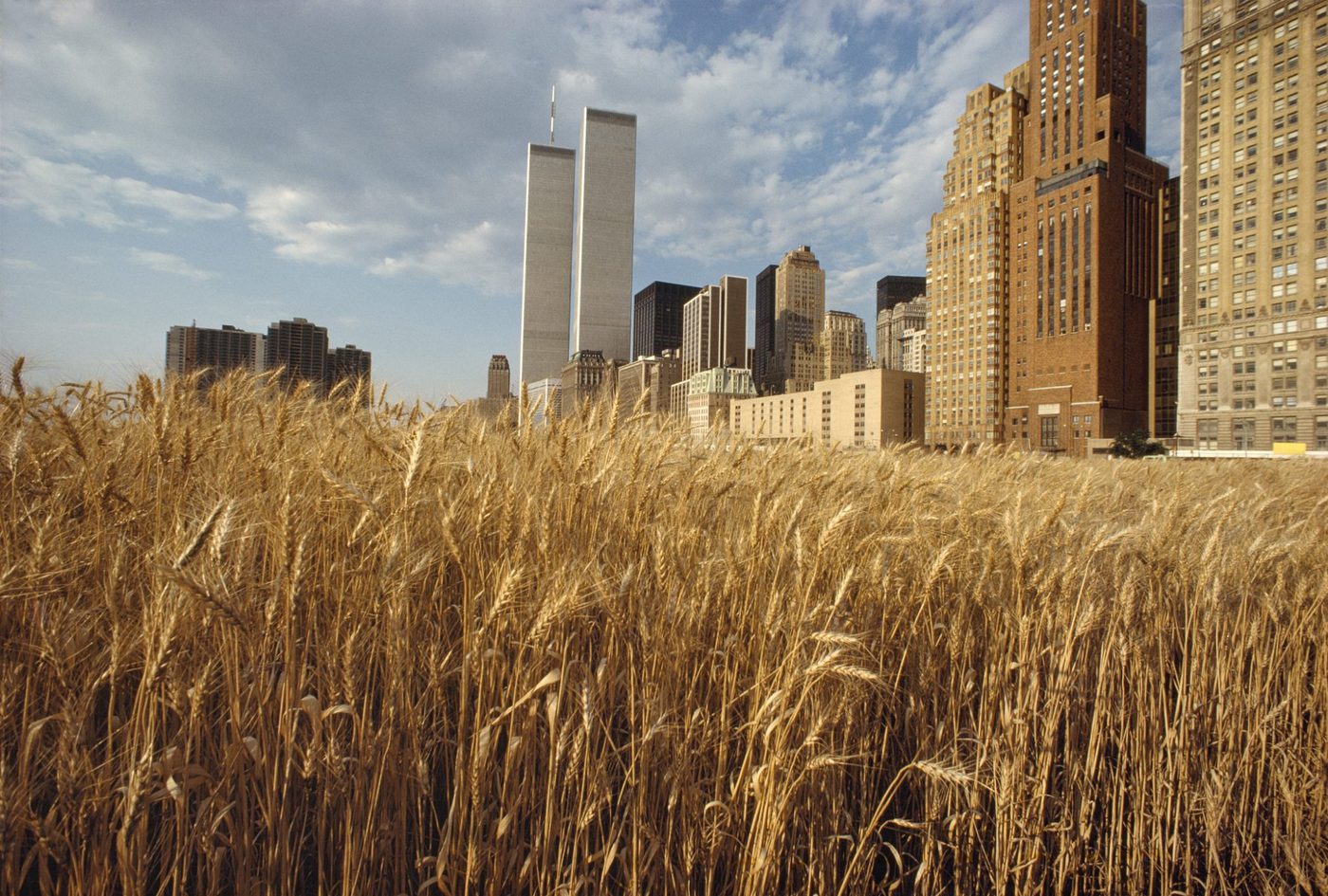
Look closely: Subject: wheat field planted in an urban site. Style: conceptual and environmental. Technique: farming as artistic action. Composition: natural growth contrasts with city architecture. Meaning/Context: challenges land value, food production, ecology and capitalism.
Denes designed Wheatfield – A Confrontation as a deliberate collision between ecological value and financial value. In 1982 she planted and harvested two acres of wheat on landfill in Lower Manhattan, close to Wall Street and the World Trade Center. The living crop set food, labour and biological growth against some of the world’s most expensive urban land. Denes described the work through ideas of food, energy, commerce, economics, waste, hunger and ecological concern, so the field functioned as an argument rather than as picturesque landscape. Her practice combines conceptual planning with sustained physical labour: soil was brought in, furrows were prepared, seed planted, the crop maintained and finally harvested. The city environment is essential to the meaning because the contrast would disappear in ordinary farmland. By making productive land temporarily occupy a centre of capital, Denes asks what societies choose to value and what those priorities cost.
Maya Lin — Vietnam Veterans Memorial
Key artist note: Maya Lin is an American artist and architect known for memorials that use simplicity, landscape and visitor experience. Her Vietnam Veterans Memorial changed expectations of public monuments by emphasising reflection rather than heroic display. She is useful for discussing memory, site, material and emotional response.
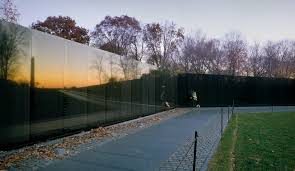
Look closely: Subject: public memory and loss. Style: minimal, reflective and architectural. Technique: polished stone inscribed with names. Composition: descending wall leads viewers through mourning. Meaning/Context: makes remembrance personal, national and participatory.
Lin rejected the conventional language of the triumphant war monument and designed remembrance as an encounter with absence. Two polished black-granite walls descend into the earth and meet in a V, carrying the names of the dead and missing in chronological order. The names are not supporting information; they are the memorial’s central material, shifting attention from an abstract national victory to individual human loss. As visitors walk downward and upward along the wall, their reflections appear in the stone alongside the engraved names, visually bringing present and past into the same surface. This is also an environmental work: the memorial is cut into the landscape rather than raised above it, and its orientation connects it to the larger monumental setting of Washington. Lin’s practice joins architecture, sculpture, typography and landscape to create a public space in which mourning and interpretation are left deliberately personal rather than dictated by heroic imagery.
Cartoon Saloon — The Secret of Kells
Key artist note: Cartoon Saloon is an Irish animation studio known for hand-drawn visual style, storytelling and references to Irish art and folklore. Its films often connect contemporary animation with manuscript design, pattern and myth. It is useful for discussing visual culture, design process and Irish identity today.
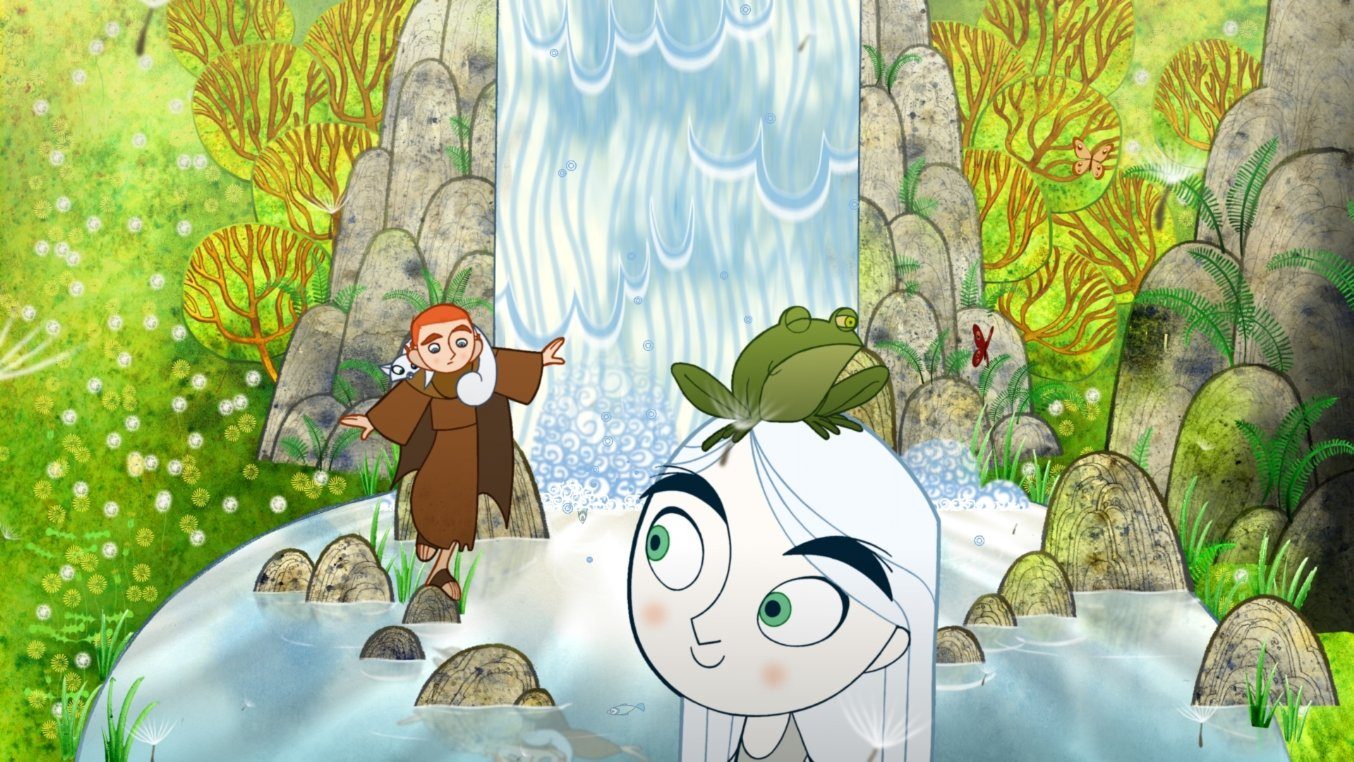
Look closely: Subject: Irish manuscript culture reimagined through animation. Style: flat, decorative and Celtic-inspired. Technique: digital animation with hand-drawn design. Composition: pattern, line and colour echo Insular art. Meaning/Context: connects heritage, storytelling and contemporary visual media.
The Secret of Kells does more than borrow Celtic decoration; its visual theory translates the logic of medieval manuscript illumination into the language of animation. Flattened space, strong contour, intricate pattern, symbolic colour and highly designed shapes often take priority over naturalistic depth, allowing the film’s moving images to echo the ornamental intensity of the Book of Kells. This choice connects contemporary Irish animation to a much older visual culture without simply reproducing the manuscript. The film also comments on cultural survival: storytelling, image-making and the preservation of knowledge are set against fear, violence and destruction. Cartoon Saloon’s practice combines drawing, character development, digital production, music and collaborative filmmaking, so heritage becomes a starting point for invention rather than a fixed historical style. The result presents Irish identity as something that can be reinterpreted and communicated internationally through contemporary visual media.
Today's World: Art Elements and Design Principles
Use these terms to analyse any artwork, design object, building, film still, poster, installation, public artwork or craft piece. Shape and form are treated together here so that two-dimensional and three-dimensional qualities are linked clearly.
Art Elements
| Art element | Explanation for visual analysis |
|---|---|
| Line | The path made by a mark, edge or direction. Line can be straight, curved, jagged, flowing, broken or implied. It can describe contour, create movement, suggest emotion or lead the viewer’s eye. |
| Colour | Hue, saturation and temperature. Colour can create mood, symbolism, emphasis, contrast, identity, atmosphere or visual unity. |
| Tone / Value | The lightness or darkness of a colour or surface. Tone creates volume, shadow, depth, drama, contrast and focal points. |
| Texture | The actual or implied surface quality of something. Texture may be rough, smooth, polished, woven, scratched, digital, natural or industrial; it helps communicate material and touch. |
| Pattern | Repeated lines, shapes, colours, motifs or forms. Pattern can create rhythm, decoration, cultural reference, surface interest or visual unity. |
| Space | The area around, within or between objects. Space may be positive or negative, shallow or deep, open or crowded, real or illusionistic. |
| Shape and Form | Shape is usually flat and two-dimensional; form is three-dimensional or appears three-dimensional. Together they help describe silhouettes, volume, structure, mass and the physical presence of objects. |
| Scale | The size of something in relation to the viewer, the body, the environment or other objects. Scale can make work feel intimate, monumental, playful, threatening or immersive. |
Design Principles
| Design principle | Explanation for visual analysis |
|---|---|
| Balance | The distribution of visual weight. Balance may be symmetrical, asymmetrical or radial and can make a design feel stable, dynamic or deliberately unsettled. |
| Contrast | A strong difference between elements, such as light/dark, large/small, rough/smooth, old/new or natural/artificial. Contrast creates impact and helps ideas stand out. |
| Emphasis | The focal point or area of importance. Emphasis may be created through scale, colour, placement, contrast, detail, lighting or isolation. |
| Movement | The way the viewer’s eye travels through a work, or the suggestion of physical motion. Movement may be created by line, repetition, gesture, sequence, blur or composition. |
| Rhythm | A visual beat created by repeated or alternating elements. Rhythm can make a work feel calm, energetic, flowing, mechanical or musical. |
| Unity / Harmony | The sense that the parts belong together. Unity may be created through repeated colours, materials, shapes, themes, style or composition. |
| Variety | Differences within a work that prevent it from becoming monotonous. Variety can be created through changing scale, colour, texture, direction, material or form. |
| Proportion | The size relationship between parts of a work. Proportion can be naturalistic, idealised, exaggerated or distorted for effect. |
| Composition | The overall arrangement of elements. Composition controls structure, flow, focus, balance and how meaning is organised visually. |
Today's World Case Study Bank
Use this bank to connect Today’s World themes with artists, designers and artworks. A strong exam answer should always discuss context, artist/designer intention, visual analysis, materials, process, audience and innovation.
| Focus | Possible case studies | What to analyse |
|---|---|---|
| Social commentary | Banksy; Ai Weiwei; Kara Walker; Shepard Fairey | Message, audience, public space, text/image relationship, symbolism, scale and political context. |
| Environment | Olafur Eliasson; Andy Goldsworthy; Agnes Denes; Maya Lin | Site, natural materials, sustainability, climate awareness, time, documentation and audience experience. |
| Design and media | Paula Scher; Tinker Hatfield; Apple / product design; film and animation studios | Function, branding, typography, user experience, innovation, process, materials and visual communication. |
| Public art / installation | Yayoi Kusama; Christo and Jeanne-Claude; Anish Kapoor; local public art commissions | Space, participation, scale, material, location, accessibility and public meaning. |
| Craft and material practice | Contemporary ceramics, textiles, jewellery, furniture or architectural design | Material choice, process, handcraft/technology, function, surface, texture and cultural context. |
Legacy / influence: Today’s World art influences later practice by expanding what counts as art. It encourages students to see art as research, activism, design thinking, environmental response and public communication rather than only painting or sculpture.
Pre-Christian Ireland
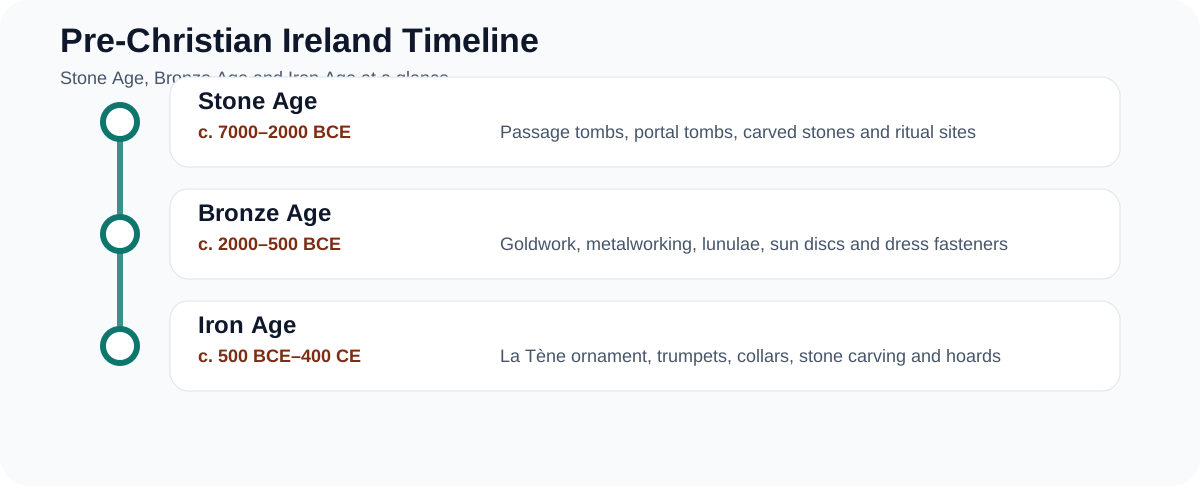
Context / main ideas: Pre-Christian Irish art developed before written historical records, so objects and monuments are key evidence. The main ideas are ritual, burial, status, skilled making and the relationship between people, landscape and belief.
Study structure for this section
Students should understand and be able to describe and discuss the context that informed and led to the chosen period/movement using the six elements listed below.
Students should understand and be able to describe and explain the period/movement using the six elements listed below.
The framework is structured around six elements:
Stone Age • Bronze Age • Iron Age
1. Overview Timeline
| Period | Approx. Dates | Key Features |
|---|---|---|
| Stone Age (Neolithic) | c. 4000–2000 BCE | Farming, tomb building, ritual monuments, stone carving |
| Bronze Age | c. 2000–500 BCE | Metalworking, gold jewellery, ceremonial objects, trade; Beaker pottery, single burials and early metalworking contacts |
| Iron Age | c. 500 BCE–400 CE | Celtic/La Tène influence, abstract decoration, elite objects |
2. Stone Age (Neolithic Ireland)
Context / main ideas: Stone Age Ireland was shaped by farming communities, megalithic tombs and ritual landscapes. Passage tombs, portal tombs and carved stones show cooperation, engineering skill and belief in ancestors, burial and cosmic order. The major change is the creation of permanent sacred monuments in stone.
Context
- People settled and farmed the land.
- Communities built large ritual tombs.
- Religion focused on death, ancestors and nature.
- Burial monuments were built collectively by communities.
- Astronomy and the movement of the sun were important.
Key Artworks and Monuments
Newgrange
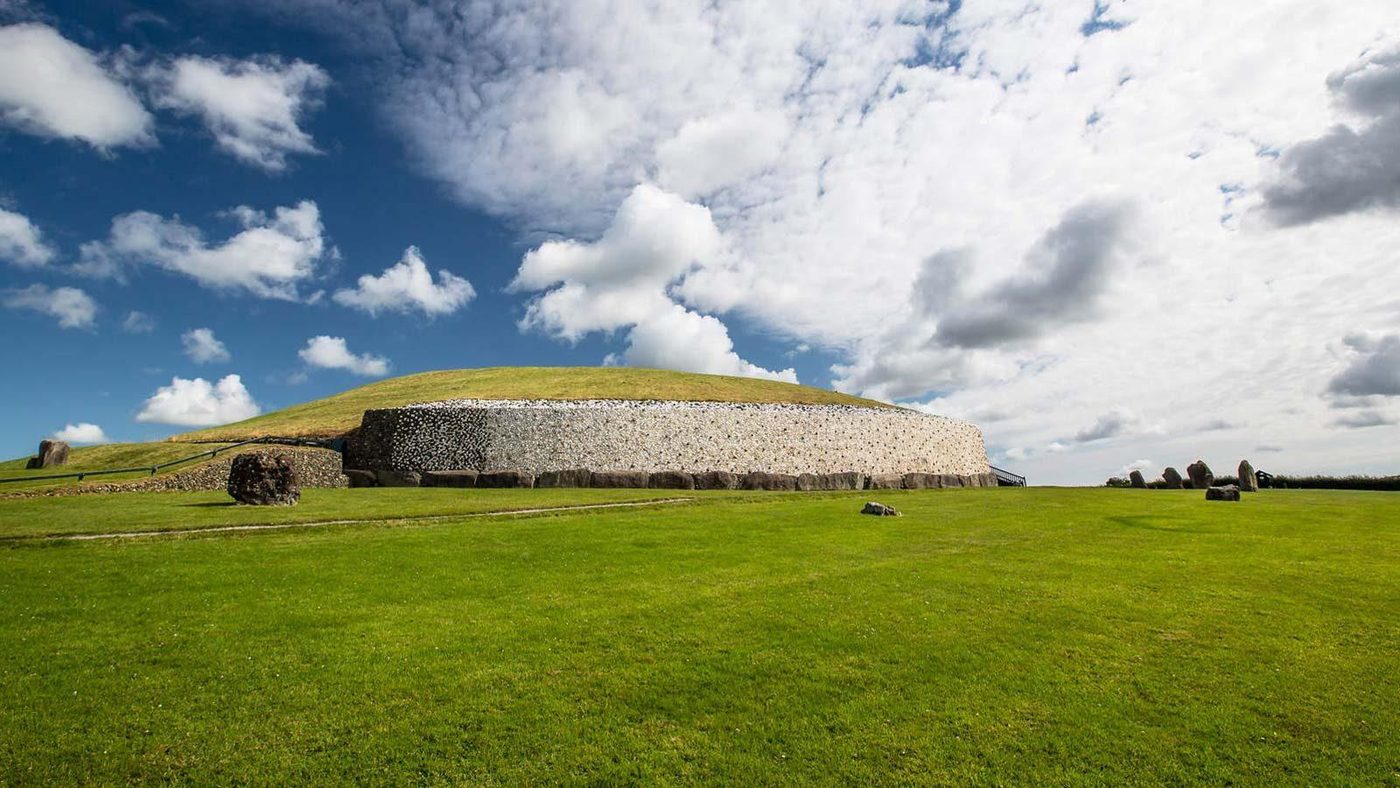
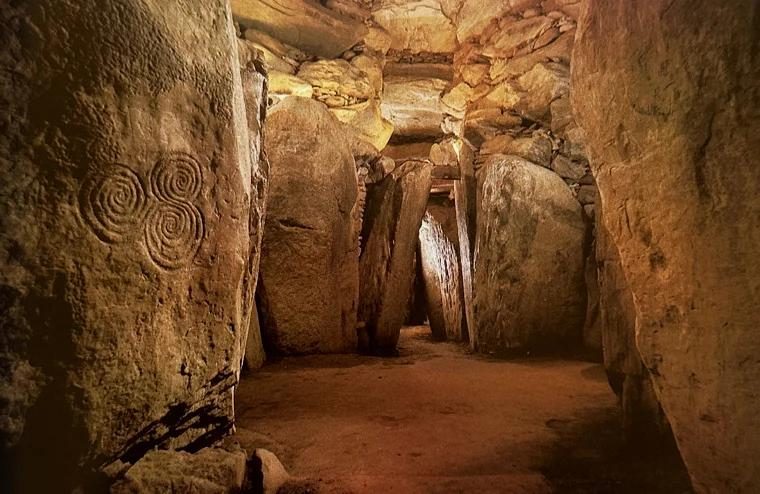
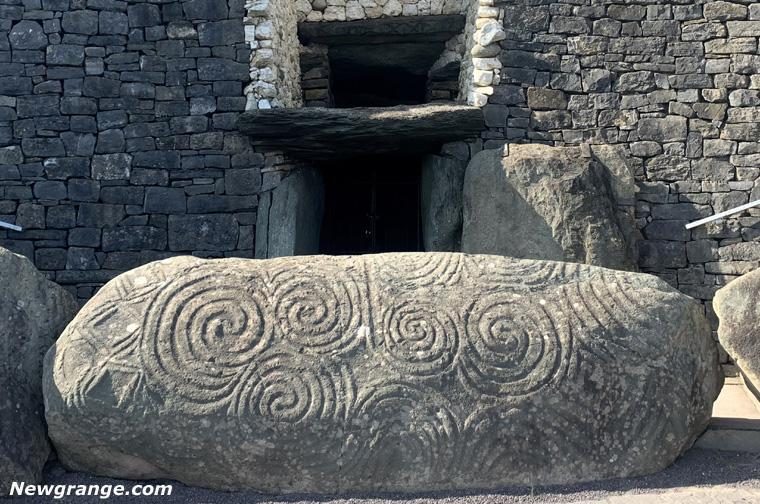
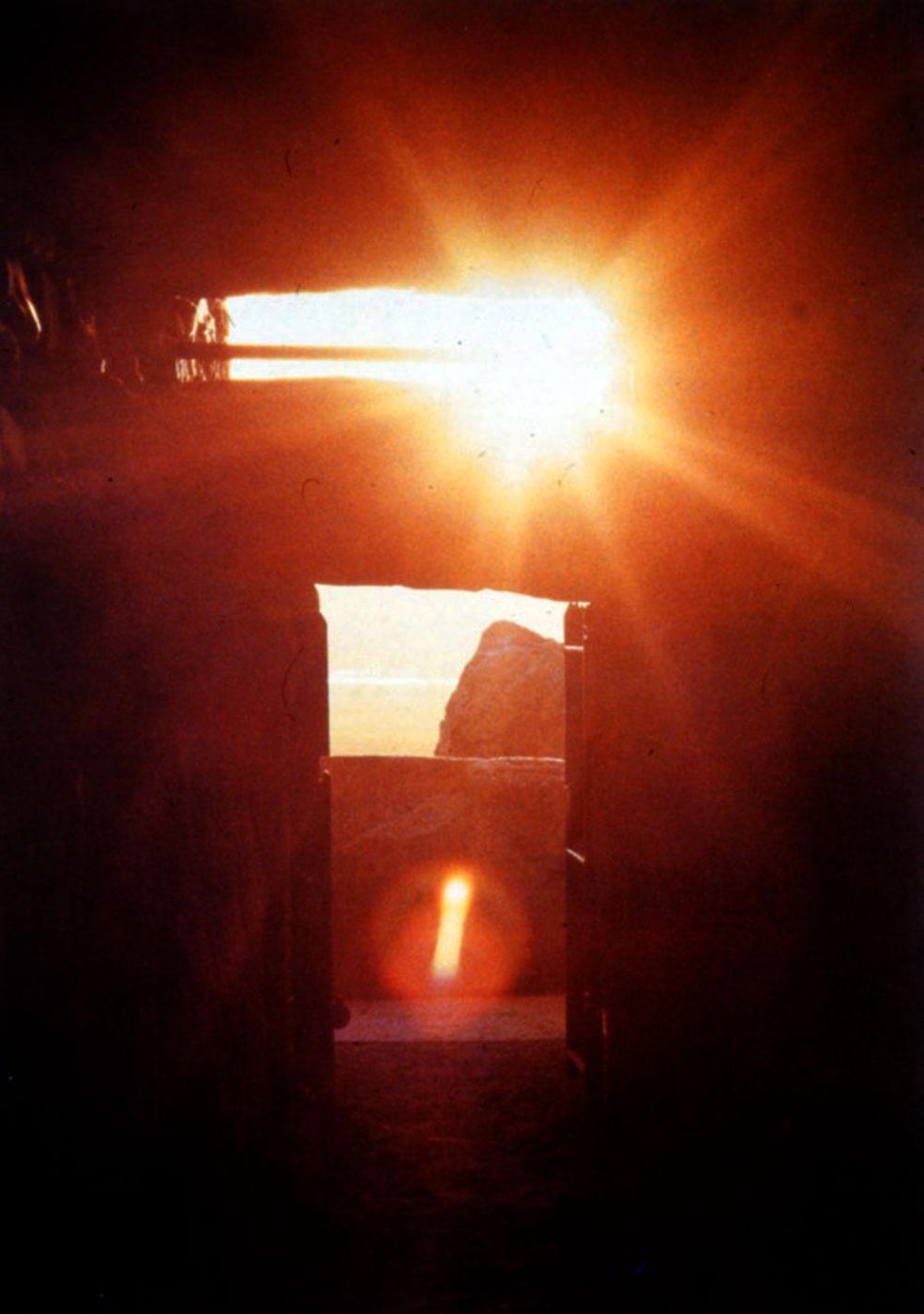
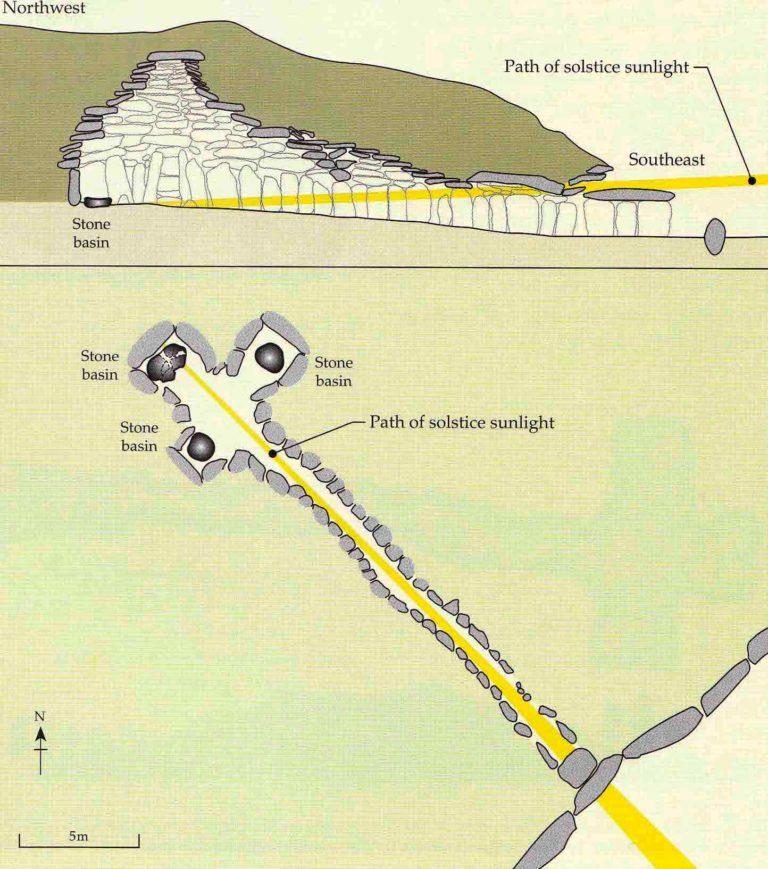
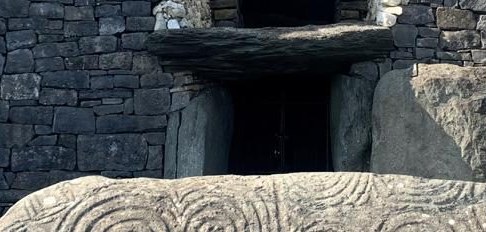
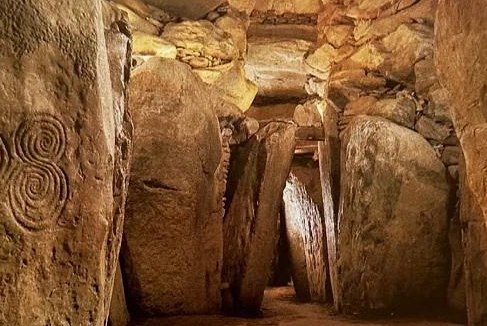
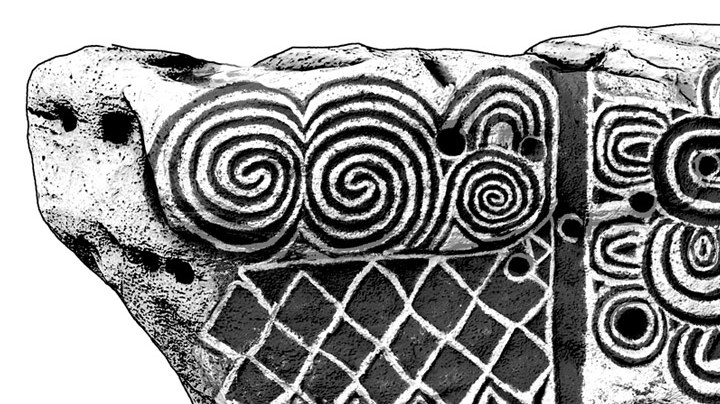
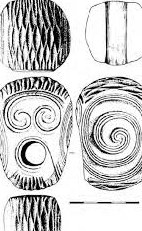
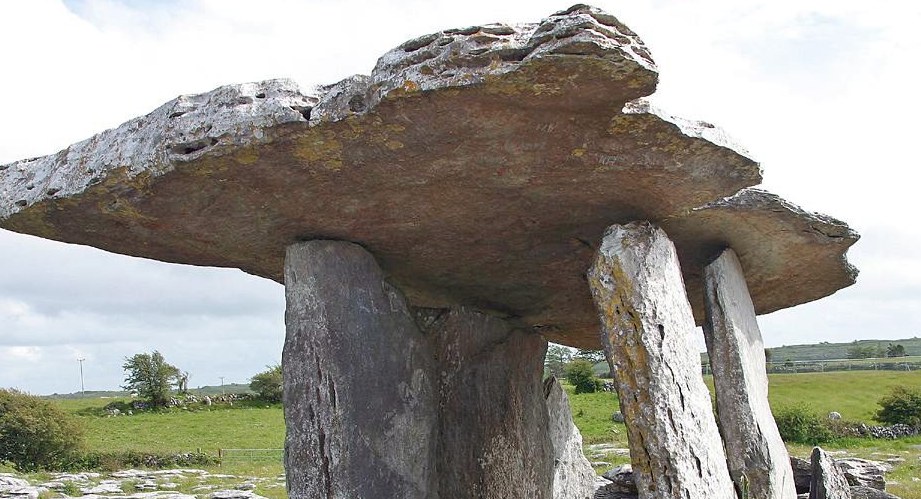
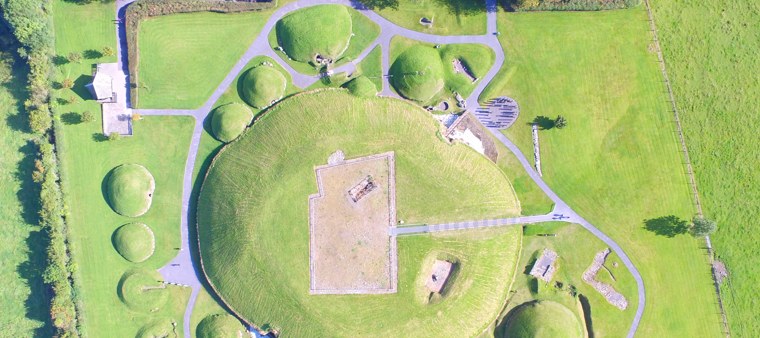
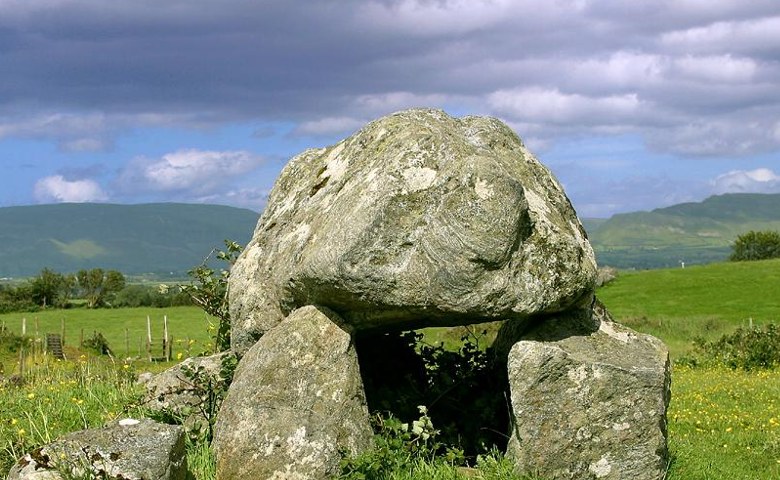
- Passage tomb in the Boyne Valley.
- Built around 3200 BCE.
- Older than Stonehenge and the pyramids.
- Famous for winter solstice alignment.
Knowth
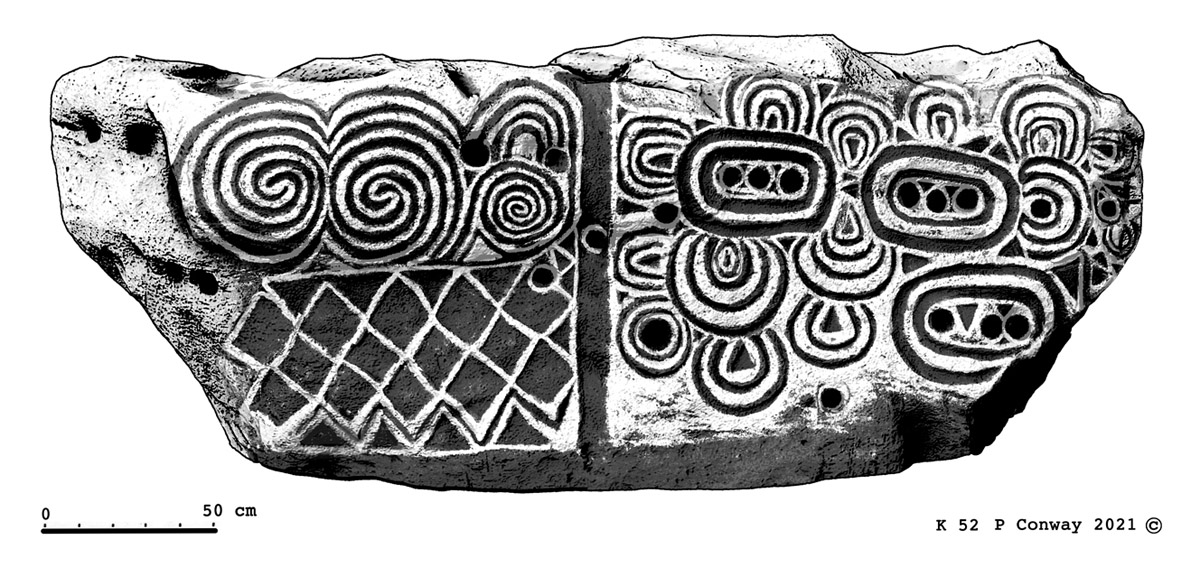
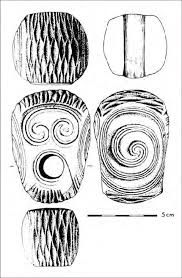
- Large passage tomb with extensive carved stones.
- Contains many spiral and geometric motifs.
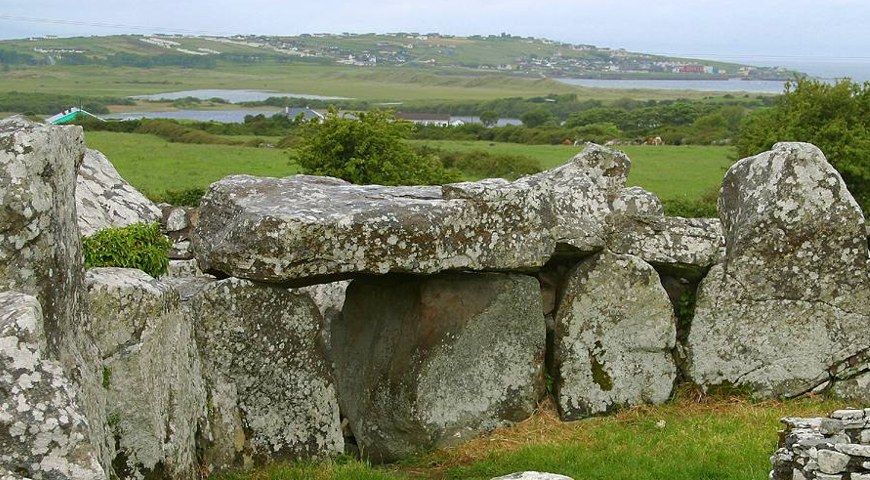
Poulnabrone Dolmen
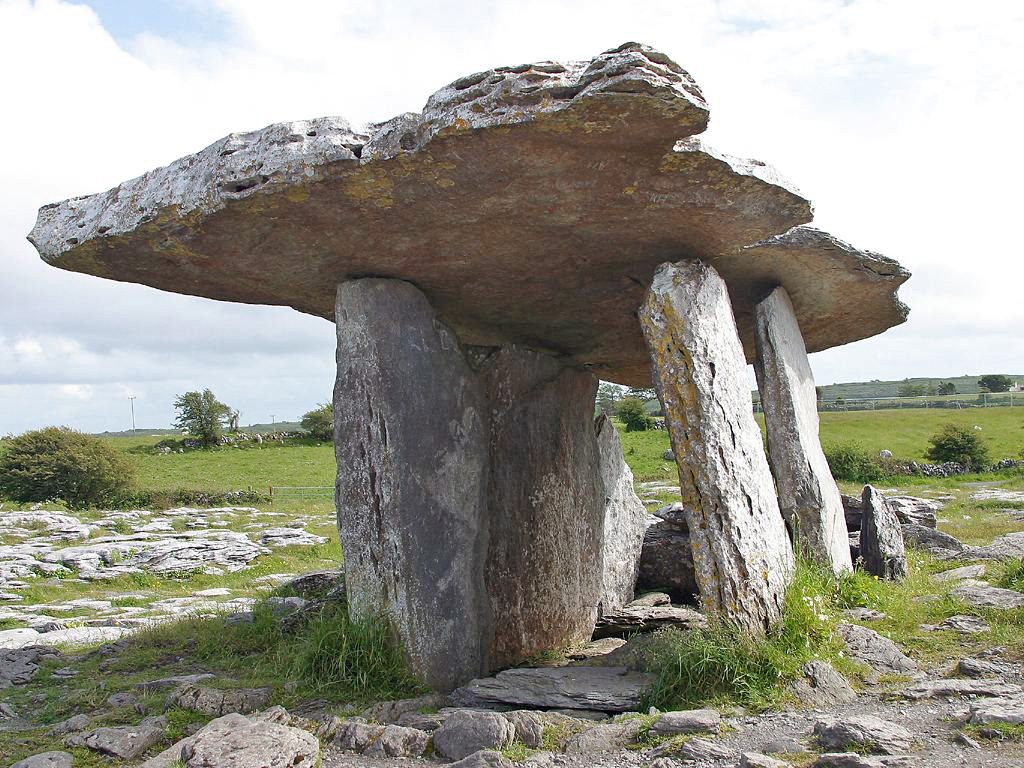
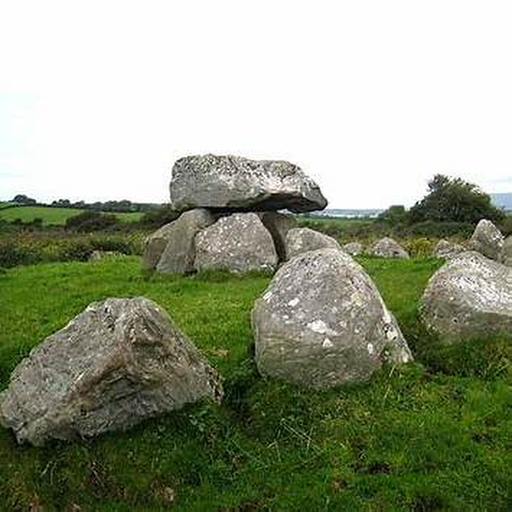
- Portal tomb made from large upright stones and a capstone.
- Burial and ritual function.
- Located in the Burren, County Clare.
- Shows the engineering skill of Neolithic builders using massive stone slabs.
Dowth
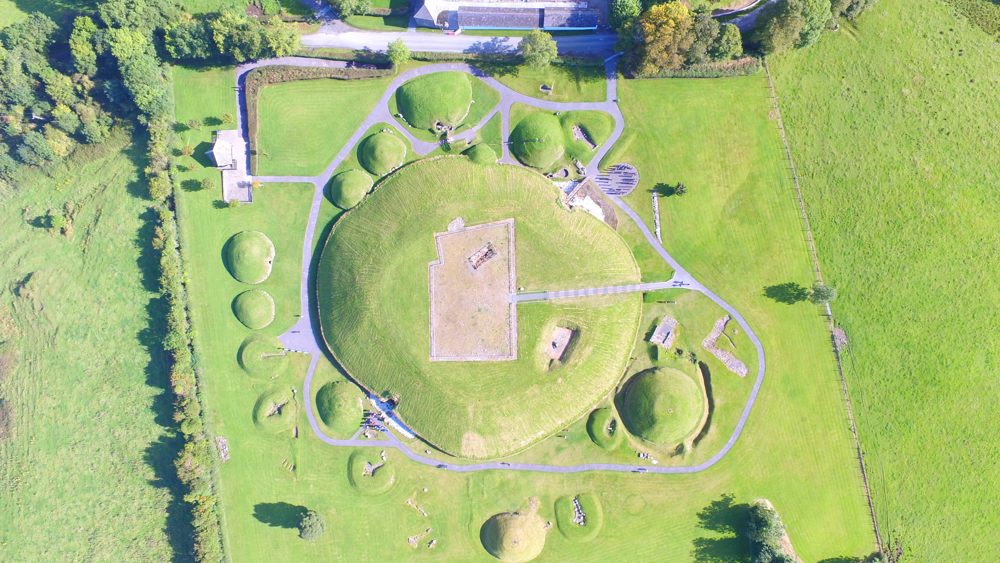
- Passage tomb in the Boyne Valley, part of Brú na Bóinne.
- One of the three great Boyne Valley tombs alongside Newgrange and Knowth.
- Important for carved stones, ritual function and links with solar alignment.
Carrowmore
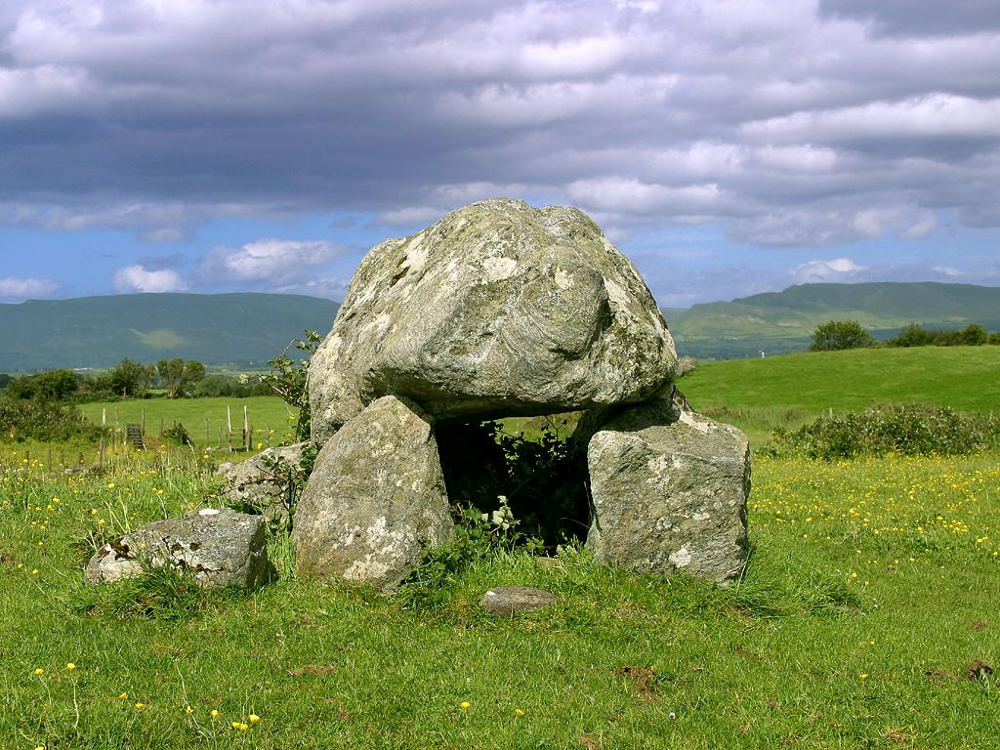
- Large megalithic cemetery in County Sligo.
- Contains many tombs arranged across a wider ritual site.
- Shows communal burial traditions and the importance of place in prehistoric Ireland.
Creevykeel
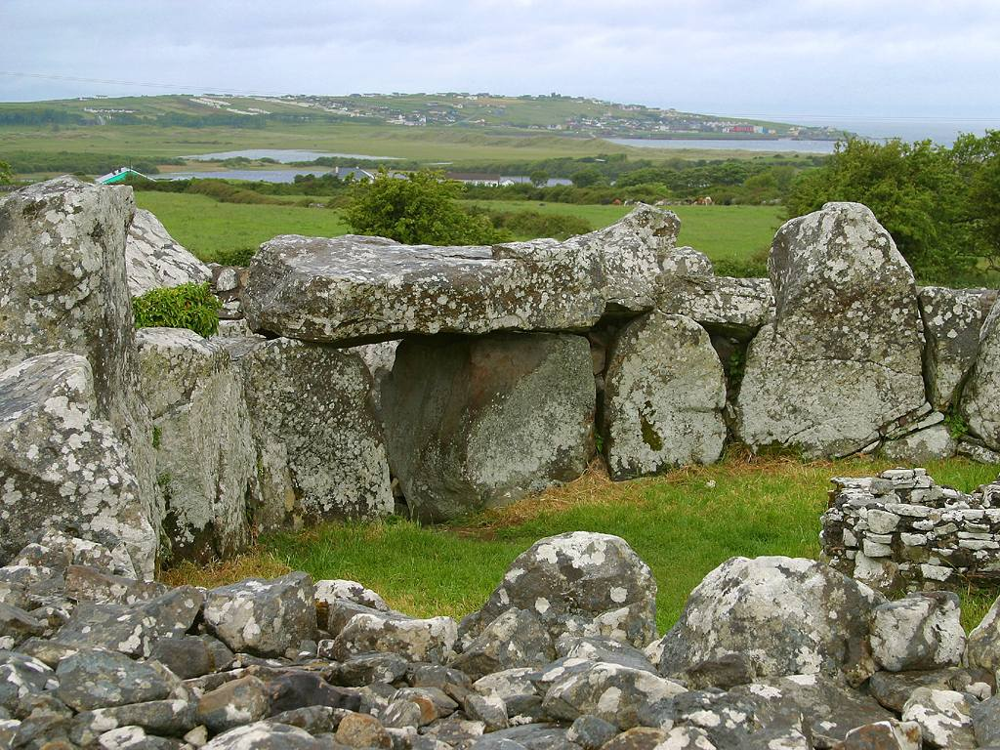
- Court tomb in County Sligo.
- Long cairn with an open forecourt leading to burial chambers.
- Important example of early Neolithic monument building and communal ritual use.
Analysis: Newgrange
Structure
- Circular mound with white quartz façade.
- Long passage leads to burial chamber.
- Corbelled roof keeps chamber waterproof.
Decoration
- Spiral carvings on kerbstones.
- Triple spirals and geometric motifs.
- Decorative carving creates rhythm and movement.
Function
- Burial tomb.
- Ceremonial and spiritual centre.
- Winter solstice sunrise enters chamber through roof box.
Significance
- Shows advanced engineering and planning.
- Demonstrates importance of ritual and astronomy.
Art Elements and Design Principles
- Line: spirals and carved grooves.
- Pattern: repeated motifs.
- Rhythm: flowing curves.
- Texture: rough stone surfaces.
- Scale: monumental construction.
- Balance: symmetrical tomb layout.
Media and Techniques
- Megalithic stone construction.
- Stone carving.
- Corbelling technique.
Innovation and Invention
- Solar alignment engineering.
- Waterproof corbelled chamber.
- Massive communal building project.
Stone Age Sample Exam Points
Possible themes:
- Religion and belief.
- Engineering and innovation.
- Symbolism in decoration.
- Relationship with nature and astronomy.
Artist, Artwork and Artefact Analysis: Stone Age
Stone Age examples focus on passage tombs, portal tombs, megalithic architecture, carved motifs, ritual and astronomical alignment.
Newgrange
People and culture note: Newgrange was built c. 3200 BCE by Neolithic farming communities in the Boyne Valley. Its scale, carefully selected stones, carved surfaces and solar alignment show organised communal labour, specialist knowledge and a ritual concern with burial, ancestry, landscape and seasonal time.
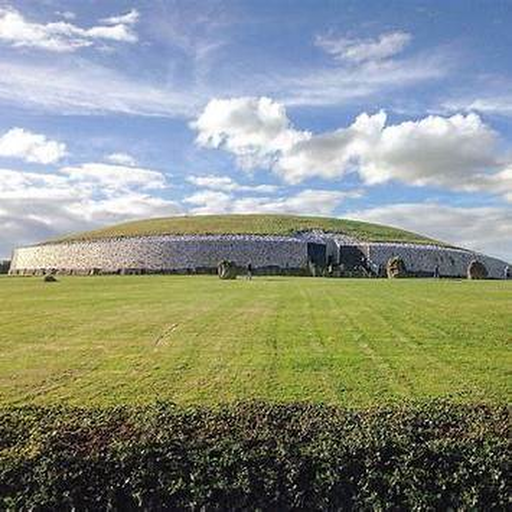
Look closely: The entrance view should be read feature by feature: the large decorated entrance kerbstone K1 lies across the front of the mound; above and behind it is the passage entrance, with the roof-box opening positioned over the doorway. The mound is retained by kerbstones and faced at the entrance with pale quartz and darker rounded stone. K1 is densely picked with curving spiral and lozenge-like motifs rather than naturalistic figures.
Newgrange is a passage tomb built from large orthostats, cairn material and kerbstones. A long, narrow passage leads to a cruciform chamber with three recesses; the roof is formed by overlapping corbelled stones that step inward until the opening can be capped. Carved decoration occurs on kerbstones, passage stones and chamber stones, using picked and incised spirals, arcs, lozenges, chevrons and other geometric forms. At the entrance, K1 is a major visual focus because its carved surface sits directly before the passage. The roof-box above the entrance is structurally separate from the doorway: around the winter solstice sunrise, light enters through this opening, travels along the passage and reaches the chamber floor. In an exam answer, identify the exact feature being discussed—K1, roof-box, orthostat, passage, chamber recess, basin stone or corbelled roof—rather than referring vaguely to “stone decoration” or “astronomy”.
Knowth
People and culture note: The makers of Ireland’s Stone Age monuments are unknown, but their work shows organised communities with engineering skill, ritual belief and knowledge of landscape. Passage tombs and portal tombs suggest cooperation, ceremony and respect for ancestors. Their art uses stone, alignment and abstract carving rather than named individual artists.
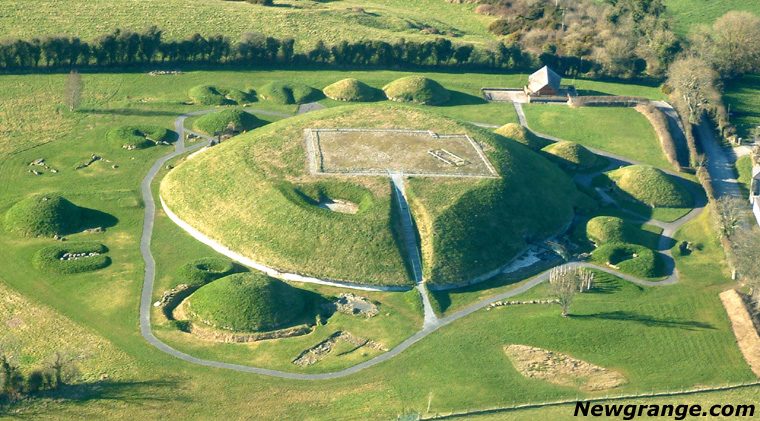
Look closely: Knowth shows abstract carved pattern, spiral rhythm and refined prehistoric craft. Use the details to discuss symbolism, surface design, ritual and skilled stone or object making.
Knowth combines monumental architecture with one of Europe’s richest collections of megalithic art. Its carved stones show spirals, circles and abstract patterns, suggesting ritual thought and symbolic communication. The builders used stone, earth and alignment to create a ceremonial landscape. Viewers respond to its scale, complexity and ancient mystery.
Poulnabrone Dolmen
People and culture note: The makers of Ireland’s Stone Age monuments are unknown, but their work shows organised communities with engineering skill, ritual belief and knowledge of landscape. Passage tombs and portal tombs suggest cooperation, ceremony and respect for ancestors. Their art uses stone, alignment and abstract carving rather than named individual artists.
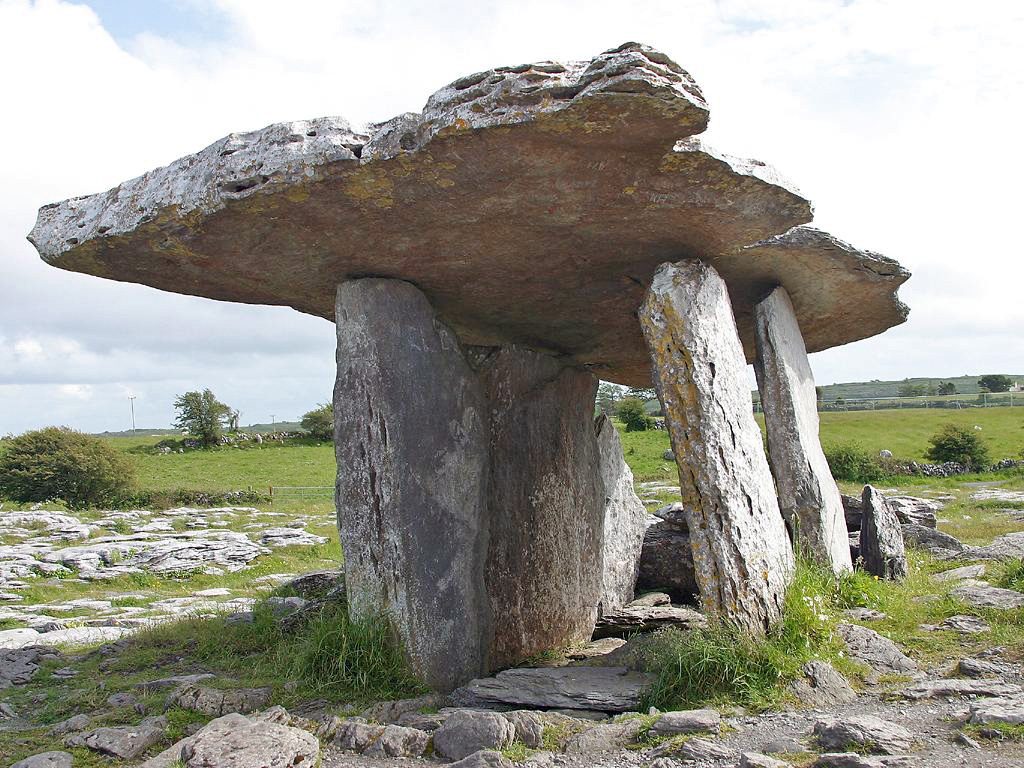
Look closely: Poulnabrone uses simple massive stones to create monumentality. The capstone, uprights and landscape setting support analysis of burial, ritual, balance and Neolithic construction.
Poulnabrone Dolmen uses massive limestone slabs to create a striking portal tomb. Its design shows technical control, ritual purpose and symbolic marking of place. The stark silhouette against the Burren landscape creates balance and tension. It communicates death, memory and community through simple structure, powerful scale and enduring material presence.
Legacy / influence: Stone Age monuments influenced later art by establishing the landscape itself as a sacred visual form. Their spirals, alignment and monumental stone construction became lasting symbols of memory, place and Irish prehistory.
3. Bronze Age
Context / main ideas: Bronze Age Ireland introduces metalworking, trade and new forms of personal display. Beaker culture, bronze tools, gold lunulae, gorgets and hoards show wealth, status, ceremony and technical skill. The major change is from stone monument building to portable objects made from bronze and gold.
Context
- Metalworking became highly developed.
- Beaker People / Beaker culture is critical for the beginning of the Bronze Age in Ireland.
- Bell-shaped Beaker pottery, single burials and cist graves show changing ritual and identity.
- Wider European contacts helped spread copper-working knowledge and supported the move towards bronze metalworking.
- Trade networks expanded across Europe.
- Wealth and status became important.
- Gold objects symbolised power and prestige.
Key Artworks
Beaker Pottery
- Bell-shaped pottery linked with early Bronze Age Beaker culture.
- Important evidence for changing burial customs, trade contacts and new technologies.
Gleninsheen Gorget
- Gold collar worn around neck.
- Richly decorated ceremonial object.
Gold Lunula
- Crescent-shaped gold ornament.
- Thin hammered sheet gold.
Dowris Hoard
- Large collection of bronze objects.
- Includes horns and tools.
Art Elements and Design Principles
- Pattern: repeated decoration.
- Line: incised detail.
- Texture: polished reflective surface.
- Balance: symmetrical layout.
- Emphasis: decorative central areas.
Media and Techniques
- Bronze casting.
- Hammering.
- Repoussé.
- Incising.
- Goldsmithing.
Innovation and Invention
- Bronze alloy technology.
- Advanced metalworking.
- International trade for copper and tin.
Bronze Age Sample Exam Points
Possible themes:
- Trade and cultural exchange.
- Metalworking innovation.
- Status and ceremonial objects.
- Decorative pattern and symbolism.
- Beaker People as a key transition into Bronze Age Ireland.
Artist, Artwork and Artefact Analysis: Bronze Age
Bronze Age examples focus on metalworking, gold, status objects, ritual deposition and technical control of new materials. Beaker People are important here because their pottery, burial customs and European contacts mark the transition into Bronze Age Ireland.
Gleninsheen Gorget
People and culture note: Bronze Age Ireland was shaped by metalworking, trade and skilled craft communities. The makers of gold ornaments and hoards are unknown, but their objects show wealth, status and technical control. These artefacts are useful for discussing function, display, ritual deposition and the social value of precious materials. Beaker communities are a key early Bronze Age influence: their bell-shaped pottery, single burials and wider exchange networks show changing identity, ritual and technology.
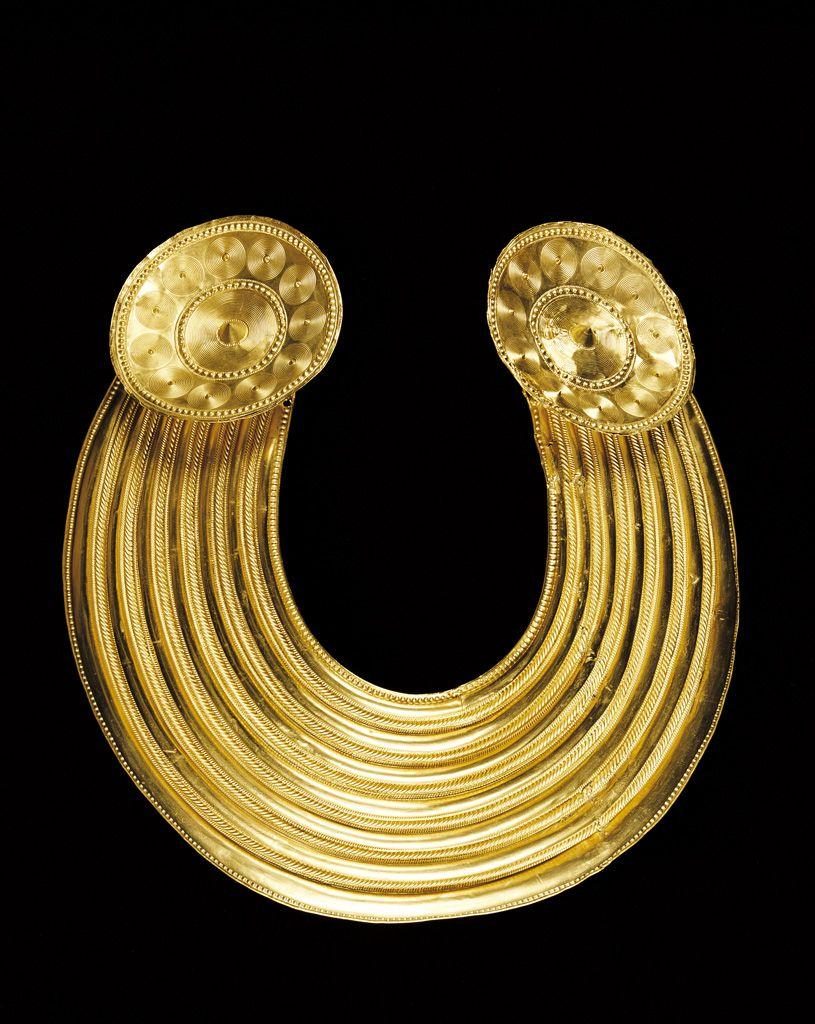
Look closely: Subject: elite Bronze Age neck ornament. Style: refined, geometric and ceremonial. Technique: hammered gold with incised decoration. Composition: crescent form frames the body. Meaning/Context: shows wealth, status, ritual display and advanced Irish metalworking.
The Gleninsheen Gorget demonstrates elite Bronze Age metalwork and personal display. Made from thin hammered gold, its crescent form suggests status, ritual and identity. The smooth surface, symmetry and reflective quality create visual richness. Its innovation lies in technical refinement, turning precious material into a symbolic object of power.
Expanded Bronze Age analysis: Technique: thin sheet gold was hammered, shaped, polished and decorated with incised linear detail. Meaning: the crescent form communicated elite status, ceremonial identity and control of valuable resources. Process: specialist metalworkers used careful shaping and surface finishing. Idea: the artefact links beauty, power, ritual and Bronze Age innovation.
Gold Lunula
People and culture note: Bronze Age Ireland was shaped by metalworking, trade and skilled craft communities. The makers of gold ornaments and hoards are unknown, but their objects show wealth, status and technical control. These artefacts are useful for discussing function, display, ritual deposition and the social value of precious materials. Beaker communities are a key early Bronze Age influence: their bell-shaped pottery, single burials and wider exchange networks show changing identity, ritual and technology.
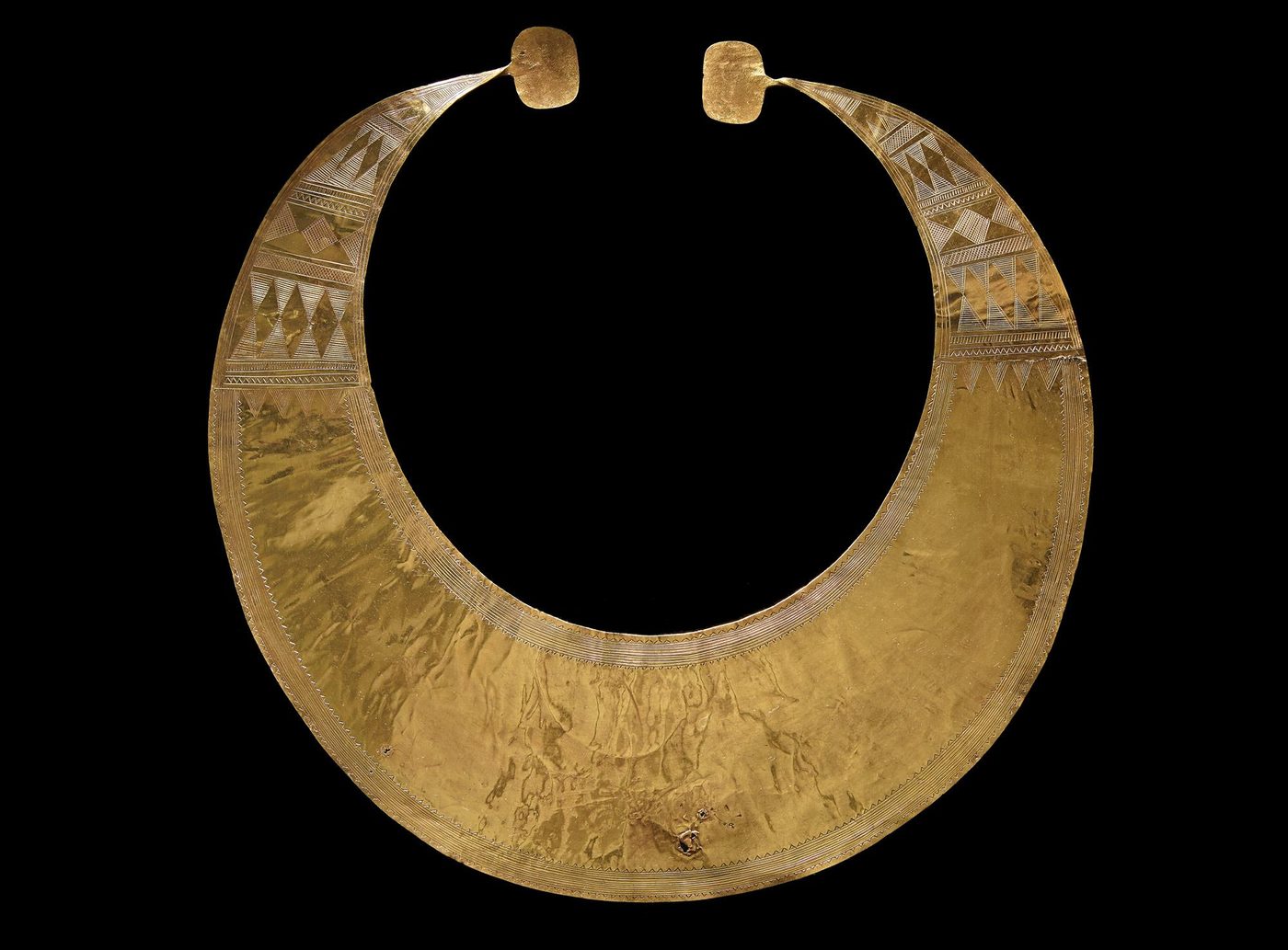
Look closely: Subject: Bronze Age gold collar. Style: simple crescent form with patterned edges. Technique: hammered sheet gold and incised ornament. Composition: curved shape creates symmetry and balance. Meaning/Context: suggests status, ceremony and skilled early goldsmithing.
The Gold Lunula shows how prehistoric makers used gold to express status, ritual and beauty. Its crescent shape may connect to the moon, body adornment or ceremonial identity. Hammered sheet gold and incised decoration reveal advanced craft. The balanced form, delicate pattern and reflective surface create elegance and authority.
Expanded Bronze Age analysis: Technique: hammered sheet gold and incised decoration create a light, wearable ceremonial object. Meaning: the crescent shape suggests status, possible lunar symbolism and ritual identity. Process: the maker refined gold into a balanced, symmetrical form. Idea: precious material, pattern and body adornment made social power visible.
Dowris Hoard
People and culture note: Bronze Age Ireland was shaped by metalworking, trade and skilled craft communities. The makers of gold ornaments and hoards are unknown, but their objects show wealth, status and technical control. These artefacts are useful for discussing function, display, ritual deposition and the social value of precious materials. Beaker communities are a key early Bronze Age influence: their bell-shaped pottery, single burials and wider exchange networks show changing identity, ritual and technology.
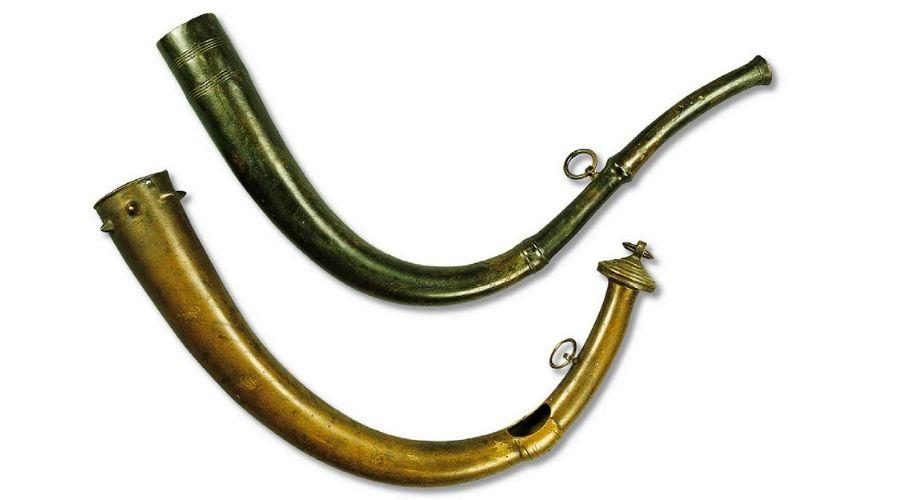
Look closely: Subject: collection of Bronze Age objects. Style: functional and ceremonial metalwork. Technique: casting, shaping and finishing bronze. Composition: grouped artefacts show repeated forms. Meaning/Context: reveals wealth, ritual deposition and sophisticated prehistoric craft.
The Dowris Hoard reflects Bronze Age ritual, warfare and social hierarchy. Its weapons, horns and metal objects suggest ceremonial deposition rather than ordinary use. Bronze casting and repeated forms show specialised production. The hoard’s quantity and variety create impact, revealing a society where material, sound, status and belief were closely linked.
Expanded Bronze Age analysis: Technique: bronze alloy casting produced horns, tools, weapons and repeated object forms. Meaning: the hoard suggests ritual deposition, status, sound, warfare and communal ceremony. Process: copper and tin were combined and cast by skilled makers. Idea: Bronze Age society connected material technology with belief, hierarchy and display.
Legacy / influence: Bronze Age metalwork influenced later craft by setting a high standard for Irish goldsmithing, surface decoration and prestige objects. Its emphasis on skill, shine and status continued into Insular and medieval metalwork.
4. Iron Age
Context / main ideas: Iron Age Ireland is linked with Celtic La Tène style, elite display and abstract ornament. Curving lines, spirals, trumpet patterns and stylised forms appear on stone and metalwork. The major change is a more decorative, symbolic and non-naturalistic visual language connected with identity and ritual.
Context
- Celtic culture influenced Irish art.
- La Tène style spread across Europe.
- Art became highly abstract and decorative.
- Elite objects symbolised power and identity.
Key Artworks
Turoe Stone
- Granite stone covered in La Tène decoration.
Castlestrange Stone
- Decorated ritual stone.
Broighter Collar
- Fine gold collar with twisted decoration.
Petrie Crown
- Decorative bronze headdress.
Art Elements and Design Principles
- Rhythm: flowing curves.
- Movement: swirling patterns.
- Pattern: continuous decoration.
- Line: curvilinear motifs.
- Unity: complete surface decoration.
Media and Techniques
- Stone carving.
- Goldsmithing.
- Bronze work.
Innovation and Invention
- Iron tools improved carving precision.
- Celtic decorative systems developed.
- European artistic influence visible in Irish work.
Artist, Artwork and Artefact Analysis: Iron Age
Iron Age examples focus on La Tène design, curvilinear ornament, elite display, ritual deposition, trade and European influence.
Broighter Hoard
People and culture note: Iron Age Irish art is linked to Celtic culture, elite display and abstract decoration. The makers are unknown, but their work shows advanced metalworking, stone carving and a preference for curves, spirals and hidden symmetry. These artefacts suggest status, ritual, sound, movement and symbolic power.
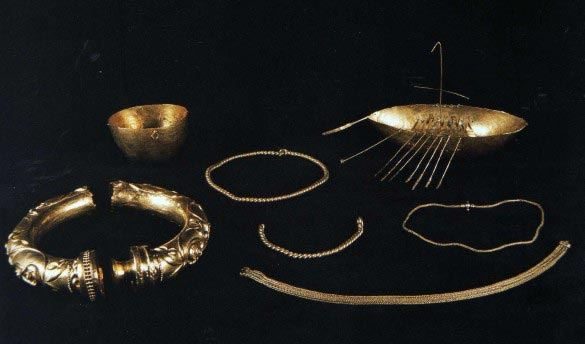
Look closely: Broighter Hoard — gold boat and artefact group
The Broighter Hoard reveals wealth, ritual offering and complex metalworking in Iron Age Ireland. The gold boat, torc and collar suggest status, trade and sacred deposition. Fine casting, hammering and decoration show technical sophistication. The objects’ scale, shine and symbolic forms create a sense of ceremony, power and mystery.
Expanded Iron Age analysis: Technique: casting, hammering and goldworking created refined objects such as the boat, collar and bowl. Meaning: the hoard suggests wealth, trade, ritual offering and sacred deposition. Process: specialist makers shaped precious metal into symbolic forms. Idea: the collection links ceremony, belief, status and technical sophistication.
Turoe Stone
People and culture note: Iron Age Irish art is linked to Celtic culture, elite display and abstract decoration. The makers are unknown, but their work shows advanced metalworking, stone carving and a preference for curves, spirals and hidden symmetry. These artefacts suggest status, ritual, sound, movement and symbolic power.
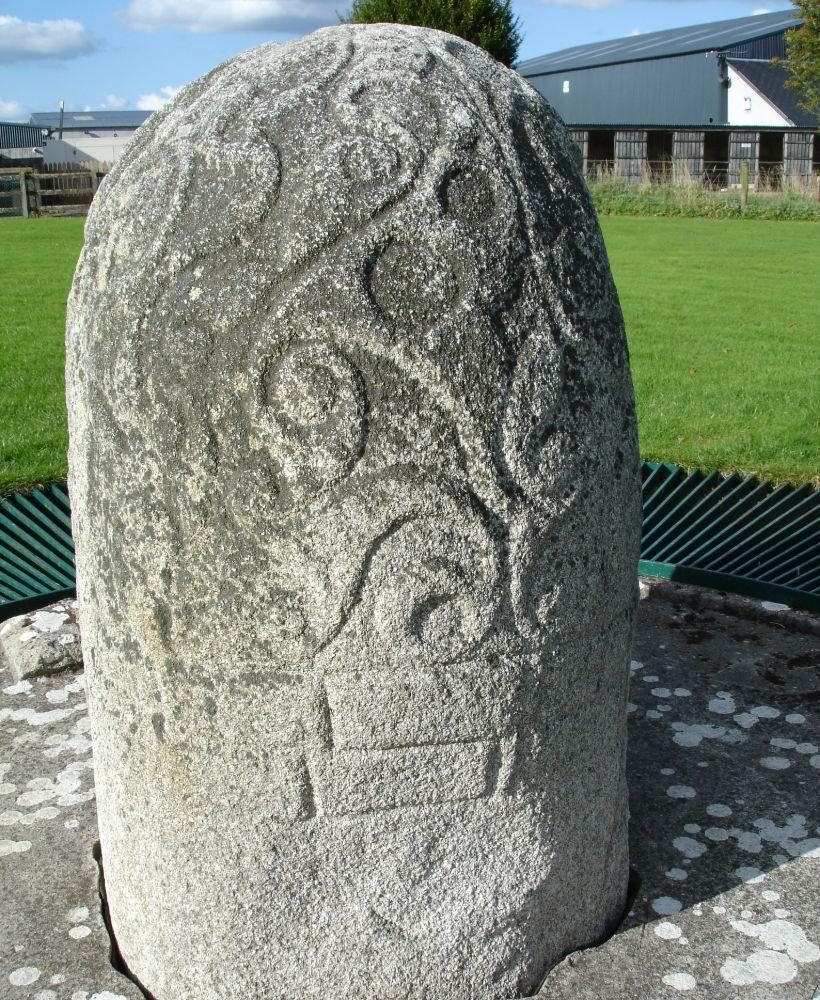
Look closely: Subject: carved ritual stone. Style: La Tène Celtic abstraction. Technique: low-relief carving into stone. Composition: spirals and trumpet curves flow across the surface. Meaning/Context: shows Iron Age symbolism, ceremony and non-naturalistic design in Ireland.
The Turoe Stone uses carved La Tène patterns to express energy, movement and symbolic power. Its abstract spirals and curving forms show Iron Age creativity and European influence. The stone’s rounded shape and dense surface decoration create rhythm and visual flow. It may have marked ritual, status or territorial identity.
Castlestrange Stone
People and culture note: Iron Age Irish art is linked to Celtic culture, elite display and abstract decoration. The makers are unknown, but their work shows advanced metalworking, stone carving and a preference for curves, spirals and hidden symmetry. These artefacts suggest status, ritual, sound, movement and symbolic power.
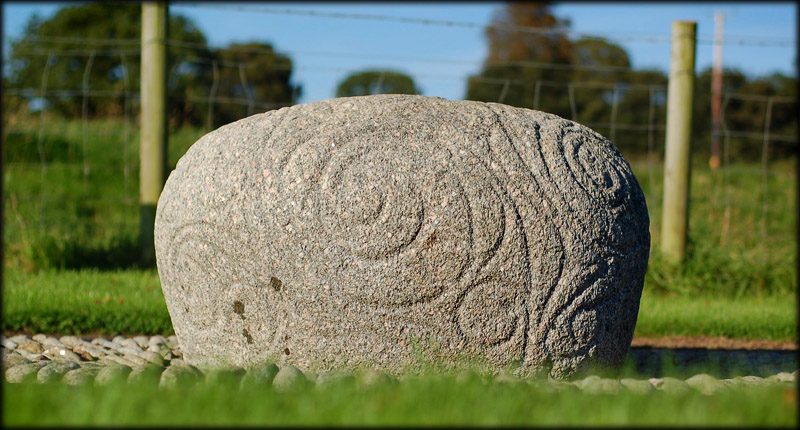
Look closely: Subject: decorated Iron Age stone. Style: La Tène, abstract and rhythmic. Technique: carved curvilinear motifs. Composition: swirling patterns cover the rounded form. Meaning/Context: links Irish stone carving with wider Celtic visual culture and ritual display.
The Castlestrange Stone is a carved granite boulder decorated with flowing La Tène ornament. Its spiral-based patterns suggest movement, transformation and ritual meaning. The maker used carving to animate a solid natural form. The contrast between hard stone and fluid line gives the object energy, mystery and symbolic force.
Broighter Collar
People and culture note: Iron Age Irish art is linked to Celtic culture, elite display and abstract decoration. The makers are unknown, but their work shows advanced metalworking, stone carving and a preference for curves, spirals and hidden symmetry. These artefacts suggest status, ritual, sound, movement and symbolic power.
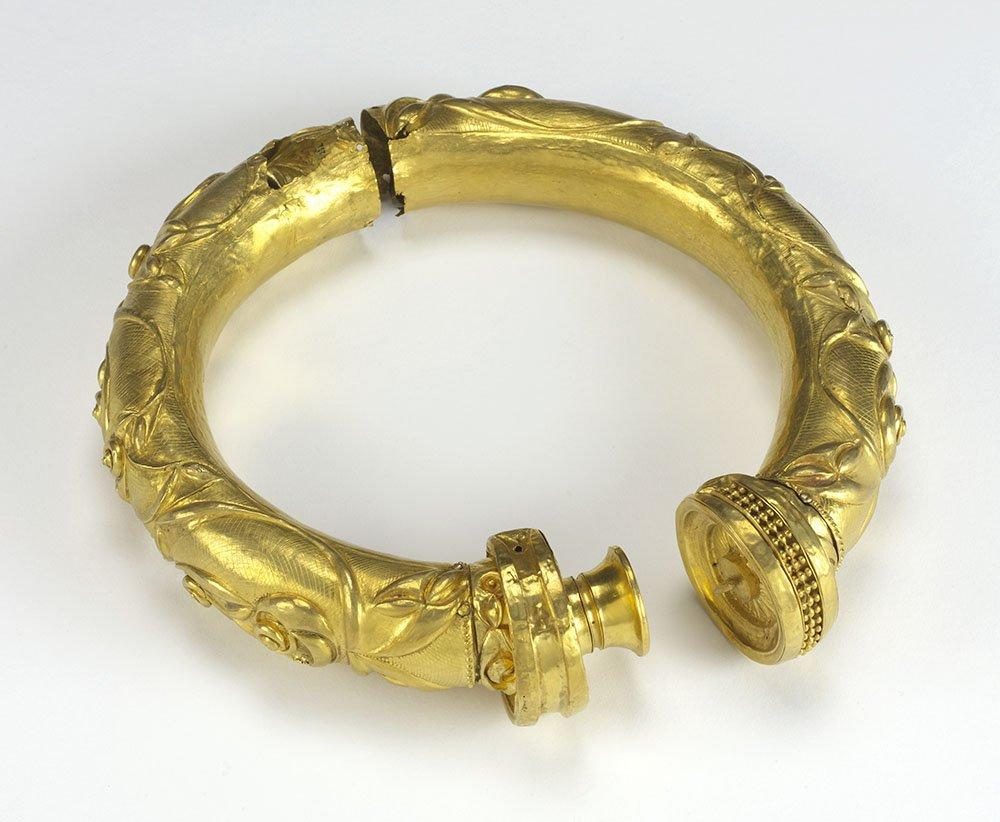
Look closely: Subject: prestigious Iron Age gold collar. Style: delicate, geometric and ceremonial. Technique: gold working, twisting and fine surface pattern. Composition: circular form emphasises symmetry and status. Meaning/Context: shows elite display, ritual value and exceptional Irish metalwork.
The Broighter Collar is an outstanding example of Iron Age goldsmithing. Its tubular form, delicate terminals and refined construction suggest elite status and ceremonial use. The gold material creates light, value and authority. Its innovation lies in precision and luxury, turning body adornment into a symbol of identity and power.
Petrie Crown
People and culture note: Iron Age Irish art is linked to Celtic culture, elite display and abstract decoration. The makers are unknown, but their work shows advanced metalworking, stone carving and a preference for curves, spirals and hidden symmetry. These artefacts suggest status, ritual, sound, movement and symbolic power.
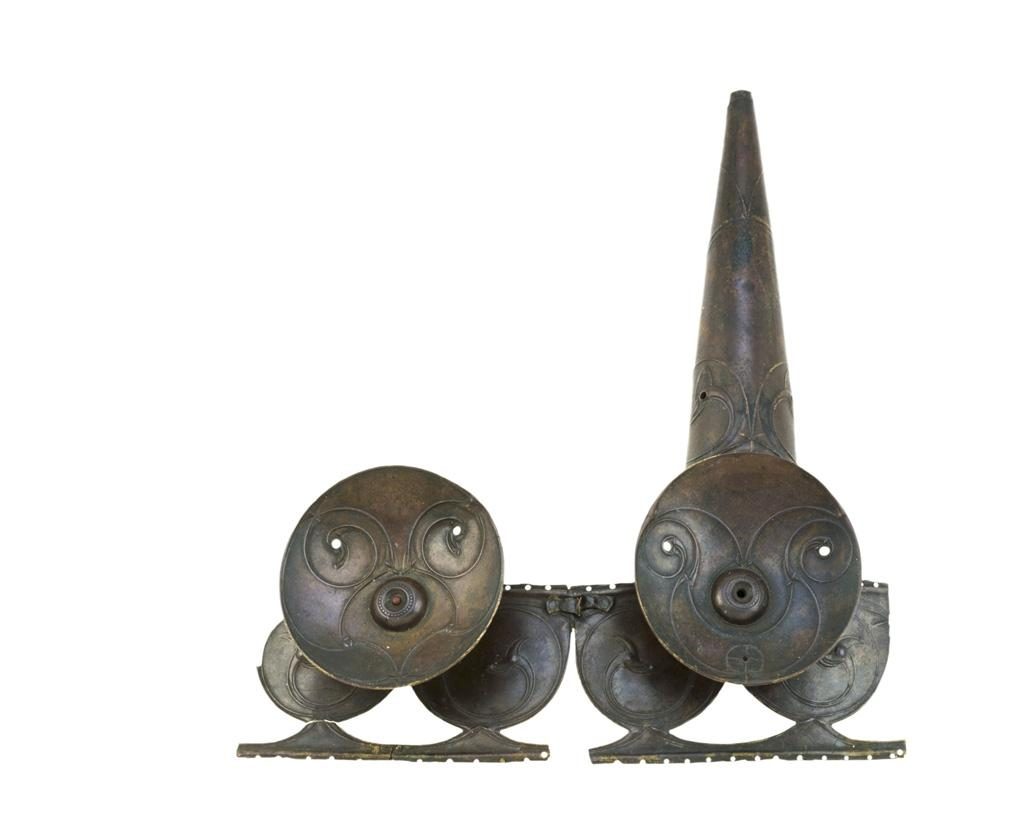
Look closely: Subject: ceremonial Iron Age headpiece. Style: La Tène-inspired and symbolic. Technique: bronze construction with decorative detail. Composition: raised forms create rhythm around the head. Meaning/Context: suggests status, ritual identity and Celtic artistic tradition.
The Petrie Crown shows sophisticated early metalwork, possibly connected to ritual or elite identity. Its bronze form, decorative discs and repeated motifs create rhythm and authority. The process involved casting, shaping and assembly. Its unusual design challenges simple interpretation, inviting viewers to consider power, ceremony, performance and symbolic display.
Loughnashade Trumpet
People and culture note: Iron Age Irish art is linked to Celtic culture, elite display and abstract decoration. The makers are unknown, but their work shows advanced metalworking, stone carving and a preference for curves, spirals and hidden symmetry. These artefacts suggest status, ritual, sound, movement and symbolic power.
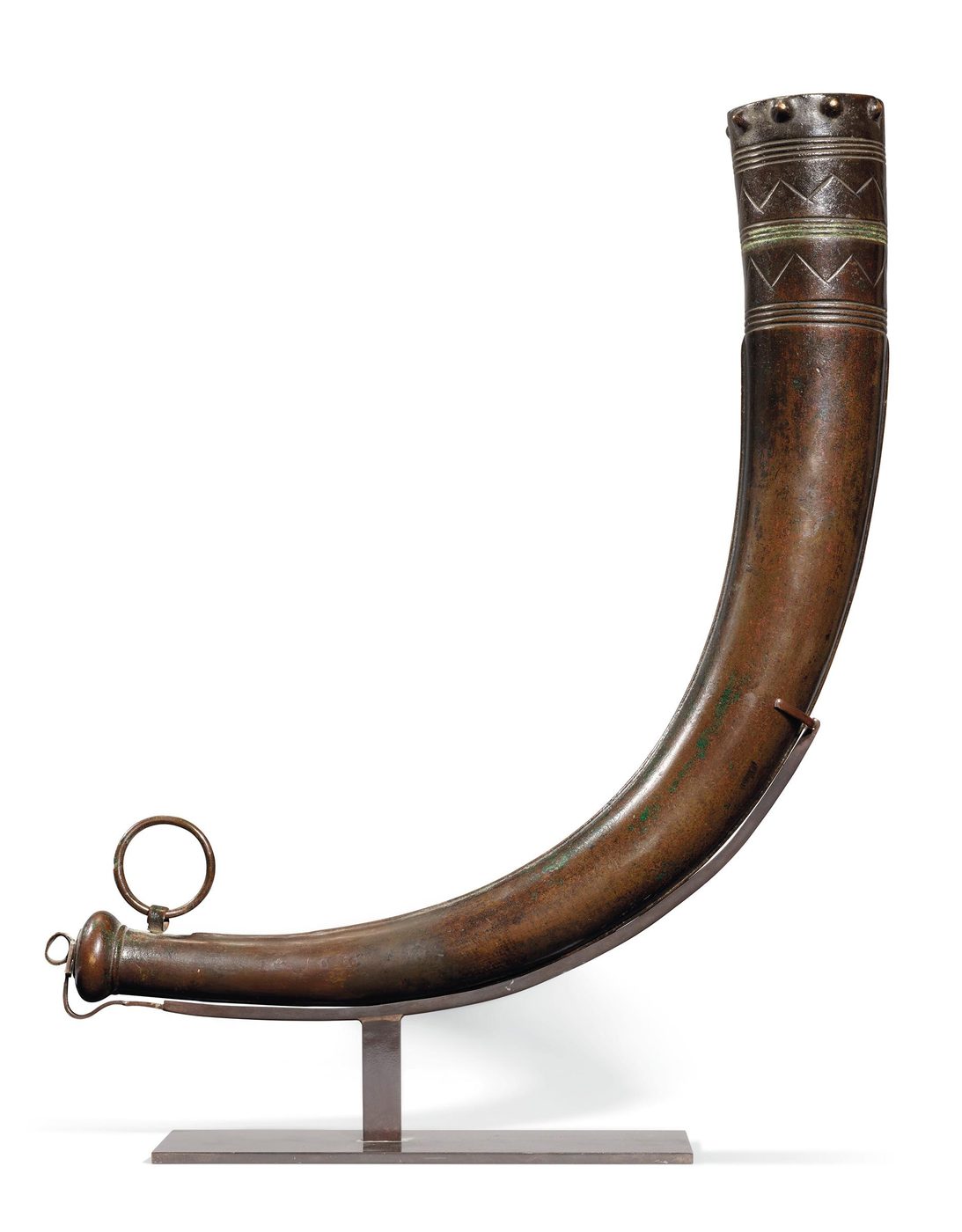
Look closely: Subject: Iron Age bronze musical instrument. Style: functional form with ceremonial presence. Technique: bronze casting and shaping. Composition: long curved form focuses attention on sound and display. Meaning/Context: connects music, ritual, gathering and elite culture.
The Loughnashade Trumpet shows Iron Age skill in bronze working and ceremonial sound. Its long curved form, riveted construction and decorated end plate suggest ritual, status and public performance. The object connects metalworking, belief and display, showing that sound could be as important as visual decoration in Celtic ceremonial culture.
Legacy / influence: Iron Age ornament influenced later Irish art through its flowing abstraction and Celtic visual language. It fed into manuscript borders, metalwork, revival design and modern ideas of Irish identity.
5. Important Themes Across All Periods
| Theme | Stone Age | Bronze Age | Iron Age |
|---|---|---|---|
| Religion | Tombs and burial rituals | Ceremonial objects | Ritual stones and elite symbols |
| Materials | Stone | Gold and bronze | Stone, gold, iron |
| Decoration | Spirals and geometric motifs | Incised patterns | Curvilinear La Tène motifs |
| Innovation | Megalithic engineering | Metalworking | Iron tools and Celtic design |
| Society | Farming communities | Hierarchical society | Warrior elite culture |
7. Key Terms to Learn
| Term | Meaning |
|---|---|
| Passage Tomb | Burial structure with passage leading to chamber |
| Corbelling | Overlapping stones forming roof |
| Megalithic | Large stone construction |
| Repoussé | Hammered raised metal decoration |
| La Tène | Celtic decorative style |
| Motif | Repeated decorative image |
| Lunula | Crescent-shaped gold ornament |
| Torc | Decorative neck ring |
Leaving Cert Art Study Guide & Notes
Legacy / influence: Pre-Christian art influenced later Irish visual culture through its spirals, interlace-like patterning, monumentality and symbolic use of materials. Later artists repeatedly returned to these forms when expressing Irish identity.
Insular Art (Early Christian Ireland)
Context / main ideas: Insular Art developed after Christianity reached Ireland and blended Celtic, Christian, Mediterranean and Anglo-Saxon influences. The main ideas are faith, learning, manuscript illumination, metalwork and high crosses. Change is seen in how earlier abstract pattern was adapted to Christian worship and teaching.
Study structure for this section
Students should understand and be able to describe and discuss the context that informed and led to the chosen period/movement using the six elements listed below.
Students should understand and be able to describe and explain the period/movement using the six elements listed below.
The framework is structured around six elements:
1. What is Insular Art?
This section introduces Insular Art as a fusion style. Monasteries became centres of learning and making, where scribes, metalworkers and stone carvers used interlace, spirals, animal forms and Christian imagery to create objects of devotion, teaching and prestige.
Insular Art developed in Ireland and Britain between approximately 500–1200 CE after the arrival of Christianity.
The word Insular means “island-based.” The style combined:
- Celtic traditions,
- Christian imagery,
- Roman influences,
- Anglo-Saxon and Viking influences.
Insular Art is famous for:
- illuminated manuscripts,
- metalwork,
- stone carving,
- interlace decoration,
- highly detailed craftsmanship.
2. Historical Context
Context
- Christianity arrived in Ireland around the 5th century.
- Monasteries became centres of learning and artistic production.
- Monks copied and decorated religious texts.
- Art was used to teach Christianity visually.
- Viking raids threatened monasteries but also influenced design.
Important monasteries:
- Clonmacnoise
- Monasterboice
- Kells
- Durrow
- Glendalough
3. Key Characteristics of Insular Art
Decorative Features
- Interlace patterns
- Spirals
- Knotwork
- Animal ornament
- Geometric pattern
- Dense surface decoration
- Stylised figures
Themes
- Christianity
- Biblical stories
- Symbolism
- Eternal life
- Spiritual power
4. Important Artworks
The key Insular artworks show how image, text, pattern and sacred meaning work together. Manuscripts, chalices, brooches and crosses were not just decorative: they expressed devotion, status, technical skill and the cultural importance of monasteries.
Illuminated Manuscripts
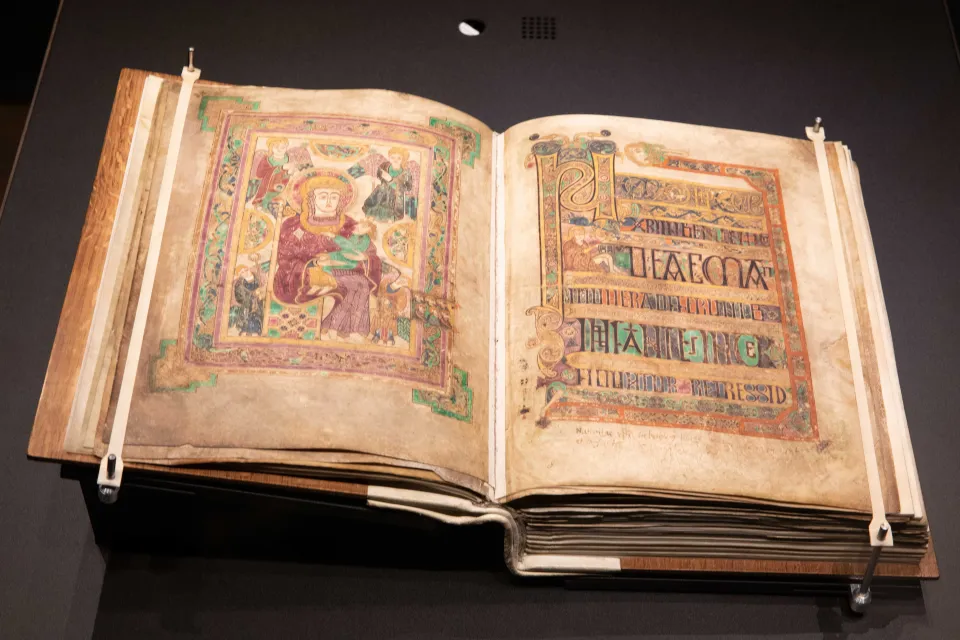
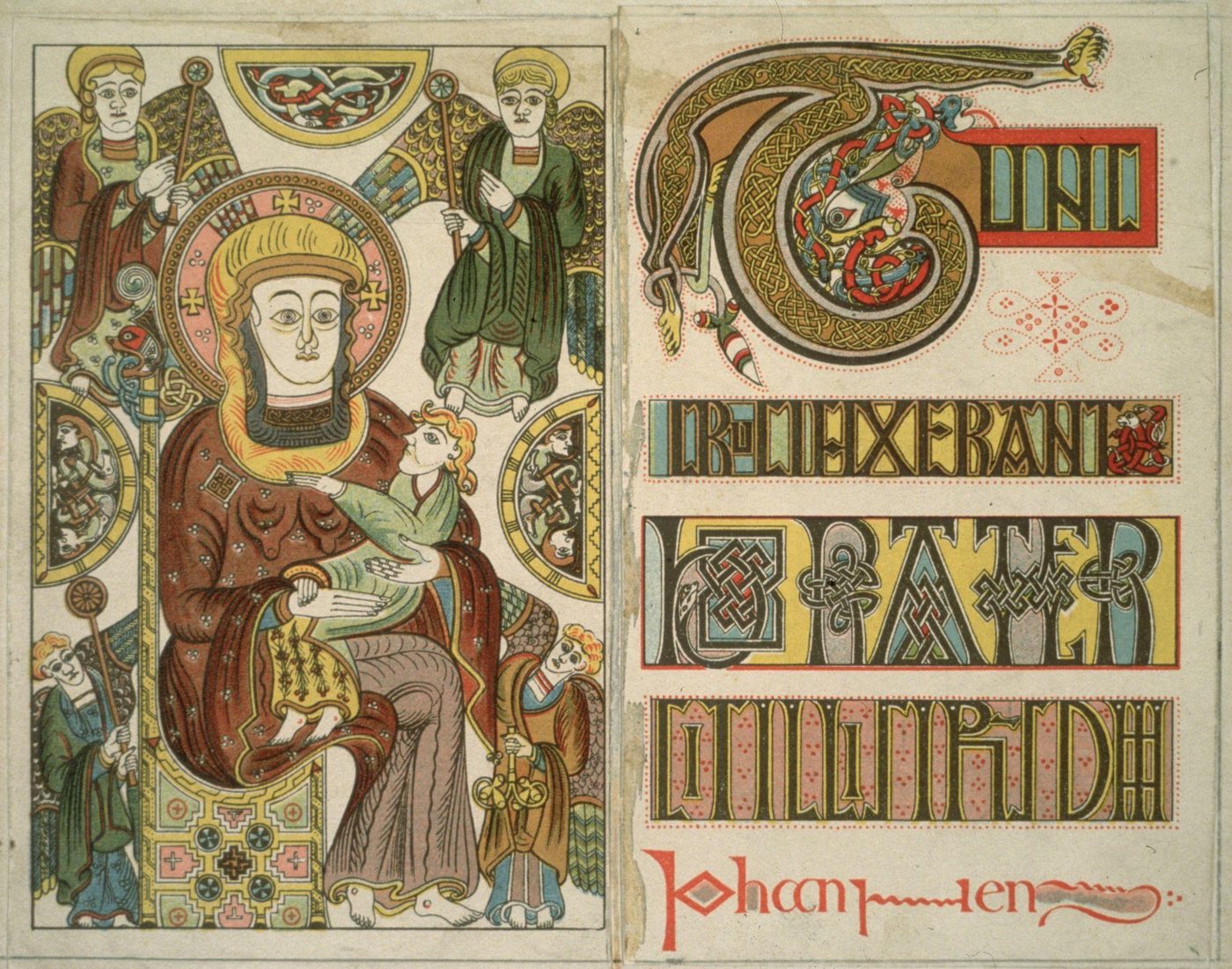
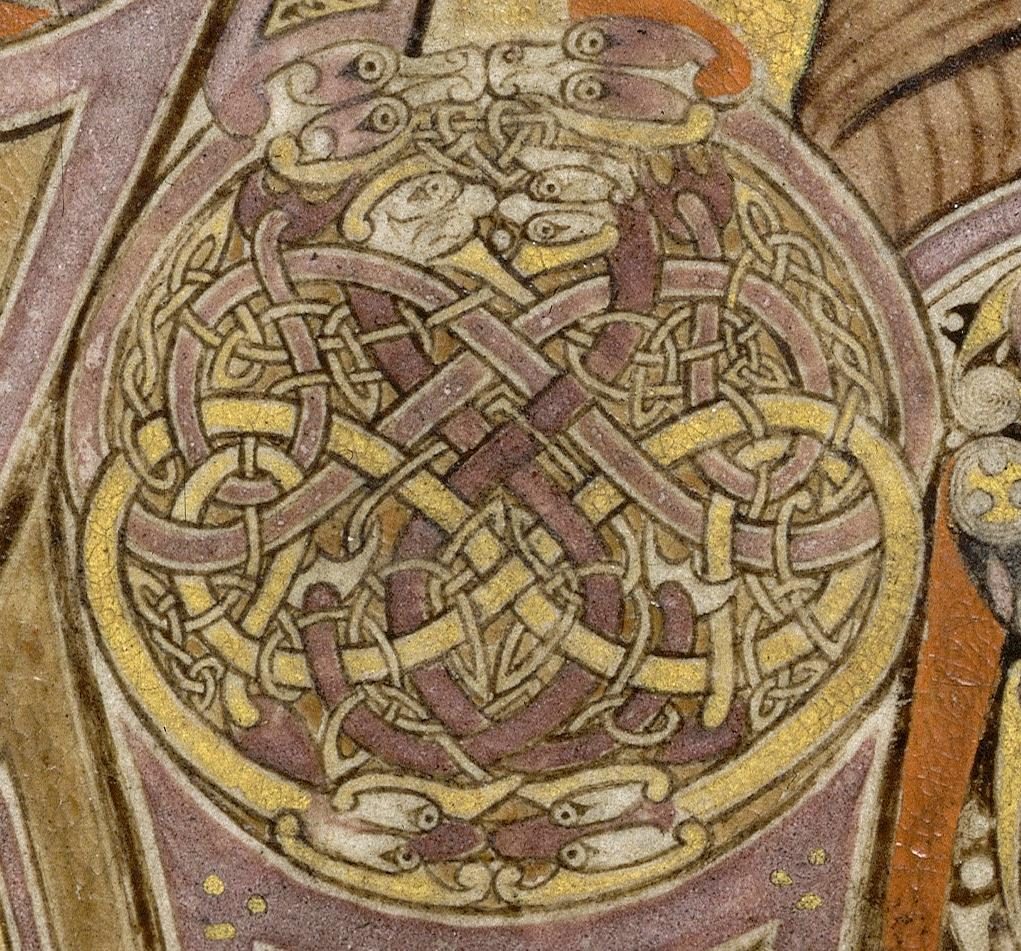
Book of Kells
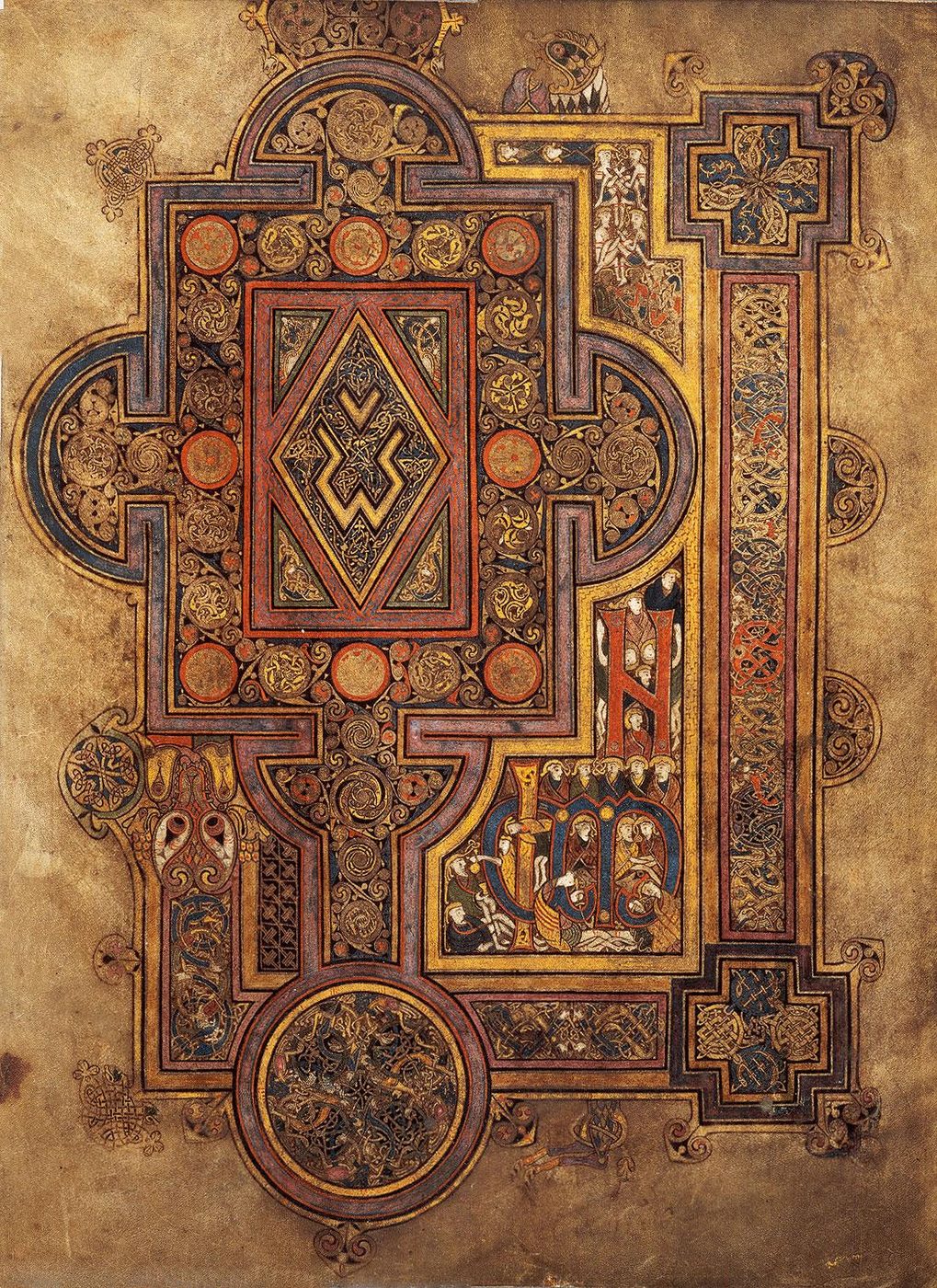
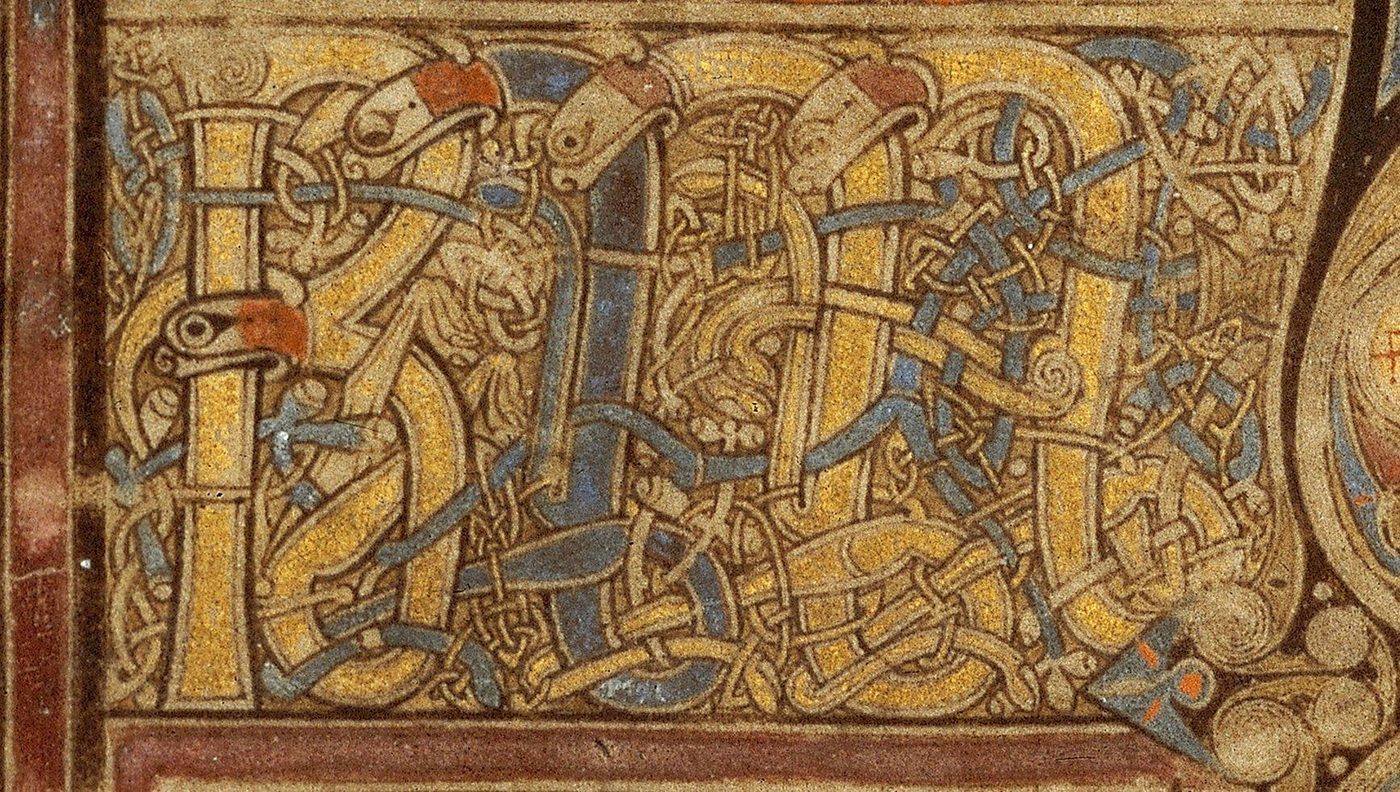
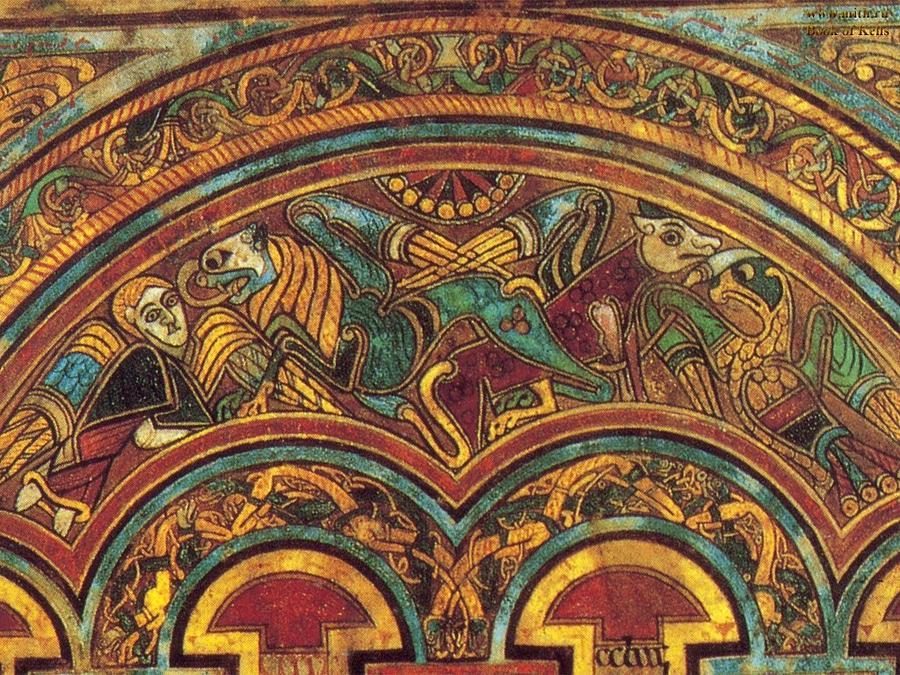
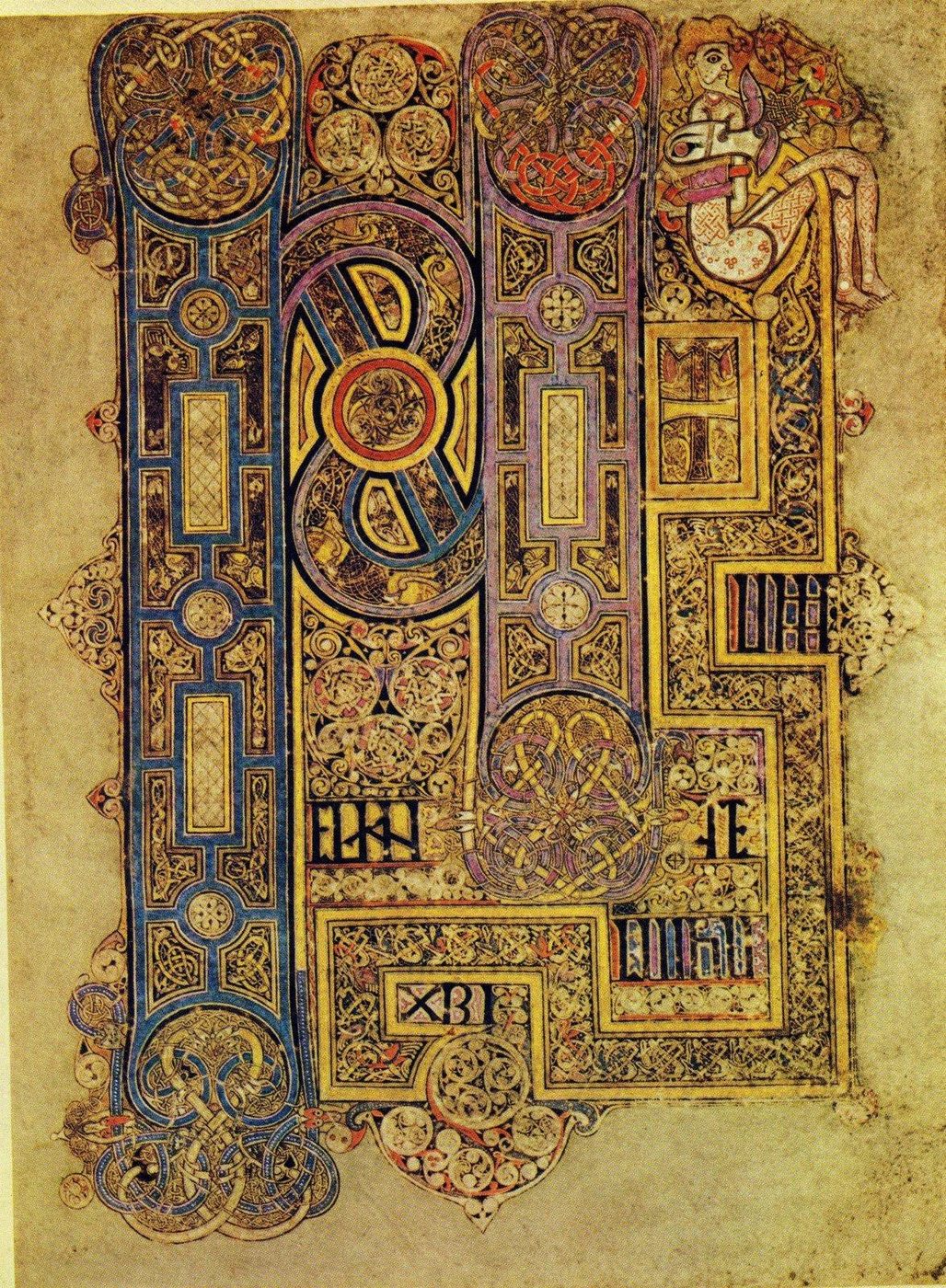
Key Facts
- Created around 800 CE.
- Probably made at Iona and/or Kells.
- Gospel manuscript containing the four Gospels.
- Written on vellum.
Analysis
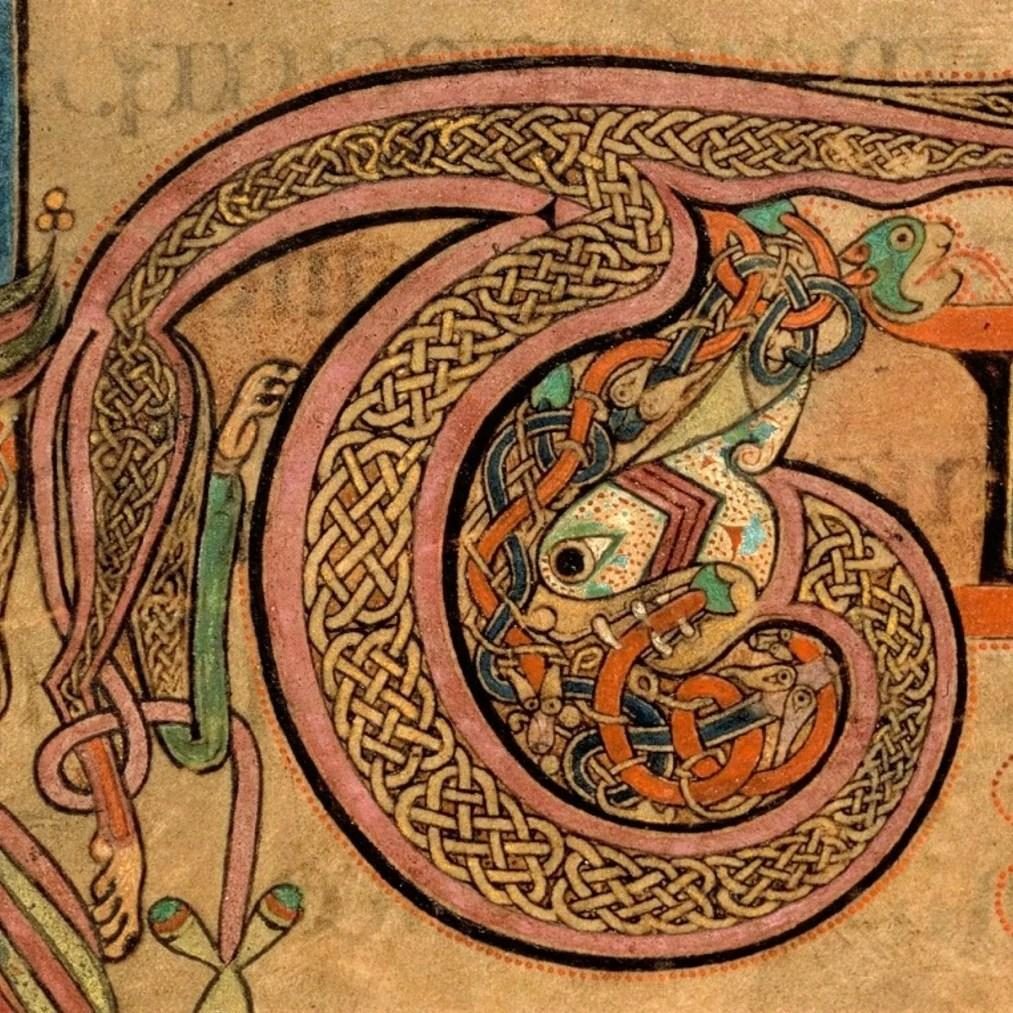
Chi-Rho Page
- One of the most famous pages.
- Decorates the letters “XPI” (Christ).
- Dense interlace and spirals.
- Hidden animal and human forms.
- Almost no empty space (horror vacui).
Art Elements
- Line: intricate flowing linework.
- Pattern: repeated knotwork.
- Colour: rich reds, yellows, blues and greens.
- Rhythm: movement created by interlace.
- Balance: symmetrical organisation.
Significance
- Demonstrates extraordinary craftsmanship.
- Combines religion with Celtic decoration.
- Considered masterpiece of Insular art.
Book of Durrow
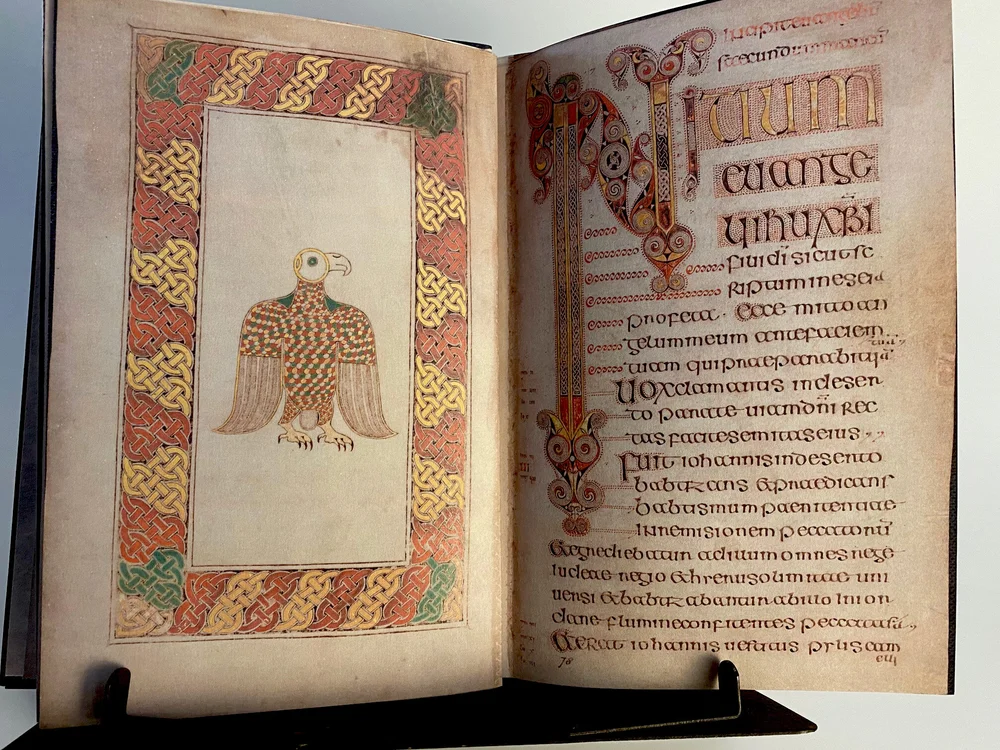
Key Features
- Earlier than Book of Kells.
- Simpler but highly decorative.
- Carpet pages and symbolic evangelist figures.
Artist, Artwork and Artefact Analysis: The Formative Phase
Context / main ideas: The Formative Phase marks early Christian Ireland as monasteries became centres of learning and production. Artists adapted local Celtic pattern and metalworking skill to new Christian purposes, creating early manuscripts, reliquaries and carved objects.
The Formative Phase shows the development of Insular visual language: interlace, abstraction, manuscript design and the blending of Christian and local traditions.
Book of Durrow
People and culture note: The individual makers are unknown, but early Insular manuscripts were produced in monastic communities where scribes, painters and craftsmen worked together. Their culture blended Christian learning with local visual traditions. Ornament, interlace and symbolic animals helped turn sacred texts into objects of devotion and study.
Look closely: The Book of Durrow shows early Insular manuscript design. Its abstract pattern, symmetry and animal ornament connect Christian text with decorative visual invention.
The Book of Durrow uses carpet pages, animal symbols and geometric pattern to express early Christian belief. Its makers combined manuscript production with Insular abstraction. Repetition, symmetry and flat design create order and sacred focus. The work innovates by fusing scripture, ornament and symbolism into a unified devotional object.
Legacy / influence: The Formative Phase influenced later Insular Art by establishing the fusion of local ornament and Christian meaning. It prepared the ground for the technical brilliance of later manuscripts and metalwork.
5. Metalwork
Insular metalwork shows exceptional craft and luxury materials. Gold, silver, bronze, glass and enamel were shaped into objects for worship, display and patronage. The main ideas are precision, symbolism, pattern, status and the transformation of functional objects into sacred art.
Ardagh Chalice
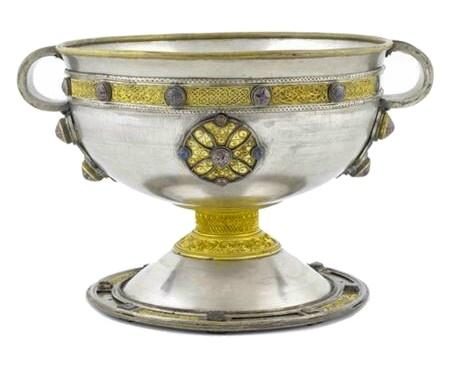
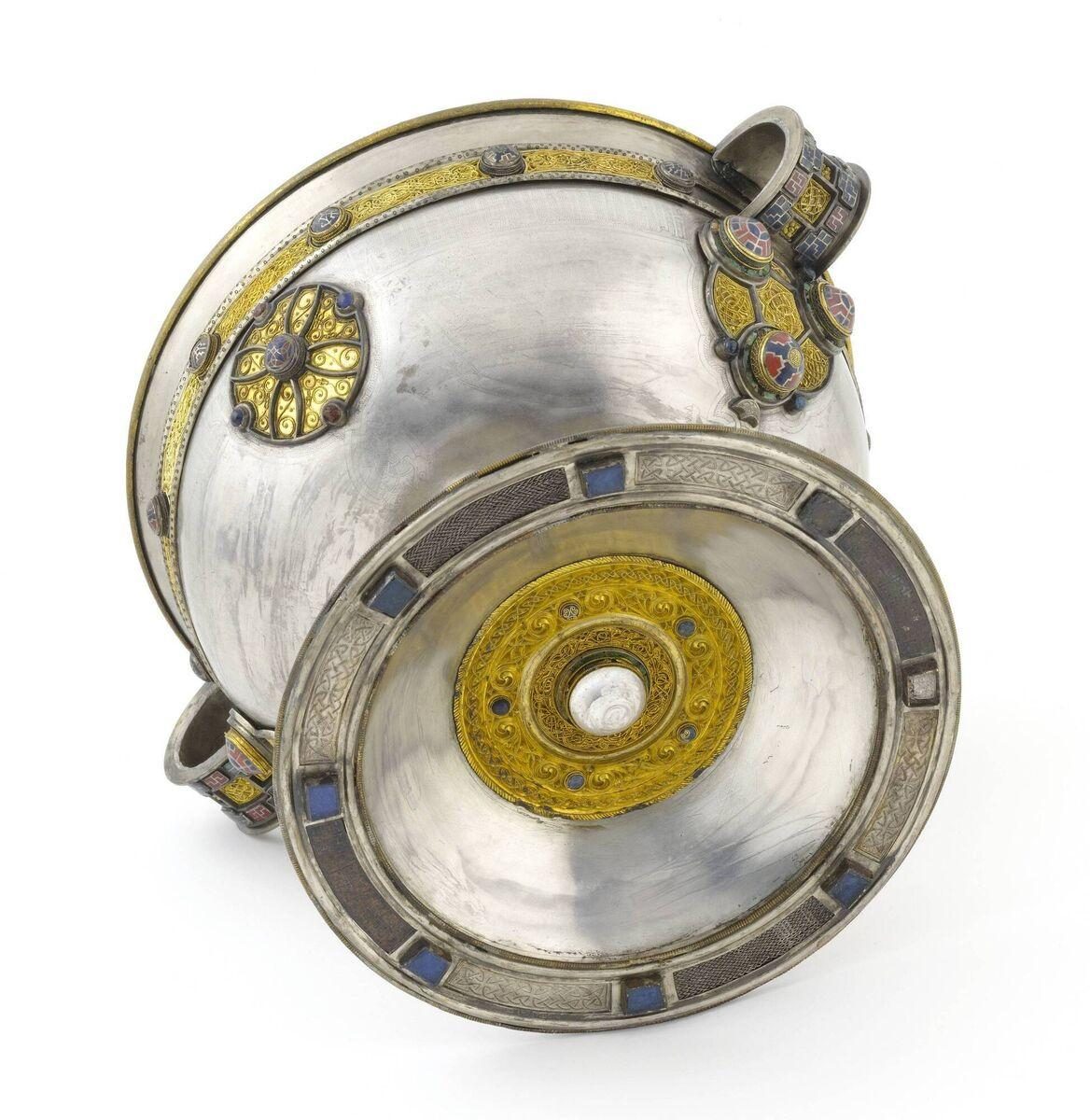
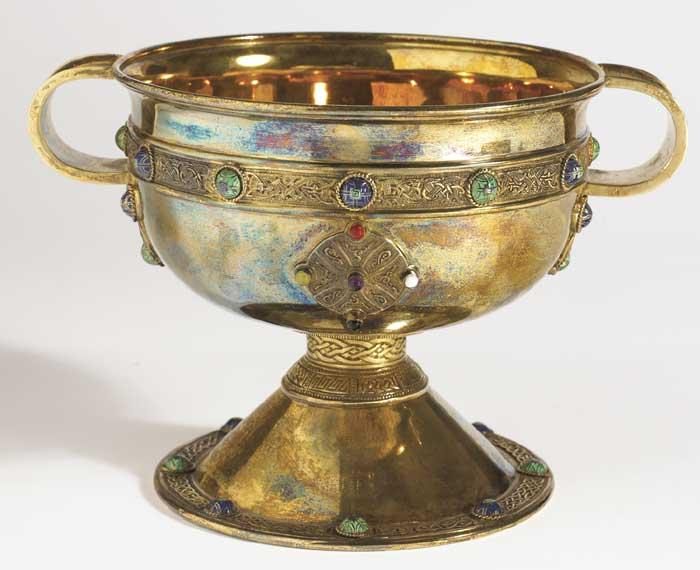
Key Facts
- Silver chalice used in the Eucharist.
- Found in County Limerick.
- Decorated with gold, enamel and glass.
Analysis
- Elegant bowl form.
- Fine interlace decoration.
- Use of precious materials.
- Extraordinary craftsmanship.
Techniques
- Filigree
- Enamelling
- Casting
- Engraving
Importance
- Combines function and decoration.
- Shows wealth and religious importance.
Tara Brooch
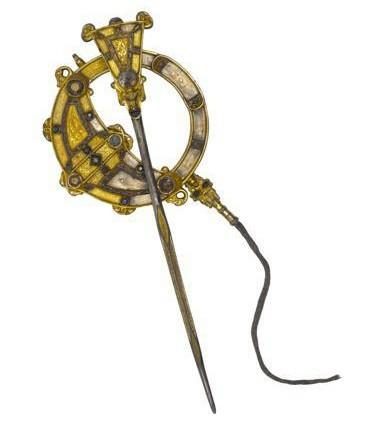
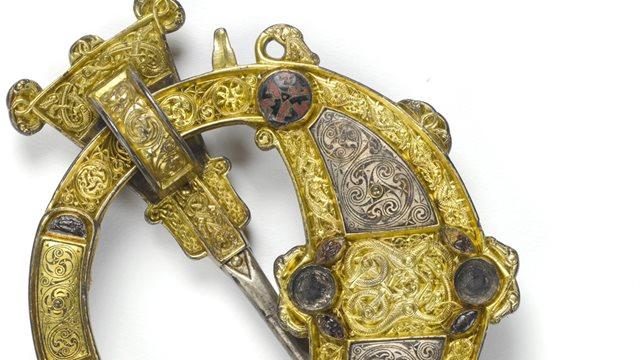
Key Features
- Highly decorative pseudo-penannular brooch.
- Covered in interlace and animal motifs.
- Made using advanced goldsmithing techniques.
Significance
- Symbol of status and artistic excellence.
- One of the greatest achievements of Irish metalwork.
Artist, Artwork and Artefact Analysis: The Golden Phase
Context / main ideas: The Golden Phase represents the peak of Insular craftsmanship. Monasteries produced richly illuminated manuscripts, refined metalwork and complex symbolic decoration that showed devotion, learning, wealth and technical mastery.
The Golden Phase brings Insular art to a high point through complex manuscripts, luxury metalwork, symbolic pattern and highly skilled craft.
Book of Kells
People and culture note: The Golden Phase was created by highly trained monastic artists and metalworkers whose names are mostly unknown. Their culture valued scripture, learning, craft and devotion. Manuscripts and liturgical objects show collaboration, patience and technical brilliance, combining Christian meaning with interlace, animal forms and precious materials.
Look closely: The Book of Kells shows Insular manuscript skill through dense ornament, interlace, colour and symbolic decoration. Use it for media, pattern, religious function and craftsmanship.
The Book of Kells transforms Christian scripture into dazzling visual devotion. Monks used vellum, pigments and intricate design to honour sacred text. Interlace, animals, symbols and colour create spiritual complexity. The work innovates by merging word and image, making reading a meditative, visual and religious experience.
Chi-Rho Page
People and culture note: The Golden Phase was created by highly trained monastic artists and metalworkers whose names are mostly unknown. Their culture valued scripture, learning, craft and devotion. Manuscripts and liturgical objects show collaboration, patience and technical brilliance, combining Christian meaning with interlace, animal forms and precious materials.
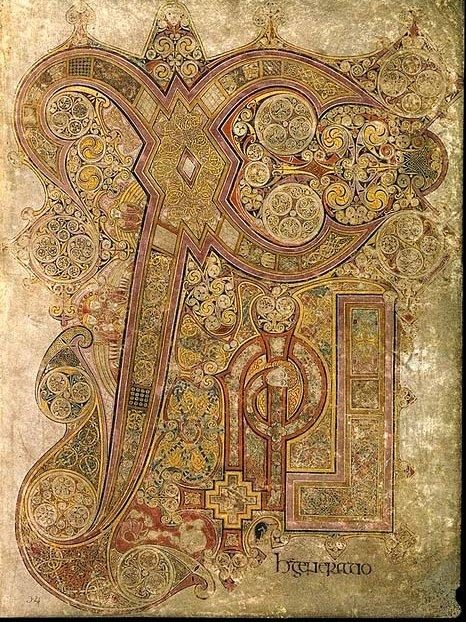
Look closely: Subject: sacred manuscript lettering. Style: Insular, intricate and symbolic. Technique: vellum illumination with interlace, colour and pattern. Composition: letters expand into dense decoration. Meaning/Context: turns scripture into visual devotion and shows Golden Age monastic skill.
The Chi-Rho Page magnifies the opening of Christ’s name into an explosion of decoration. Spirals, interlace, animals and hidden figures slow reading into contemplation. Pigment on vellum becomes spiritual theatre. The design’s dense rhythm, colour and symbolic detail make the viewer experience divine mystery through visual complexity.
Ardagh Chalice
People and culture note: The Golden Phase was created by highly trained monastic artists and metalworkers whose names are mostly unknown. Their culture valued scripture, learning, craft and devotion. Manuscripts and liturgical objects show collaboration, patience and technical brilliance, combining Christian meaning with interlace, animal forms and precious materials.
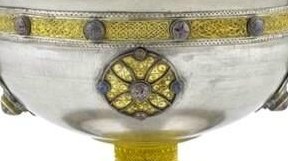
Look closely: The Ardagh Chalice combines precious material, balanced form and detailed metalwork. Use it to discuss religious function, craftsmanship, ornament and Insular design.
The Ardagh Chalice combines liturgical function with extraordinary metalwork. Silver, gold, glass and enamel create richness and sacred value. Interlace, filigree and balanced form show technical mastery. Its purpose was spiritual, but its beauty also communicates authority, devotion and cultural sophistication, making ritual visible through precious craft.
Tara Brooch
People and culture note: The Golden Phase was created by highly trained monastic artists and metalworkers whose names are mostly unknown. Their culture valued scripture, learning, craft and devotion. Manuscripts and liturgical objects show collaboration, patience and technical brilliance, combining Christian meaning with interlace, animal forms and precious materials.
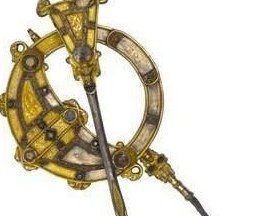
Look closely: Subject: luxury metalwork brooch. Style: Insular, ornamental and symmetrical. Technique: gold, silver, filigree, enamel and glass. Composition: circular form balances complex detail. Meaning/Context: shows elite status, technical mastery and the fusion of craft and Christian culture.
The Tara Brooch is both jewellery and a display of Insular metalworking skill. Gold, silver, amber, glass and intricate filigree create a dense decorative surface. Its interlace and animal forms symbolise complexity and status. The object transforms functional dress fastening into an elite artwork of identity and power.
Legacy / influence: The Golden Phase influenced later medieval art through its dense ornament, sacred prestige objects and page design. It also became a model for later Irish cultural revival and national visual identity.
6. High Crosses
High crosses combine sculpture, architecture and public teaching. They used biblical scenes, abstract ornament and monumental scale to communicate Christian stories to a wide audience. The main change is that stone carving became a powerful public form of religious instruction.
Muiredach's High Cross
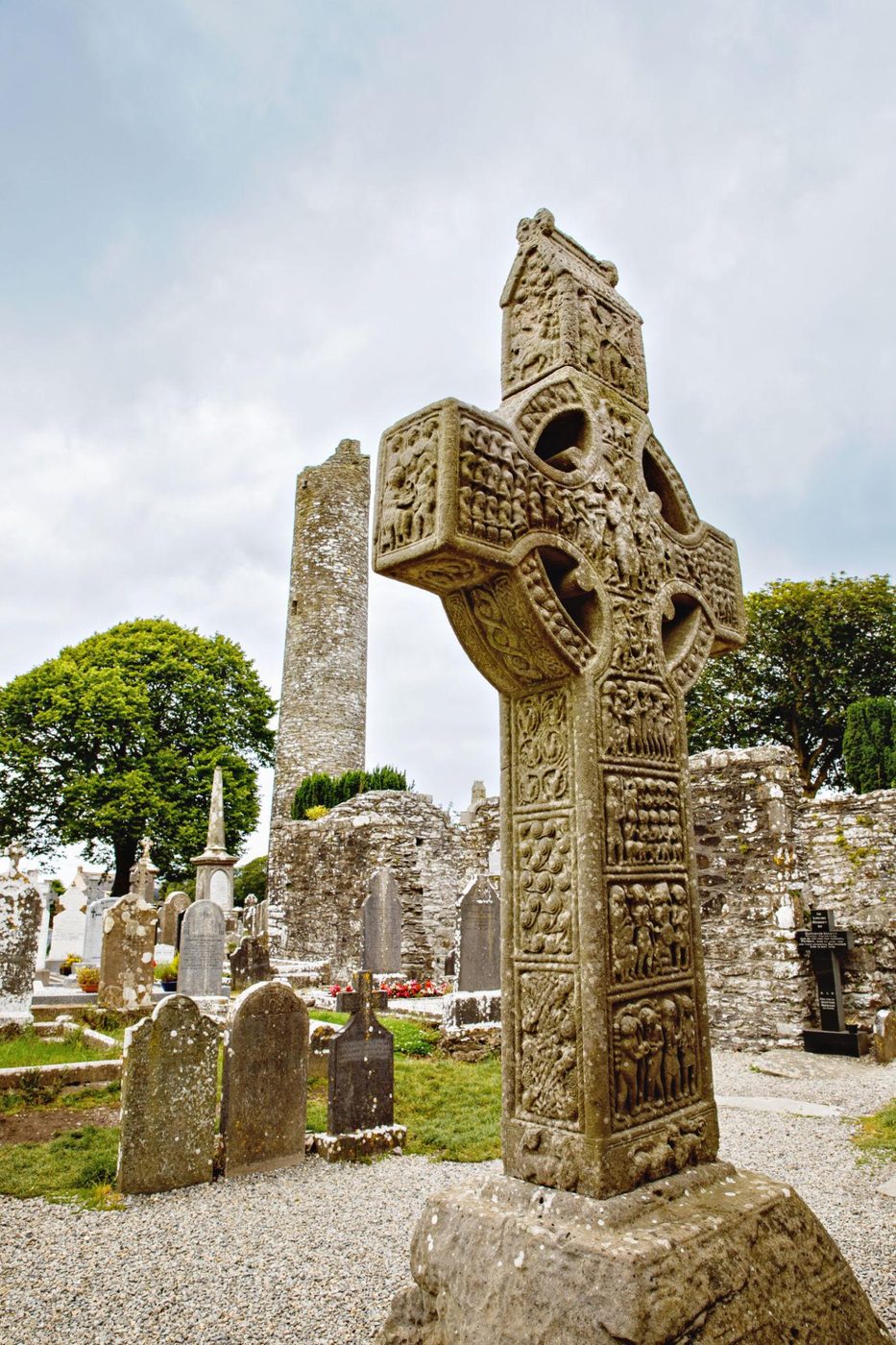
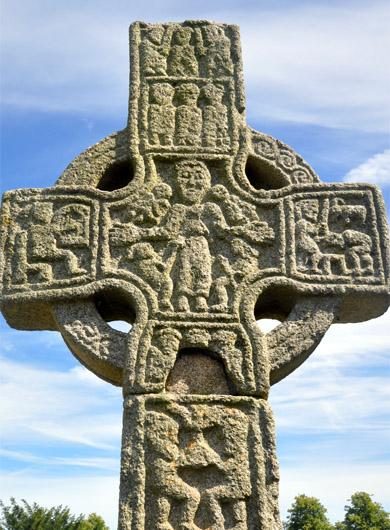
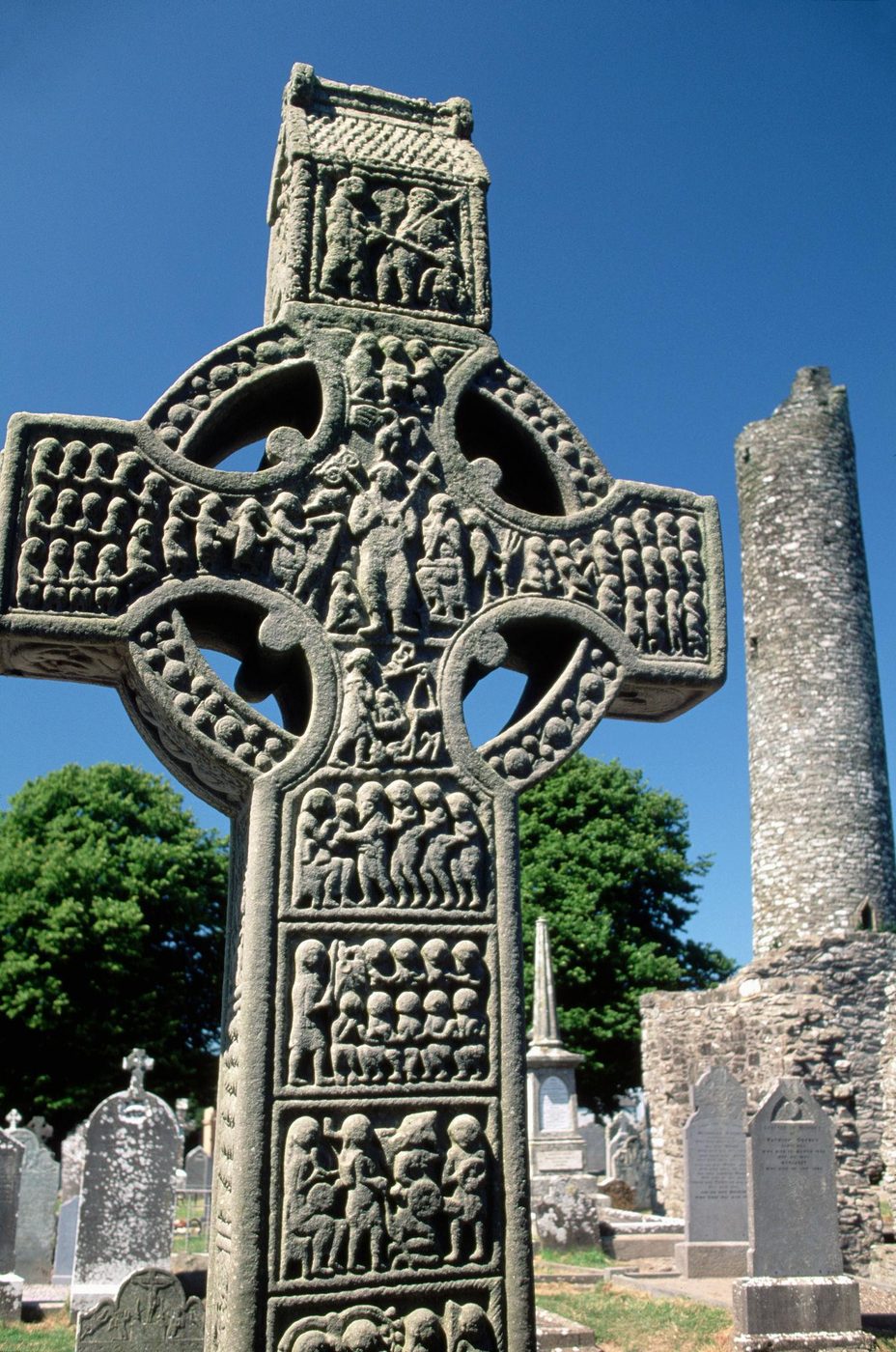
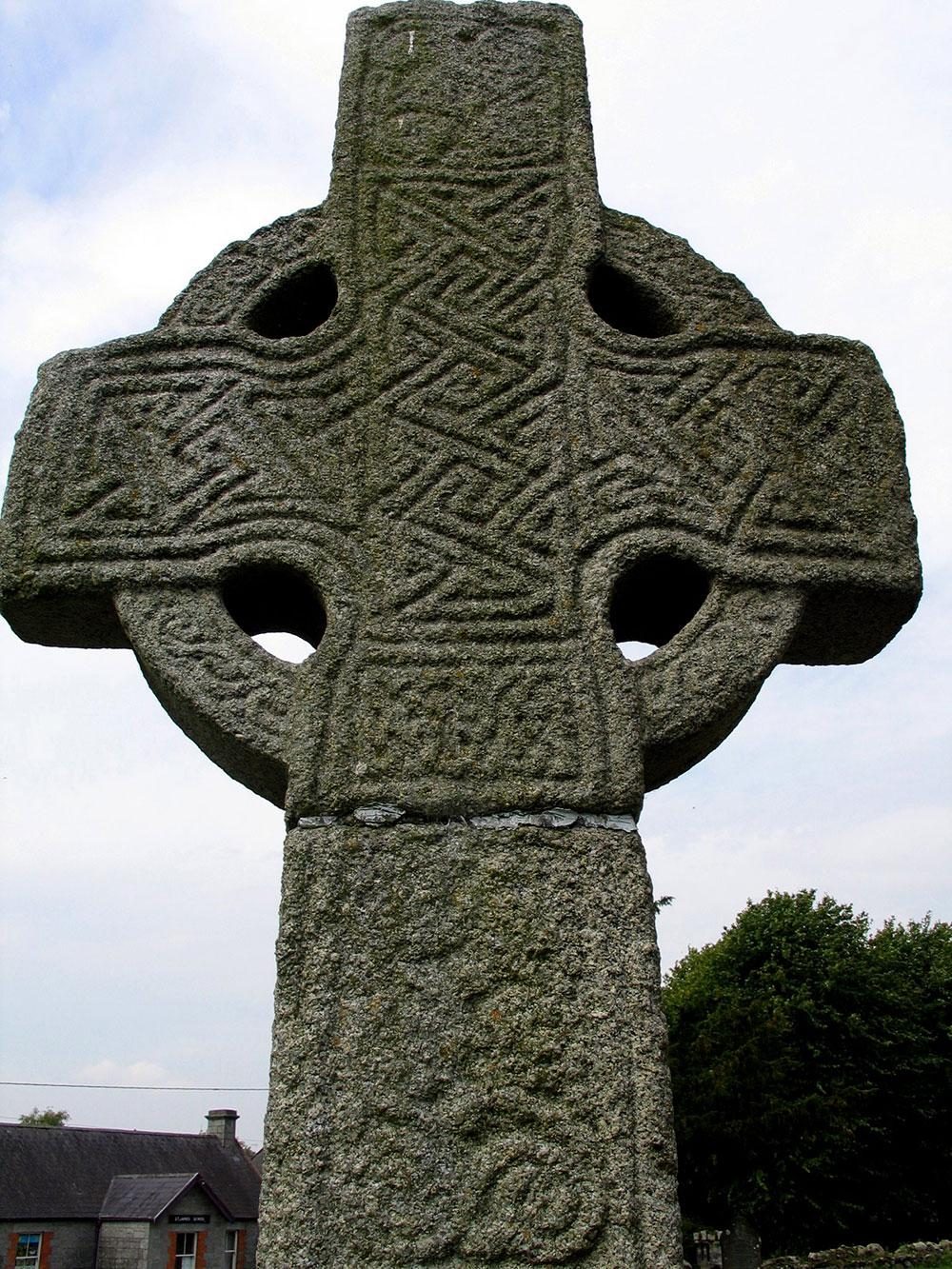
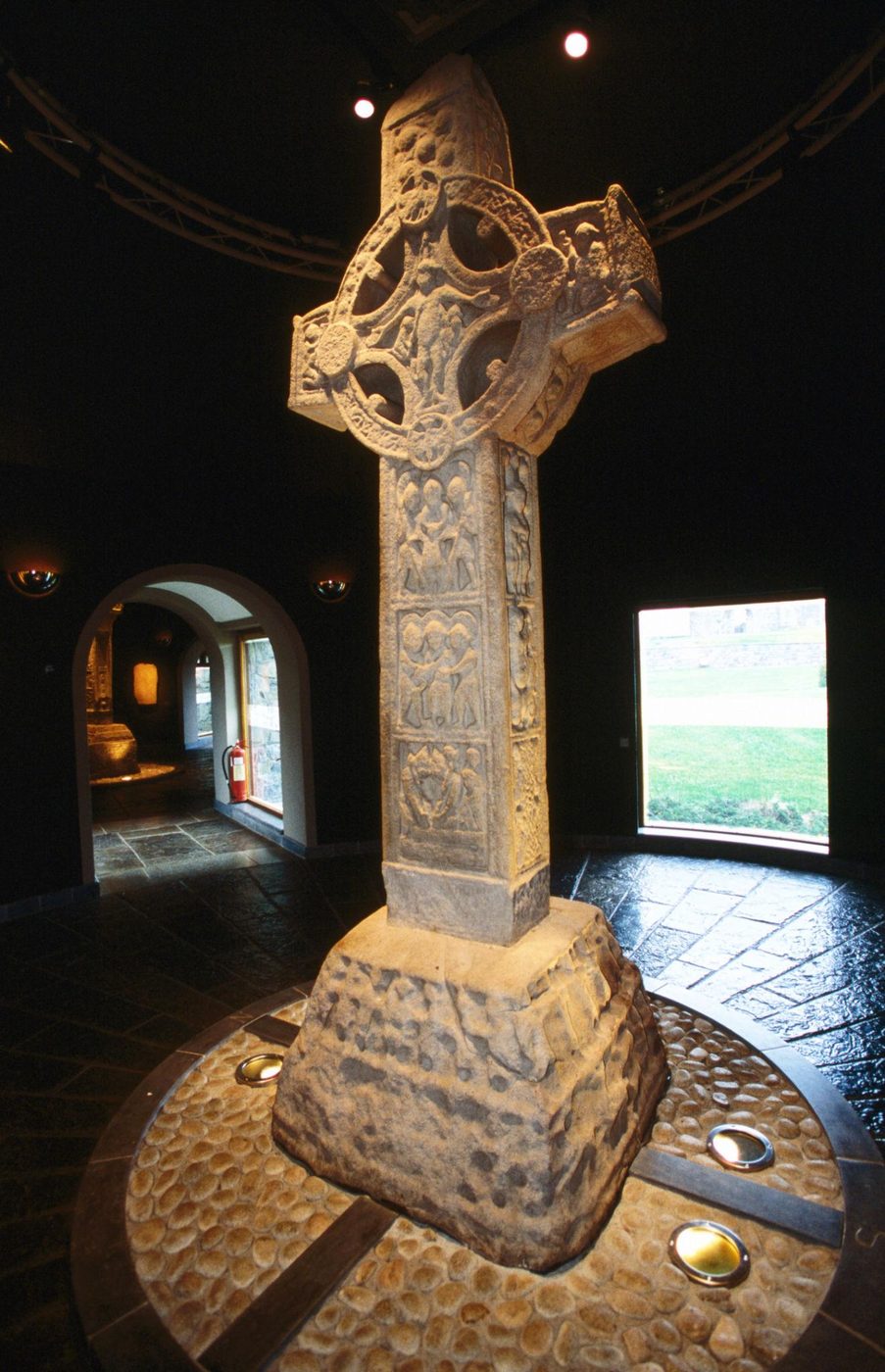
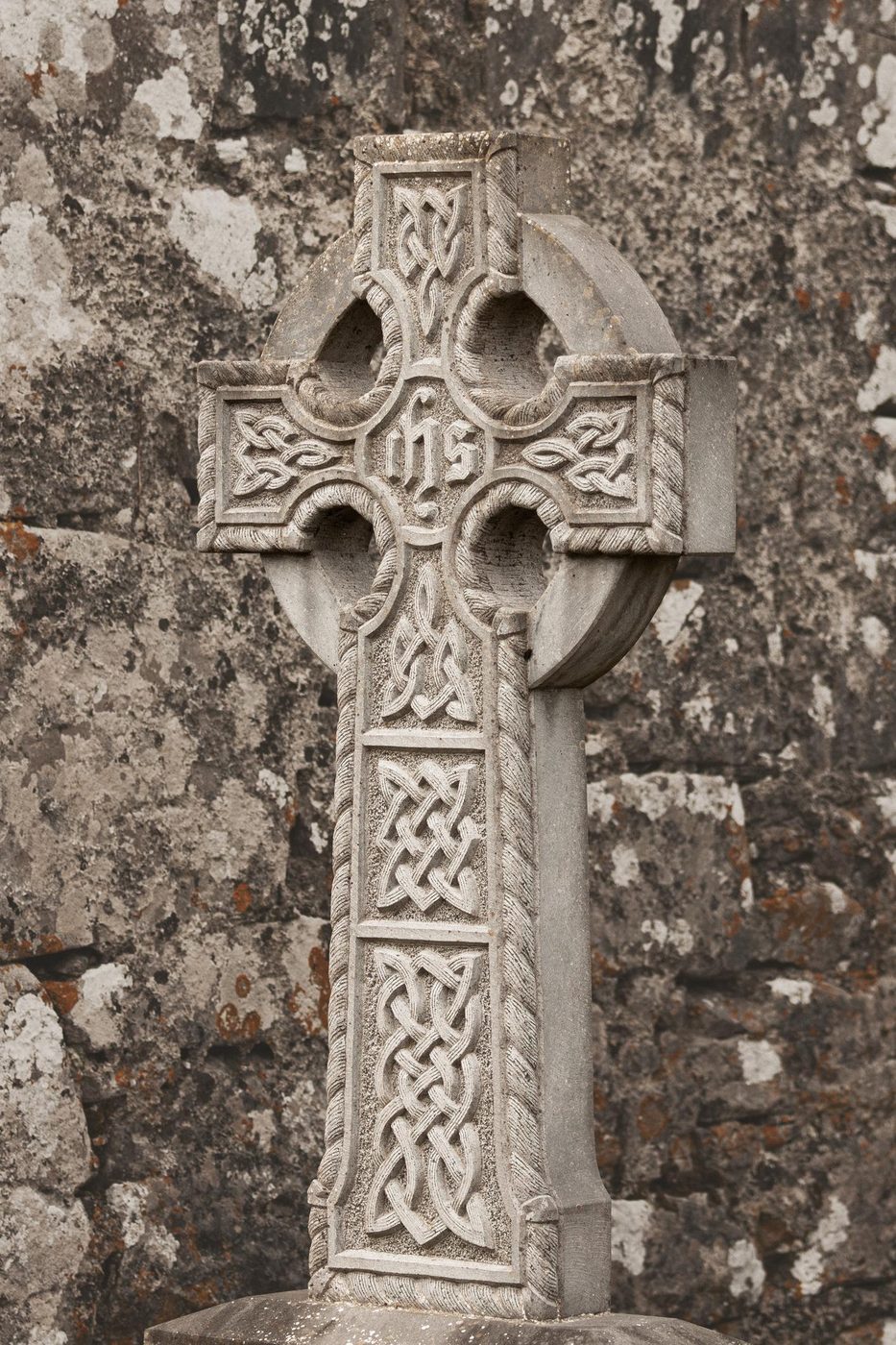
Key Facts
- Large stone cross from the 10th century.
- Decorated with biblical scenes.
- Used as teaching tools for Christian stories.
Analysis
- Relief carving.
- Narrative panels.
- Celtic interlace combined with Christian imagery.
Art Elements
- Texture from carving.
- Balance and symmetry.
- Detailed line and pattern.
Significance
- Combines sculpture and storytelling.
- Public religious monument.
Artist, Artwork and Artefact Analysis: The Late / Viking Transition Phase
Context / main ideas: The Late / Viking Transition Phase reflects disruption, adaptation and exchange. Viking raids threatened monasteries, but contact also brought new animal ornament, metalworking ideas and a wider visual vocabulary.
The Late / Viking Transition Phase emphasises monumental stone, narrative carving and changing cultural conditions as Irish art responded to contact, conflict and patronage.
Muiredach’s High Cross
People and culture note: Late Insular art reflects monastic communities adapting to changing conditions, including Viking contact, pilgrimage and public worship. The makers of high crosses are unknown, but their work taught biblical stories through stone. These monuments show how art, faith, memory and community identity met in public space.
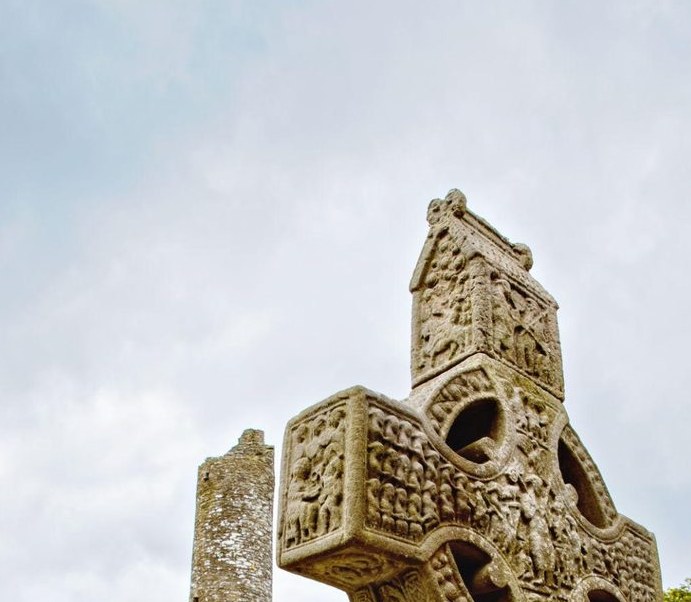
Look closely: Muiredach’s High Cross combines stone sculpture, Christian narrative and public teaching. Carved panels, hierarchy and ornament make it useful for form, function and meaning.
Muiredach’s High Cross teaches Christian stories through stone carving. Biblical scenes, symbolic figures and structured panels guide viewers visually and spiritually. Its public scale made it a teaching tool for a largely oral culture. The cross combines architecture, sculpture and narrative, using form, relief and symbolism to communicate faith.
Cross of the Scriptures, Clonmacnoise
People and culture note: Late Insular art reflects monastic communities adapting to changing conditions, including Viking contact, pilgrimage and public worship. The makers of high crosses are unknown, but their work taught biblical stories through stone. These monuments show how art, faith, memory and community identity met in public space.
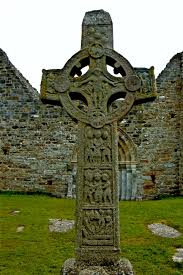
Look closely: Subject: high cross with biblical carving. Style: Insular Christian sculpture. Technique: stone carving in relief. Composition: cross form organises narrative panels. Meaning/Context: taught scripture visually and marked monastic power, faith and learning.
A major Irish high cross that uses carved biblical scenes to teach faith in a public monastic setting. Relief panels, symbolic figures and monumental scale show how stone sculpture communicated religion to viewers through narrative and memory.
Legacy / influence: This transition influenced later Irish art by mixing older Insular traditions with new forms and materials. It helped shift emphasis toward high crosses, public sculpture and hybrid decorative styles.
7. Important Terms
| Term | Meaning |
|---|---|
| Illuminated Manuscript | Decorated handwritten book |
| Interlace | Decorative woven line pattern |
| Filigree | Fine twisted wire decoration |
| Vellum | Animal skin writing surface |
| Carpet Page | Full decorative manuscript page |
| High Cross | Stone Christian cross with carvings |
| Horror Vacui | Fear of empty spaces |
8. Comparison Notes
| Artwork | Main Feature |
|---|---|
| Book of Kells | Manuscript illumination |
| Tara Brooch | Decorative metalwork |
| Ardagh Chalice | Religious ceremonial object |
| High Crosses | Stone narrative sculpture |
9. Possible Exam Topics
Possible areas to prepare:
- Christianity and symbolism in art.
- Decoration and pattern.
- The role of monasteries.
- Innovation in manuscript and metalwork production.
- Comparison between manuscripts and metalwork.
- Function and meaning of religious objects.
Leaving Cert Art Study Guide & Notes
Legacy / influence: Insular Art influenced later European manuscript illumination, Irish metalwork, Celtic Revival design and national identity. Its interlace, spirals and symbolic surfaces remain some of Ireland’s most recognisable visual forms.
Georgian Period in Ireland (c. 1714–1830)
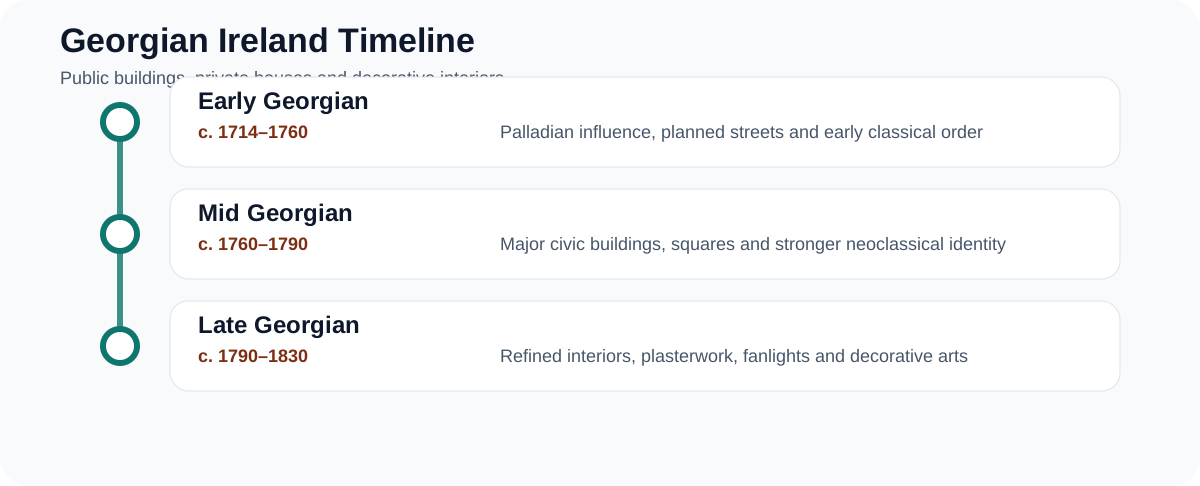
Context / main ideas: Georgian Ireland reflects Enlightenment order, classical taste, wealth, planning and urban confidence. Architecture and interiors were influenced by Palladianism, neoclassicism and the Grand Tour. The main change is the creation of planned streets, civic buildings and elegant domestic spaces.
Study structure for this section
Students should understand and be able to describe and discuss the context that informed and led to the chosen period/movement using the six elements listed below.
Students should understand and be able to describe and explain the period/movement using the six elements listed below.
The framework is structured around six elements:
1. What is the Georgian Period?
This section introduces Georgian design as a style of proportion, symmetry and classical reference. It connects Irish architecture with wider European taste, especially through patronage, education and travel. The emphasis is on order, balance, restraint and social status.
The Georgian period in Ireland spans roughly 1714–1830 and is associated with Palladian and neoclassical design, planned streets, civic buildings and elegant domestic interiors.
The period is associated with:
- elegance,
- symmetry,
- classical influence,
- urban planning,
- grand architecture,
- refined decorative arts.
In Ireland, especially in Dublin, Georgian architecture transformed the city into one of the finest Georgian capitals in Europe.
2. Historical Context
Context
- Ireland was controlled by the Anglo-Irish Protestant Ascendancy.
- Wealthy landowners and merchants funded building projects.
- Dublin expanded rapidly during the 18th century.
- Classical ideas from Ancient Greece and Rome influenced architecture and design.
- The Enlightenment encouraged order, balance and rational thinking.
- The Grand Tour exposed wealthy Irish travellers to European art and architecture.
Important developments:
- Wide streets and planned squares.
- Growth of parliament buildings.
- Construction of elegant townhouses.
- Development of decorative plasterwork and furniture.
- Increased collecting of art and classical objects.
3. The Grand Tour
Context / main ideas: The Grand Tour explains how travel influenced Irish taste. Wealthy patrons studied classical ruins, Renaissance art and European collections, then brought these ideas home through architecture, interiors, collecting and portraiture. It helped spread neoclassical style and elite cultural identity.
What was the Grand Tour?
The Grand Tour was a journey around Europe taken by wealthy upper-class young men during the 17th and 18th centuries.
The tour was considered part of a gentleman’s education.
Main destinations included:
- Rome
- Florence
- Venice
- Paris
- Naples
Why was the Grand Tour important?
The Grand Tour exposed wealthy Irish and British travellers to:
- Ancient Roman and Greek architecture,
- Renaissance art,
- sculpture,
- painting,
- classical ideals.
Travellers brought home:
- artworks,
- sculptures,
- books,
- architectural ideas,
- furniture styles.
This strongly influenced Georgian architecture and interior design in Ireland.
Influence on Georgian Ireland
Architecture
Classical buildings in Dublin were inspired by:
- Roman temples,
- Renaissance palaces,
- Palladian villas.
Architects such as Edward Lovett Pearce and James Gandon used ideas connected to classical architecture associated with Grand Tour culture.
Features influenced by the Grand Tour:
- columns,
- domes,
- pediments,
- symmetry,
- classical proportion.
Interior Design
Grand Tour travellers collected:
- marble sculpture,
- classical busts,
- paintings,
- porcelain,
- decorative objects.
Homes became displays of education and taste.
Collecting and Patronage
Wealthy families became art patrons after travelling Europe.
They supported:
- architecture,
- portrait painting,
- decorative arts,
- sculpture collections.
Legacy / influence: Grand Tour taste influenced later Irish patronage by spreading classical ideals into architecture, interiors and portraiture. It helped create a visual language of refinement, learning and elite identity.
4. Main Characteristics of Georgian Art & Architecture
Context / main ideas: This section gathers the visual language of Georgian design: symmetry, proportion, classical columns, restrained ornament and elegant interiors. The main idea is controlled harmony. Buildings and rooms were designed to show taste, education, wealth and social order.
Architecture
- Symmetry
- Proportion
- Classical columns and pediments
- Sash windows
- Brick façades
- Decorative fanlights
- Balanced layouts
Classical Column Orders: Doric, Ionic and Corinthian
These classical orders appear in Georgian architecture because Georgian design looked back to Ancient Greece and Rome for ideas about proportion, harmony, status and civic authority.
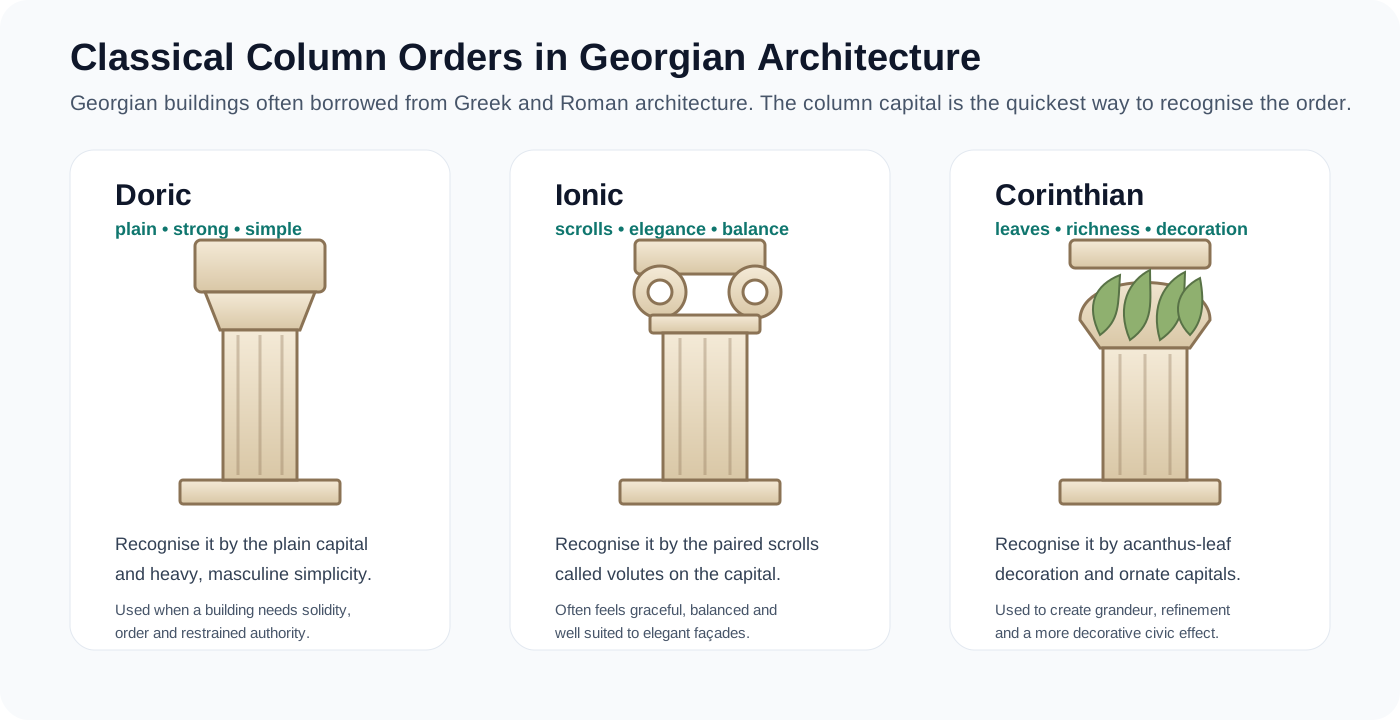
Doric
Plain, strong and heavy. Doric columns have simple capitals and communicate solidity, order and restraint.
Ionic
More elegant and decorative. Ionic capitals have scroll-like volutes and suit balanced, refined façades.
Corinthian
The most ornate of the three. Corinthian capitals use acanthus-leaf decoration to suggest luxury, status and grandeur.
Exam link: when discussing Georgian public buildings such as the Custom House or Four Courts, refer to columns and pediments as evidence of classical influence, balance and authority.
Interior Design
- Ornate plasterwork
- Decorative ceilings
- Elegant staircases
- Classical motifs
Decorative Arts
- Fine silver
- Portrait painting
- Furniture making
Legacy / influence: Georgian characteristics influenced later town planning, domestic architecture and heritage design. Fanlights, brick façades, sash windows and classical proportions remain key references for Irish streetscapes and restoration.
5. Key Architects and Buildings
5. Key Georgian Architects in Ireland
James Gandon was a leading neoclassical architect whose Dublin buildings used domes, porticos, columns and balanced façades to express civic authority. His work helped give Georgian Dublin a monumental public identity connected with government, trade and law.
Edward Lovett Pearce helped introduce Palladian architecture to Ireland. His Irish Houses of Parliament used classical proportion, symmetry and restraint to communicate political confidence and elite taste. He helped establish the formal Georgian language later used across Dublin.
Famous Irish Georgian buildings to know
- Irish Houses of Parliament / Bank of Ireland, College Green
- Custom House, Dublin
- Four Courts, Dublin
- Casino at Marino
- Castletown House
- Leinster House
- Russborough House
- Georgian townhouse terraces and squares
6. Georgian Dublin
Context / main ideas: Georgian Dublin changed through planned streets, speculative building and the work of the Wide Streets Commission. The city moved from medieval irregularity toward broad routes, axial planning, public squares and ordered terraces.
Urban Planning: Wide Streets Commission
The Wide Streets Commission was established in 1757 and is often described as Europe’s earliest modern urban planning authority. It reshaped Dublin by replacing cramped medieval street patterns with wider, straighter and more ordered Georgian routes.
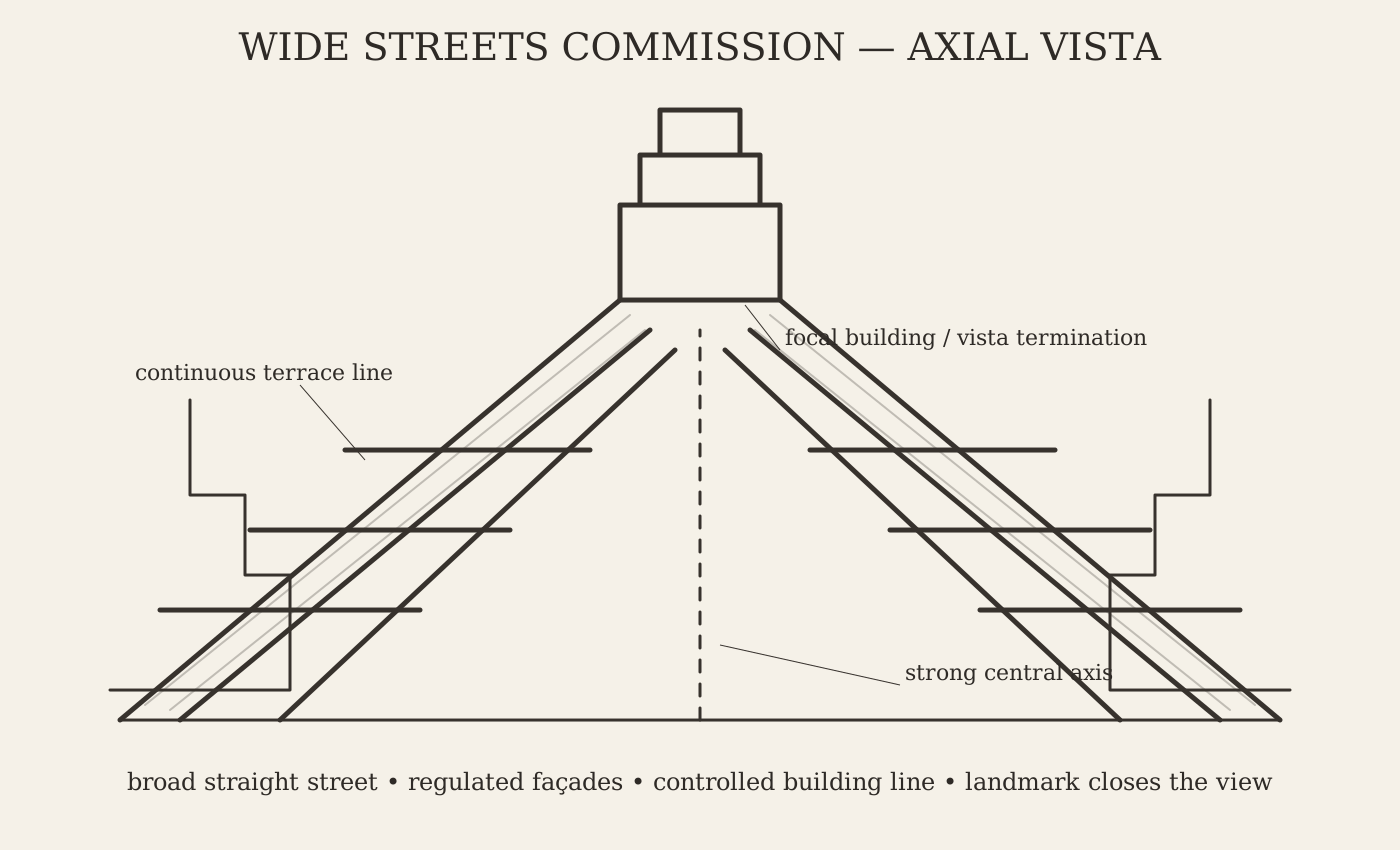
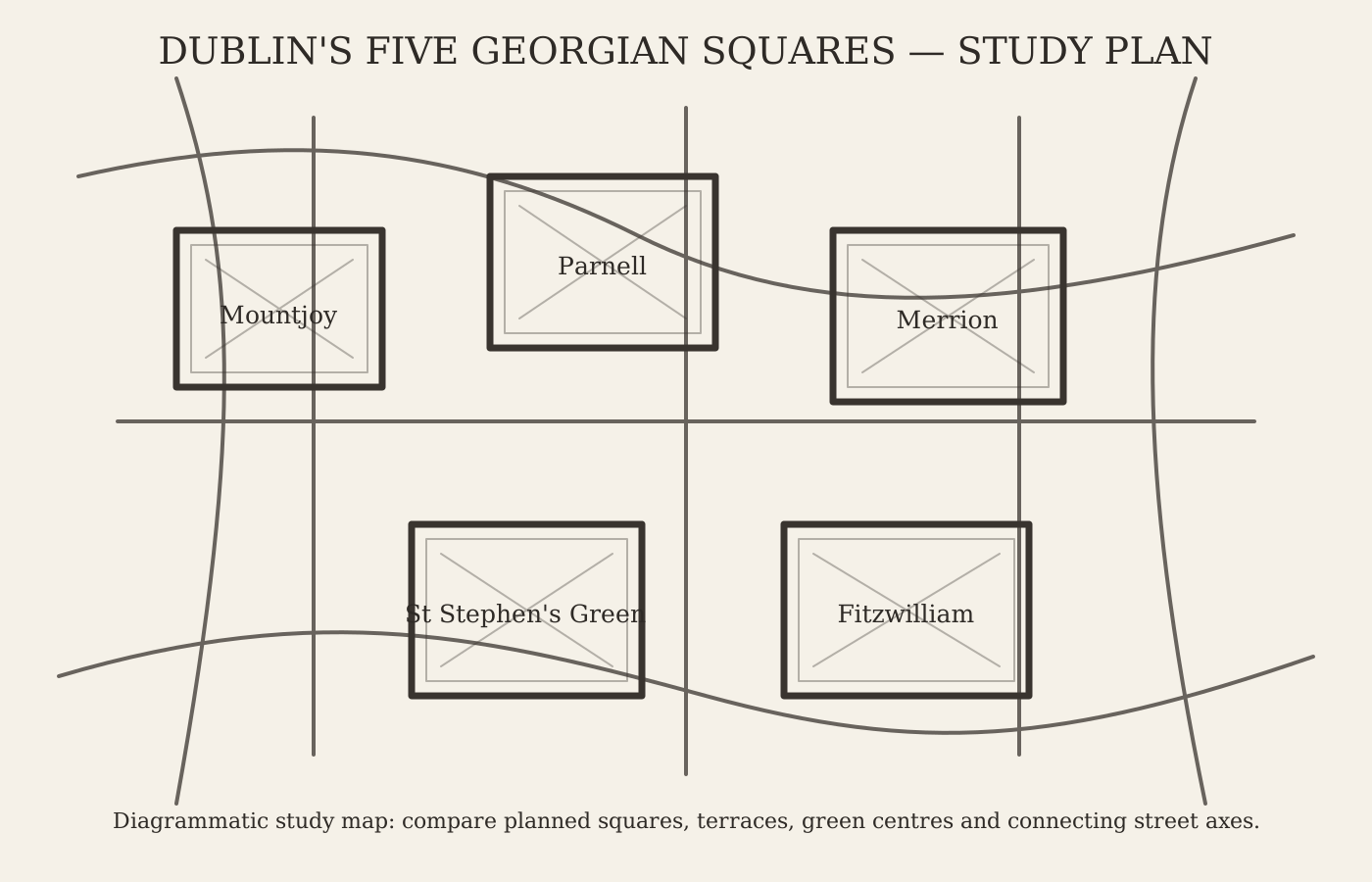
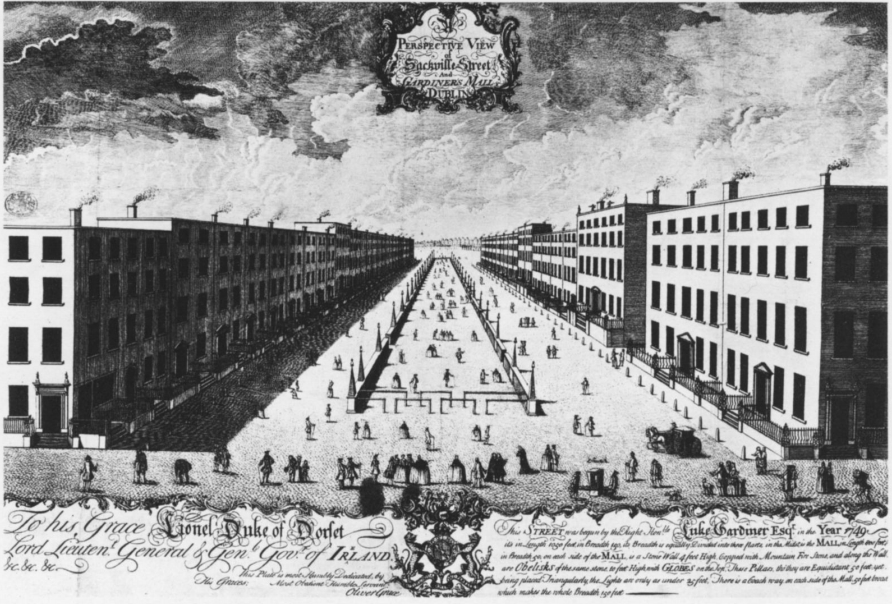
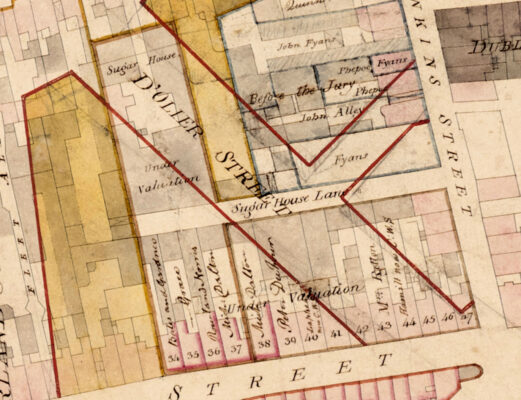
Axial vistas and new streets
- The Commission cut through narrow, unhealthy medieval alleyways to improve movement, light, air and civic order.
- Broader, straighter streets changed Dublin from an irregular medieval city into a more ordered Georgian capital.
- Planning became a civic design tool: streets, squares and vistas expressed Enlightenment order, public authority and urban improvement.
The five Georgian squares
- Development was anchored by five major squares: Parnell Square, Mountjoy Square, Merrion Square, Fitzwilliam Square and St Stephen’s Green.
- Parnell Square and Mountjoy Square formed a north-side core; Merrion Square, Fitzwilliam Square and St Stephen’s Green shaped the south-side core.
- The squares acted as structured urban boundaries and private pleasure gardens that later became public green spaces, offering light, air and recreation.
Architectural uniformity and speculation
- Speculative developers and estates, including the Gardiner family and the Fitzwilliam estate, used repeated Georgian terrace designs to create visual unity.
- Typical features include red-brick façades, strict vertical symmetry, granite steps and basements, multi-pane sash windows, fanlit doorways and restrained classical proportion.
- Fashionable Dublin shifted over time: elite building first centred on grand north-side townhouses, then moved south toward the Merrion and Fitzwilliam areas.
Exam focus: link urban planning to order, status, hygiene, patronage, movement, symmetry and the public image of Georgian Dublin.
Legacy / influence: Georgian Dublin influenced later urban design by showing how streets, squares, façades and green spaces could structure a capital city. Its legacy still shapes Dublin’s movement, identity and conservation priorities.
7. Georgian Interior Design
Context / main ideas: Georgian interiors expressed taste through symmetry, light, high ceilings, central staircases, refined woodwork and stucco plaster decoration. Decorative ceilings, swags, medallions and classical motifs showed craftsmanship without overwhelming the room.
Plasterwork
Michael Stapleton
Michael Stapleton was a leading Irish stuccodore, a specialist in decorative stucco plaster ceilings and walls. Stucco plaster is fine wet plaster modelled, cast or worked into raised ornament, then finished to create delicate relief decoration.
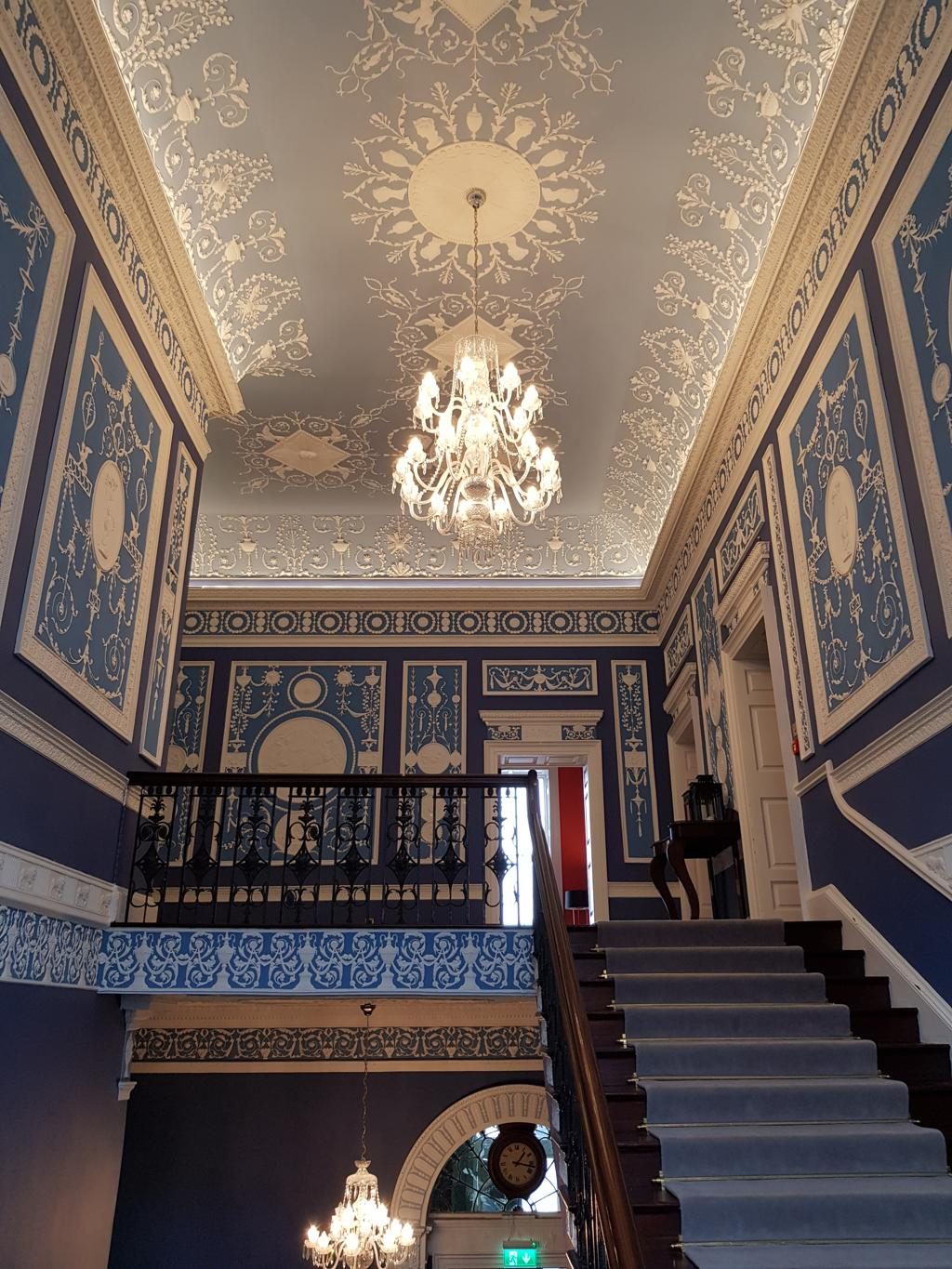
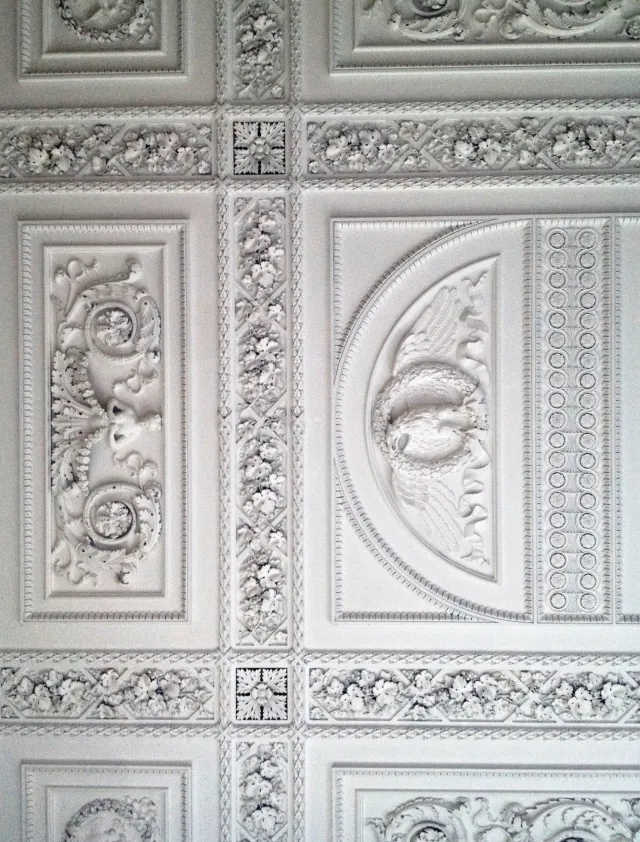
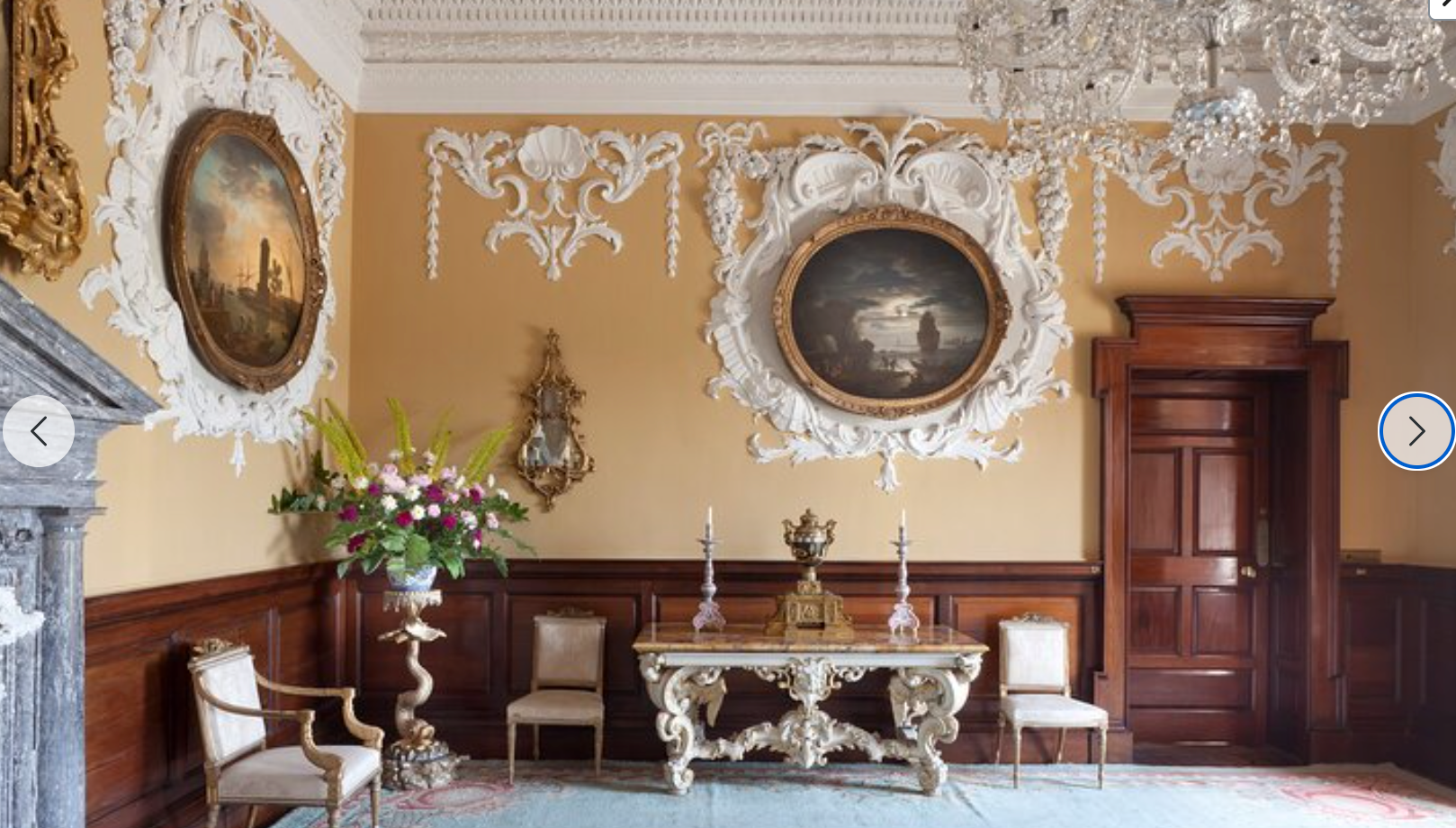
Features
- Stucco plaster relief
- Swags
- Floral motifs
- Classical figures
- Ceiling medallions
Furniture
Thomas Chippendale
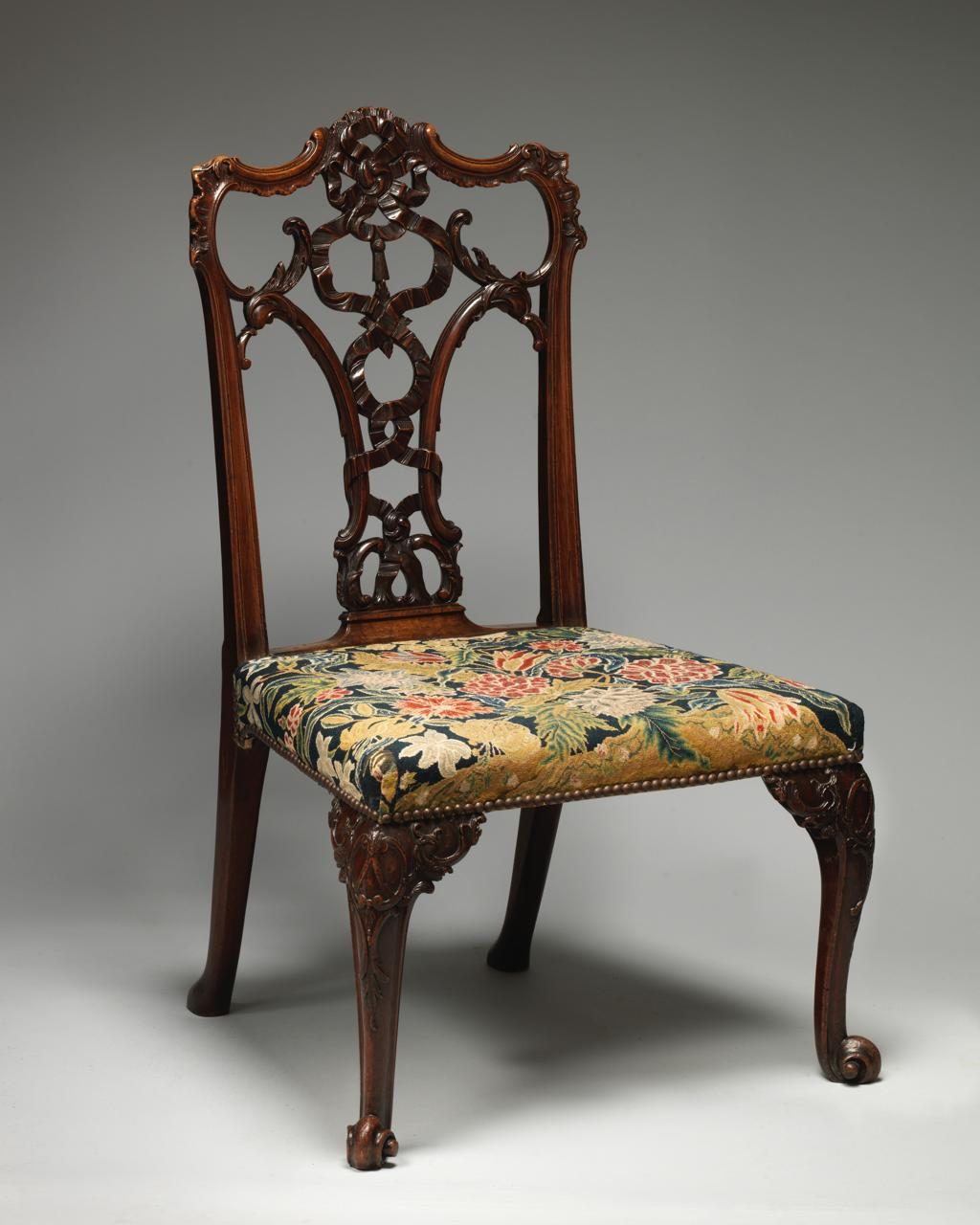
Influenced Georgian furniture style.
Features
- Mahogany wood.
- Elegant curved legs.
- Fine craftsmanship.
Legacy / influence: Georgian interior design influenced later domestic architecture by making proportion, plaster detail, elegant stair halls and restrained ornament markers of quality. These features remain important in conservation and restoration.
8. Portrait Painting
Context / main ideas: Georgian portraiture recorded status, identity and refinement. Sitters were often shown through clothing, pose, setting and expression, allowing artists to communicate wealth, education, family position and social ambition.
Hugh Douglas Hamilton
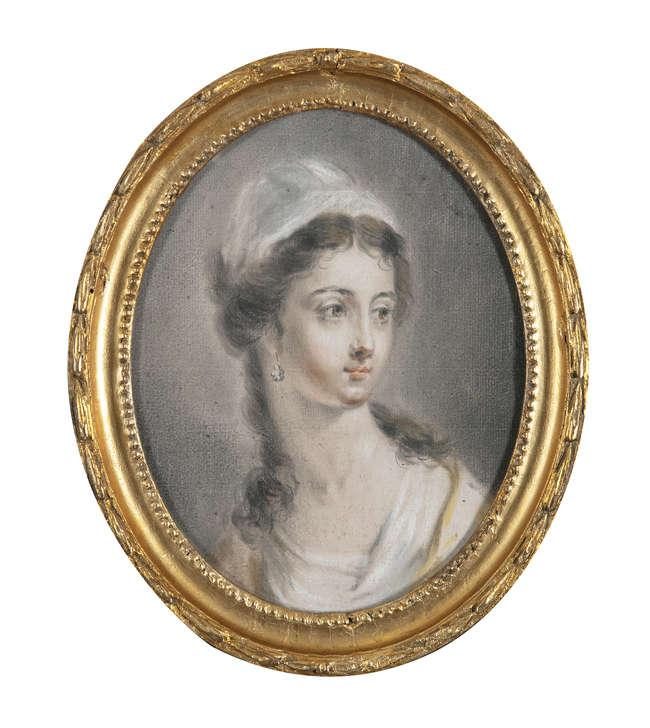
Features
- Portrait miniatures.
- Soft colours.
- Elegant aristocratic subjects.
Artist, Artwork and Artefact Analysis
For clearer revision, Georgian architecture is grouped by function. Public / civic buildings show government, law and institutional authority. Private buildings show domestic wealth, patronage and status. Dublin urban planning explains how streets, squares and terraces shaped the city.
Public / Civic Buildings
Irish Houses of Parliament / Bank of Ireland, College Green
Function note: Built as a parliament building and later converted to a bank. It is public / institutional architecture because its classical form expressed government, order and civic authority.
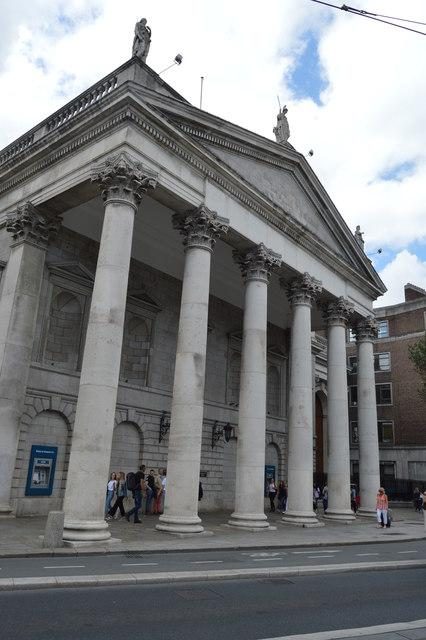
Look closely: Subject: former parliament building, later bank. Style: Palladian / Georgian classicism. Technique: stone façade, colonnade and pediment. Composition: ordered, symmetrical front. Meaning/Context: public power, institutional identity and Enlightenment order in Georgian Dublin.
The building’s classical columns, pediment and symmetry make politics look rational, stable and authoritative. It is useful for discussing Georgian public architecture, Palladian influence, College Green and the shift from parliament to banking after the Act of Union.
- Original function: parliament building; later Bank of Ireland.
- Type: public / institutional.
- Key features: columns, pediment, symmetry, controlled classical proportion.
Custom House, Dublin
Function note: Designed for government customs administration. Its monumental riverside site connected architecture with trade, taxation, administration and the commercial life of Dublin.
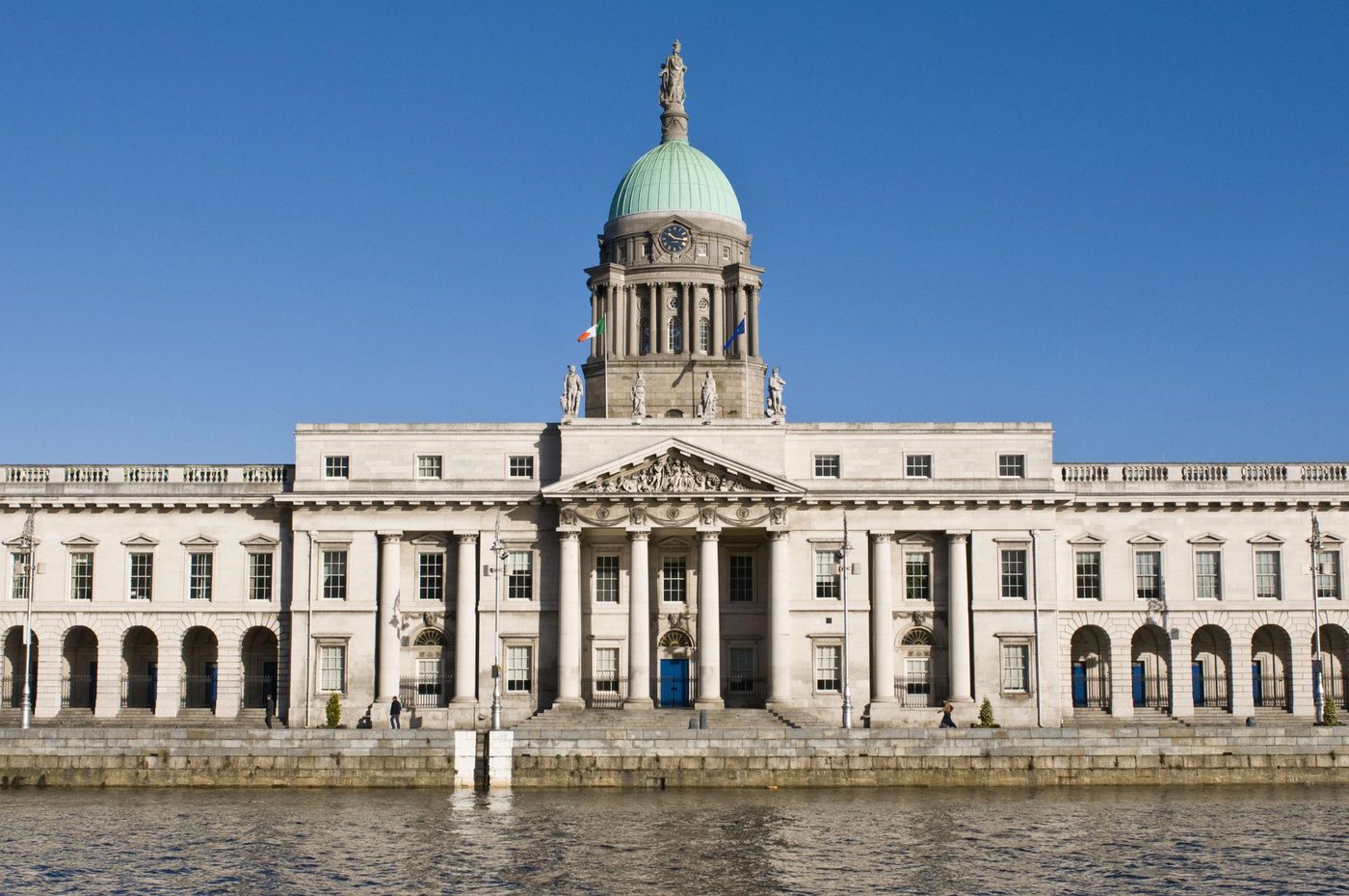
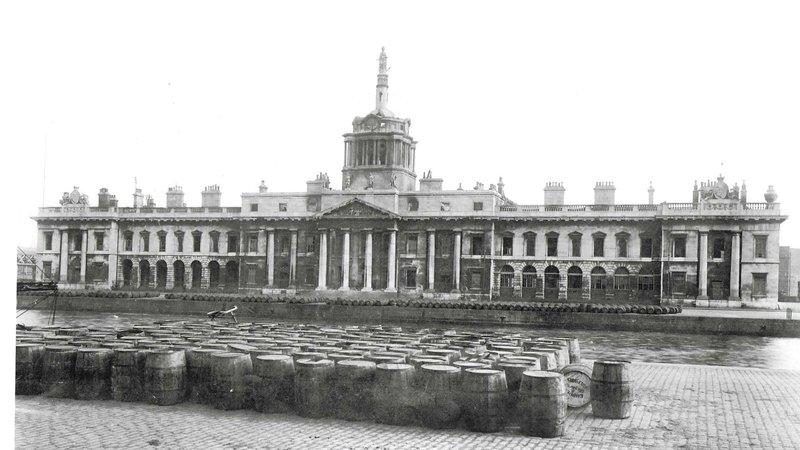
Look closely: Subject: customs administration building. Style: Neoclassical Georgian. Technique: stone façade, dome, columns and sculpture. Composition: central dome anchors a long symmetrical riverfront. Meaning/Context: public administration, trade and British authority in Georgian Dublin.
The Custom House uses symmetry, a central dome, classical columns and sculptural detail to turn government administration into civic spectacle. Its position on the Liffey links Georgian architecture with trade, empire, movement and the planned city.
- Original function: customs administration.
- Type: public building.
- Key features: dome, portico, rhythm, sculpture, riverfront setting.
Four Courts, Dublin
Function note: Built as law courts. The building’s dome, columns and balanced façade make justice appear formal, permanent and authoritative.
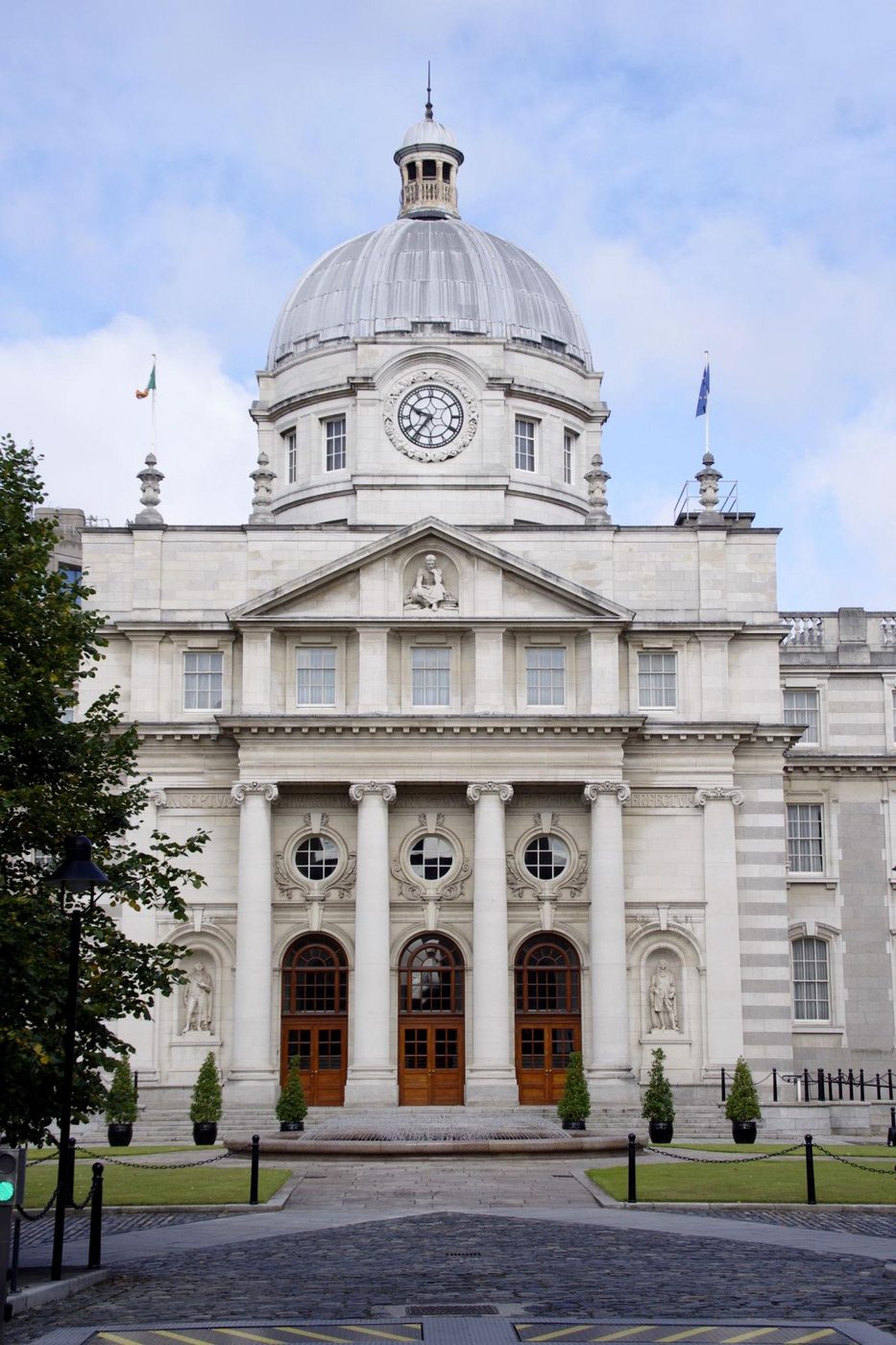
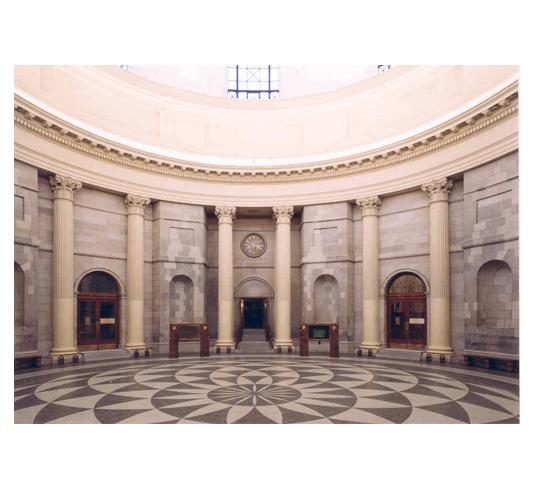
Look closely: Subject: law courts. Style: Neoclassical Georgian. Technique: stone construction with dome, columns and pediment. Composition: central dome and symmetrical wings. Meaning/Context: public law, civic authority and the visual language of justice.
The Four Courts is useful for explaining how Georgian public buildings used classical vocabulary to communicate seriousness and authority. The central dome, portico, symmetry and heavy stonework create a powerful civic identity for the legal system.
- Original function: law courts.
- Type: public building.
- Key features: dome, Corinthian columns, portico, monumental scale.
Leinster House
Function note: Originally an aristocratic townhouse for the Duke of Leinster, now the seat of the Oireachtas. It bridges private Georgian status and modern public government.
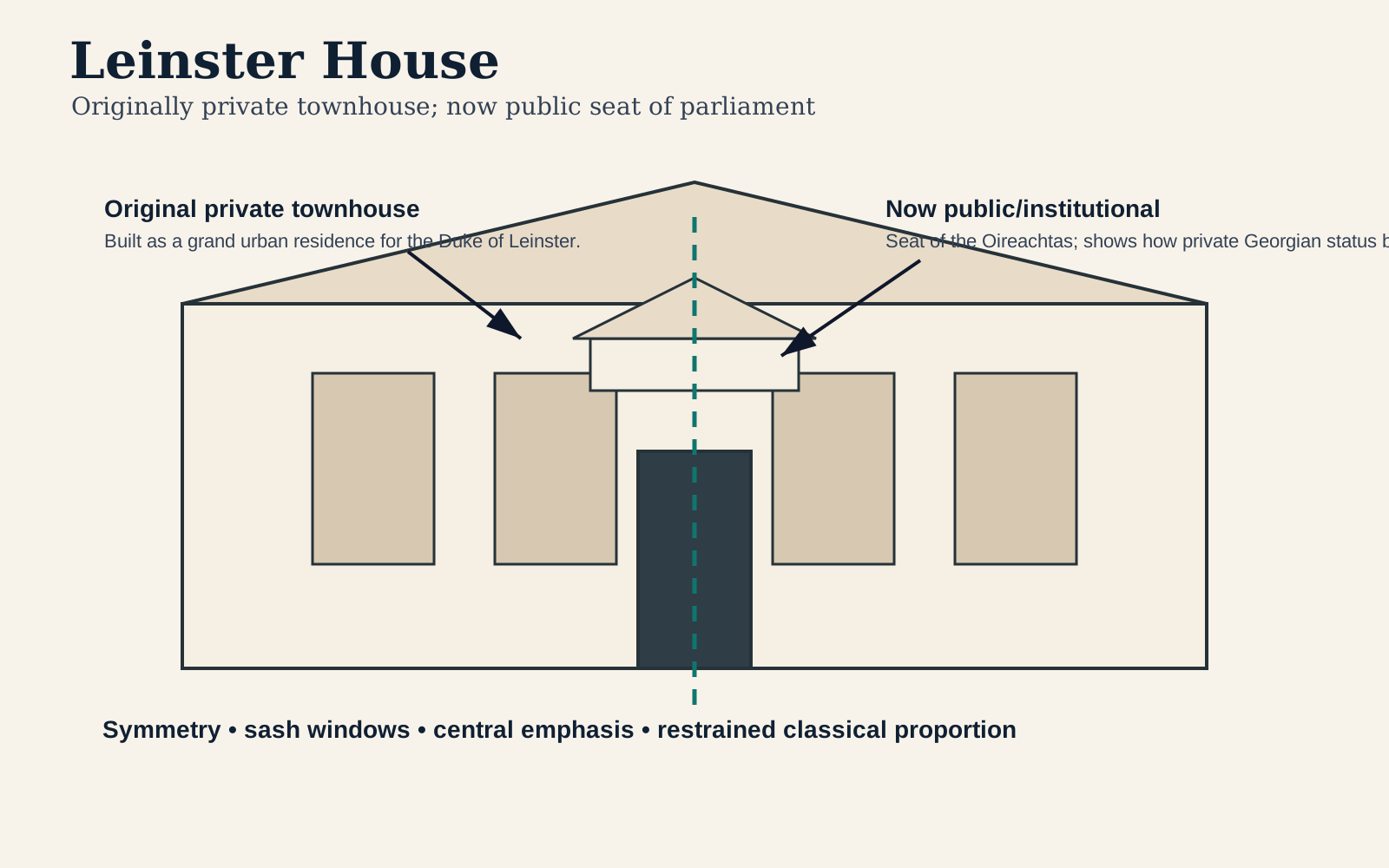
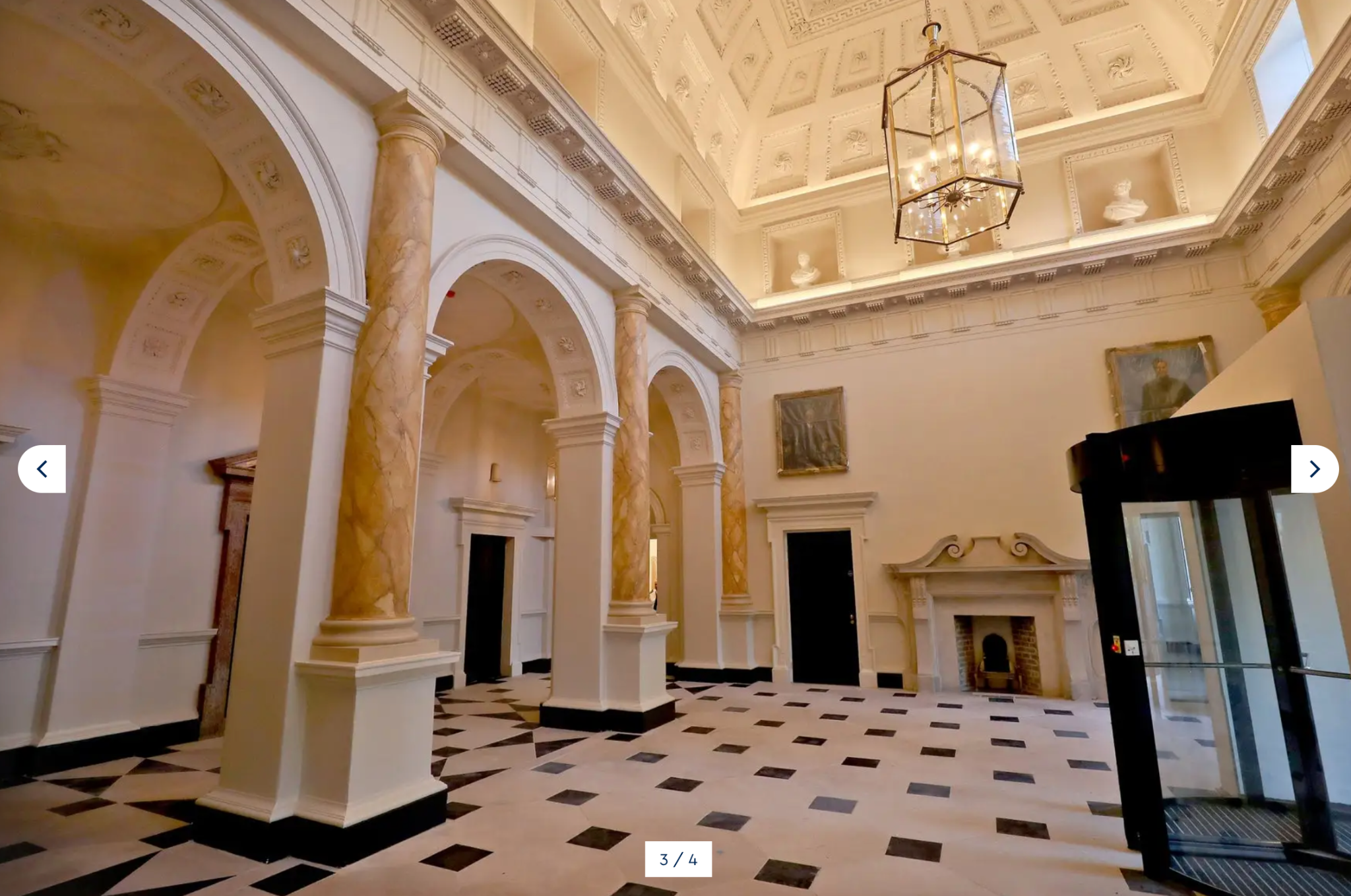
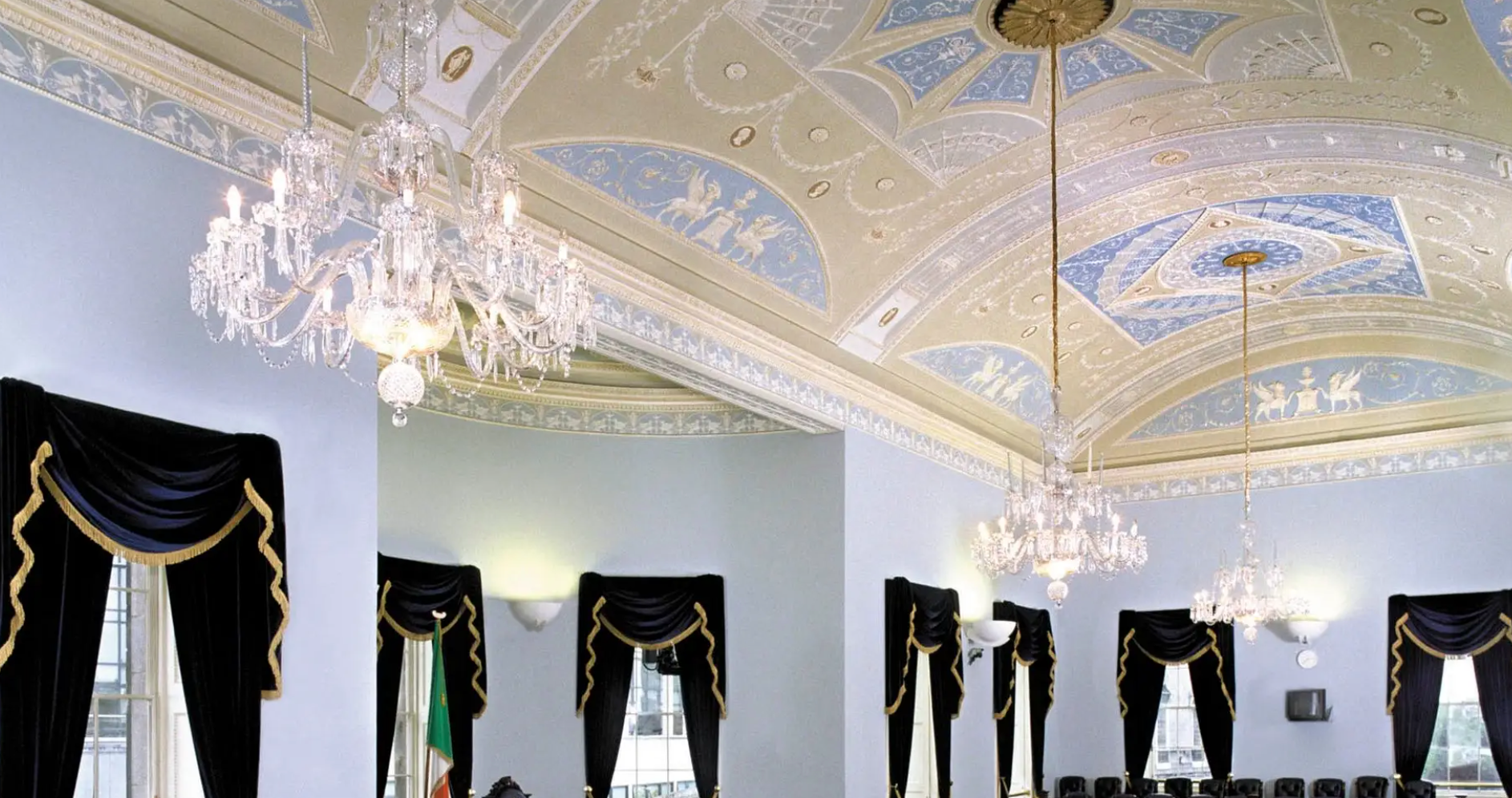
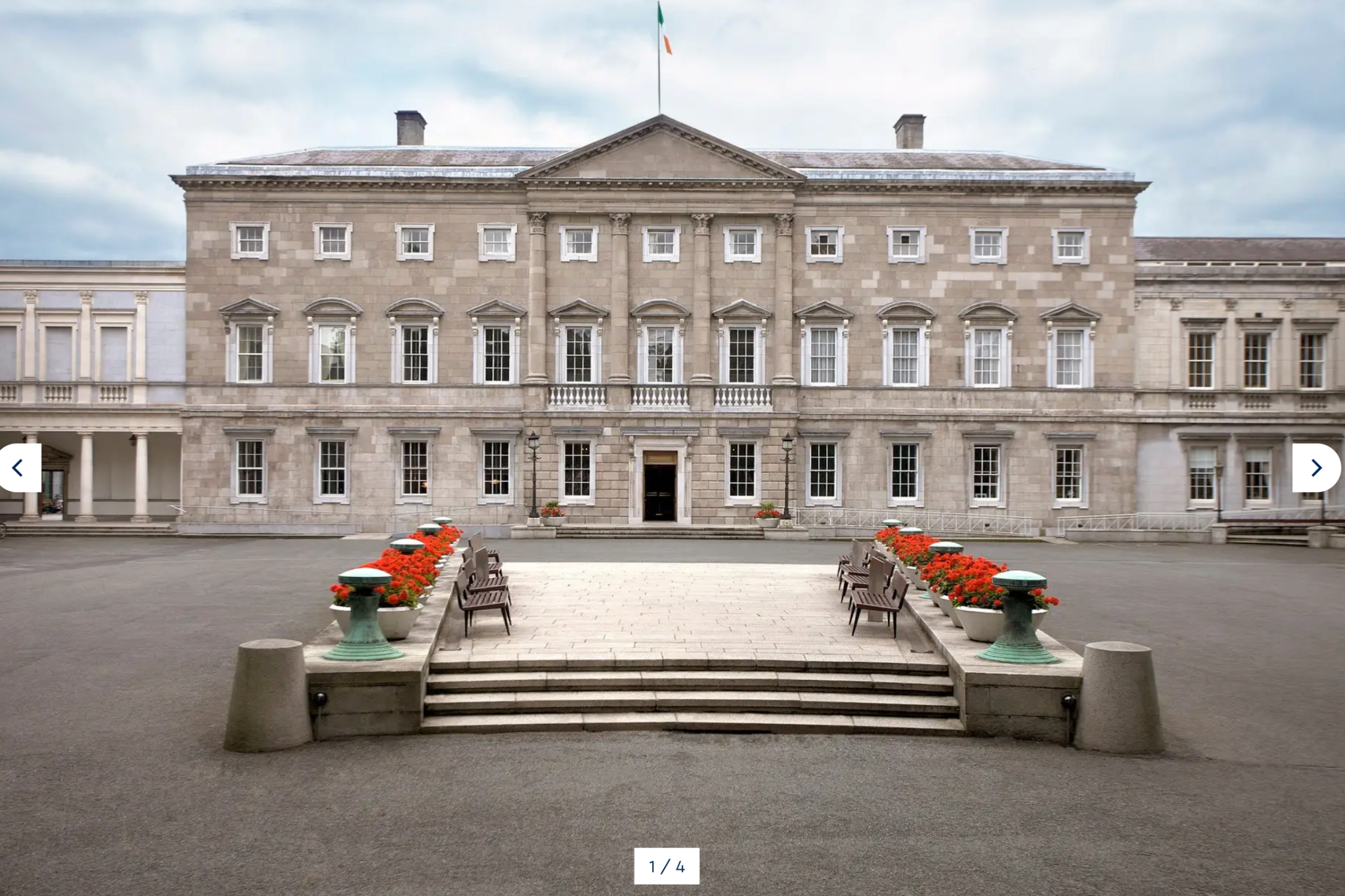
Look closely: Subject: Georgian townhouse adapted as parliament. Style: restrained classical / Georgian. Technique: symmetrical façade and ordered sash windows. Composition: central emphasis and balanced bays. Meaning/Context: private aristocratic power later transformed into national public identity.
Leinster House shows how Georgian domestic architecture could become institutional architecture. Its balanced façade, classical restraint and urban position make it useful for discussing social status, political change and the reuse of private Georgian buildings for public life.
- Original function: Duke of Leinster’s townhouse.
- Type: originally private; now public / institutional.
- Key features: symmetry, restraint, central emphasis, formal urban setting.
Private Buildings
Castletown House
Culture / patronage note: Georgian buildings and interiors often depended on patrons, architects, builders and craftspeople working together. Even when no single artist is named, the design reflects classical taste, social status and urban planning. These works are useful for discussing public identity, private wealth, proportion and refinement.
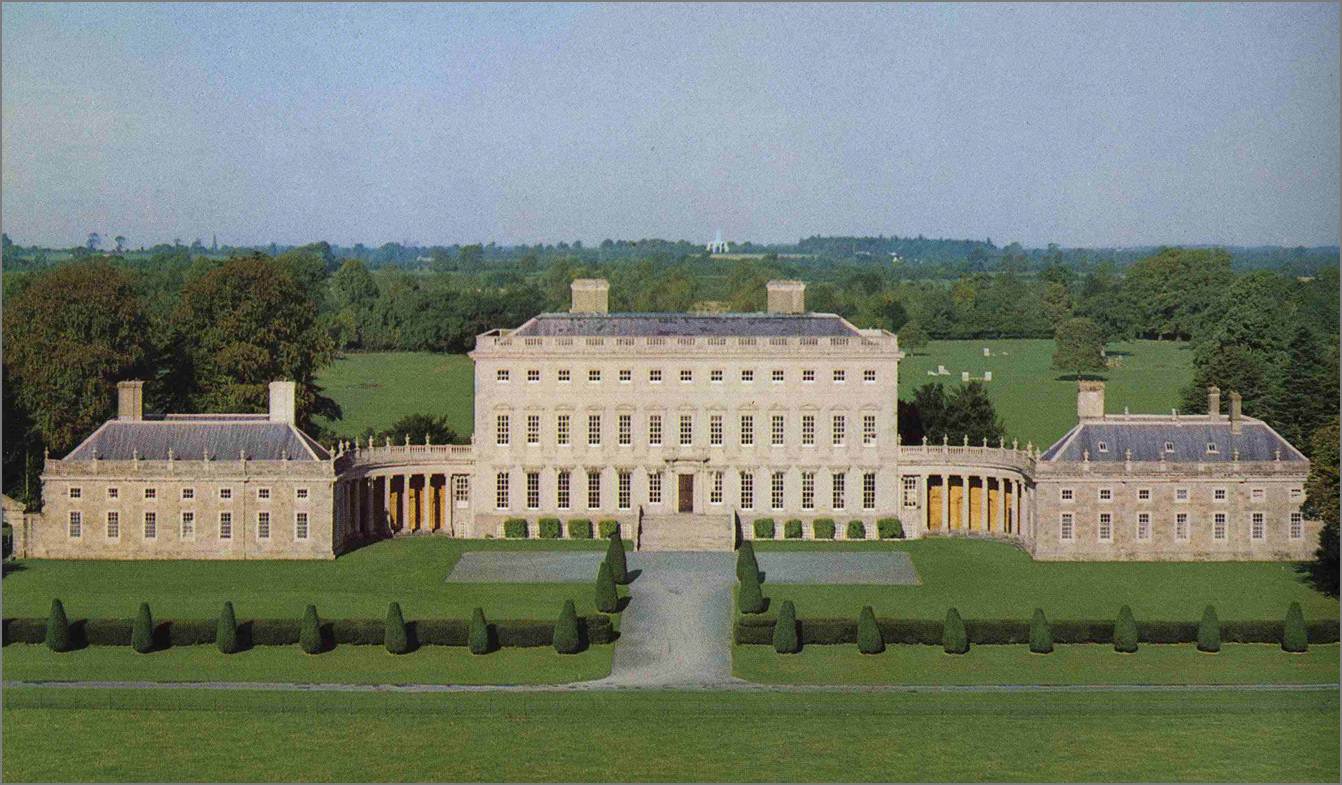
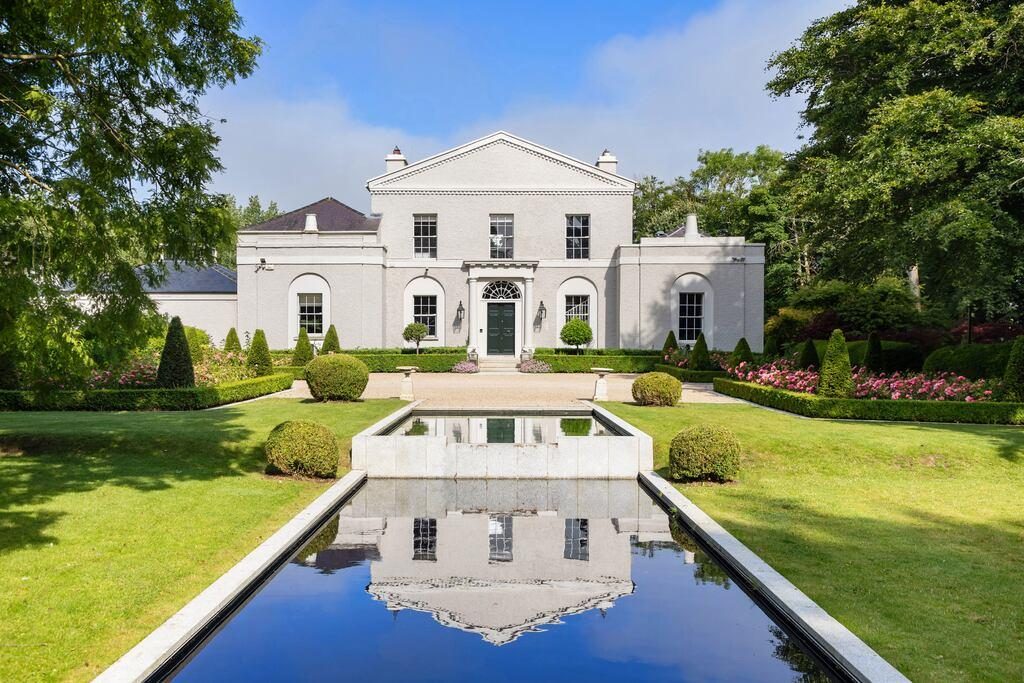
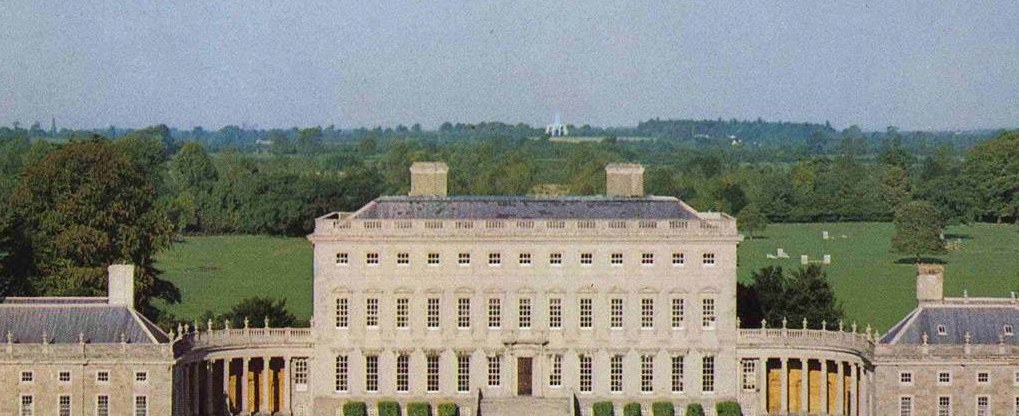
Look closely: Subject: Georgian country house. Style: Palladian, symmetrical and classical. Technique: stone architecture with ordered proportions. Composition: central block and wings create balance. Meaning/Context: expresses Anglo-Irish status, taste and Enlightenment ideals.
A key Palladian country house. Symmetry, wings, classical proportion and a clear central block express elite status and order. It helps students discuss private architecture, patronage and Georgian ideals outside the city street.
- Original function: private country residence of the Conolly family.
- Type: private.
- Key idea: Palladian order used to express status, landownership and taste.
Russborough House
Function note: A private country house / residence. It belongs with the country-house tradition because it expressed aristocratic wealth, patronage, landownership and classical taste outside the city.
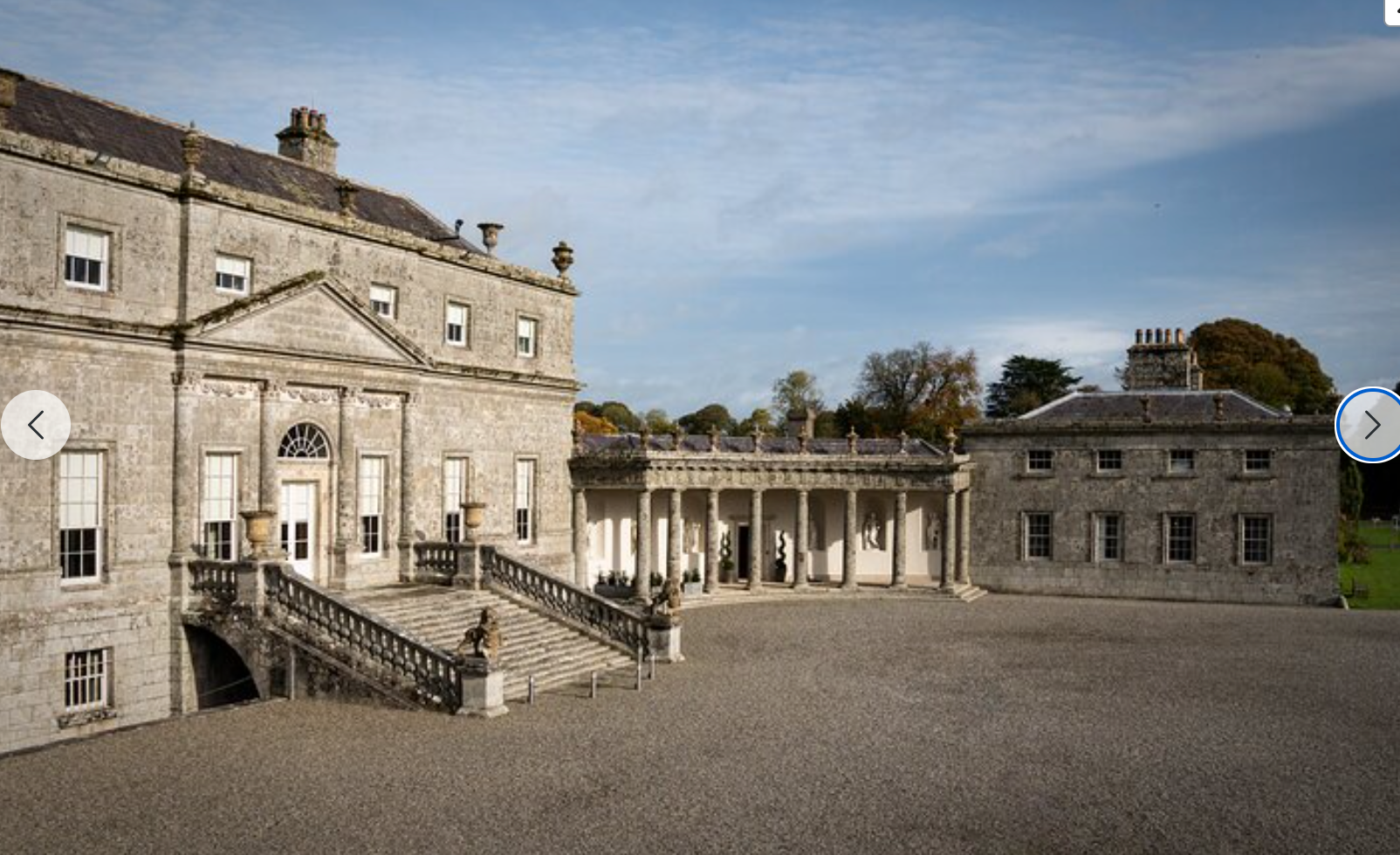
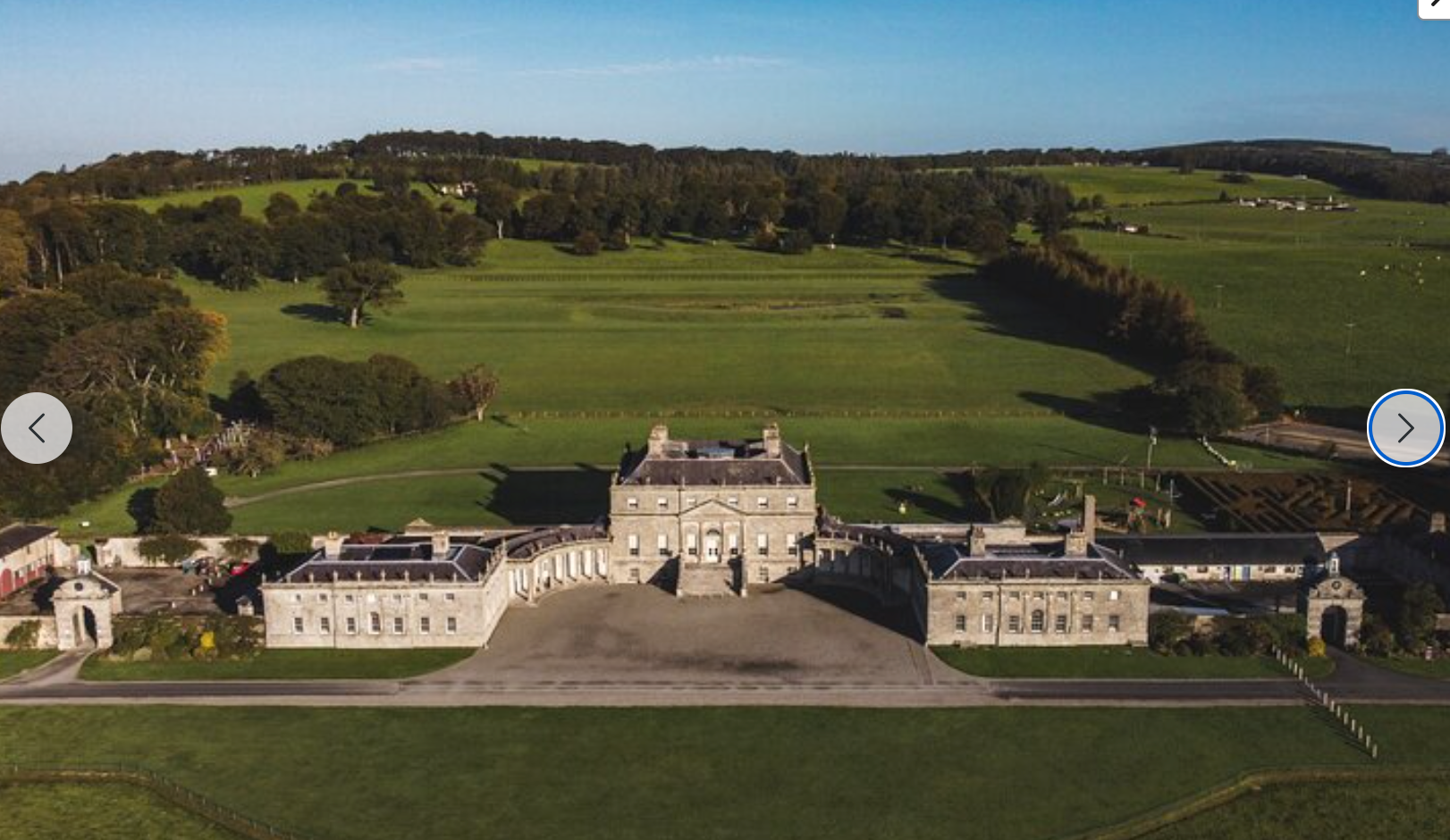
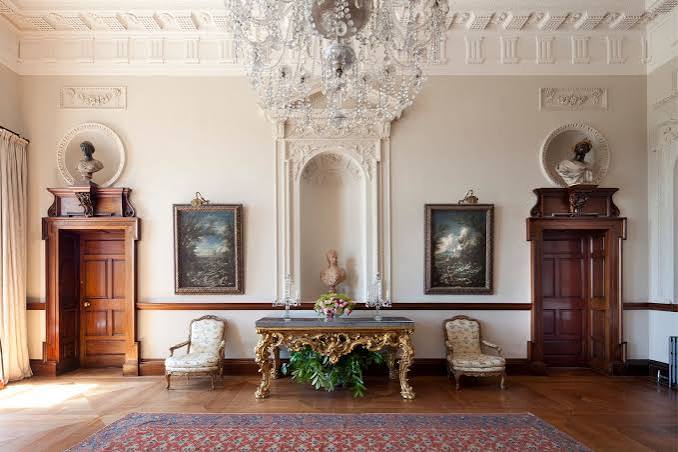
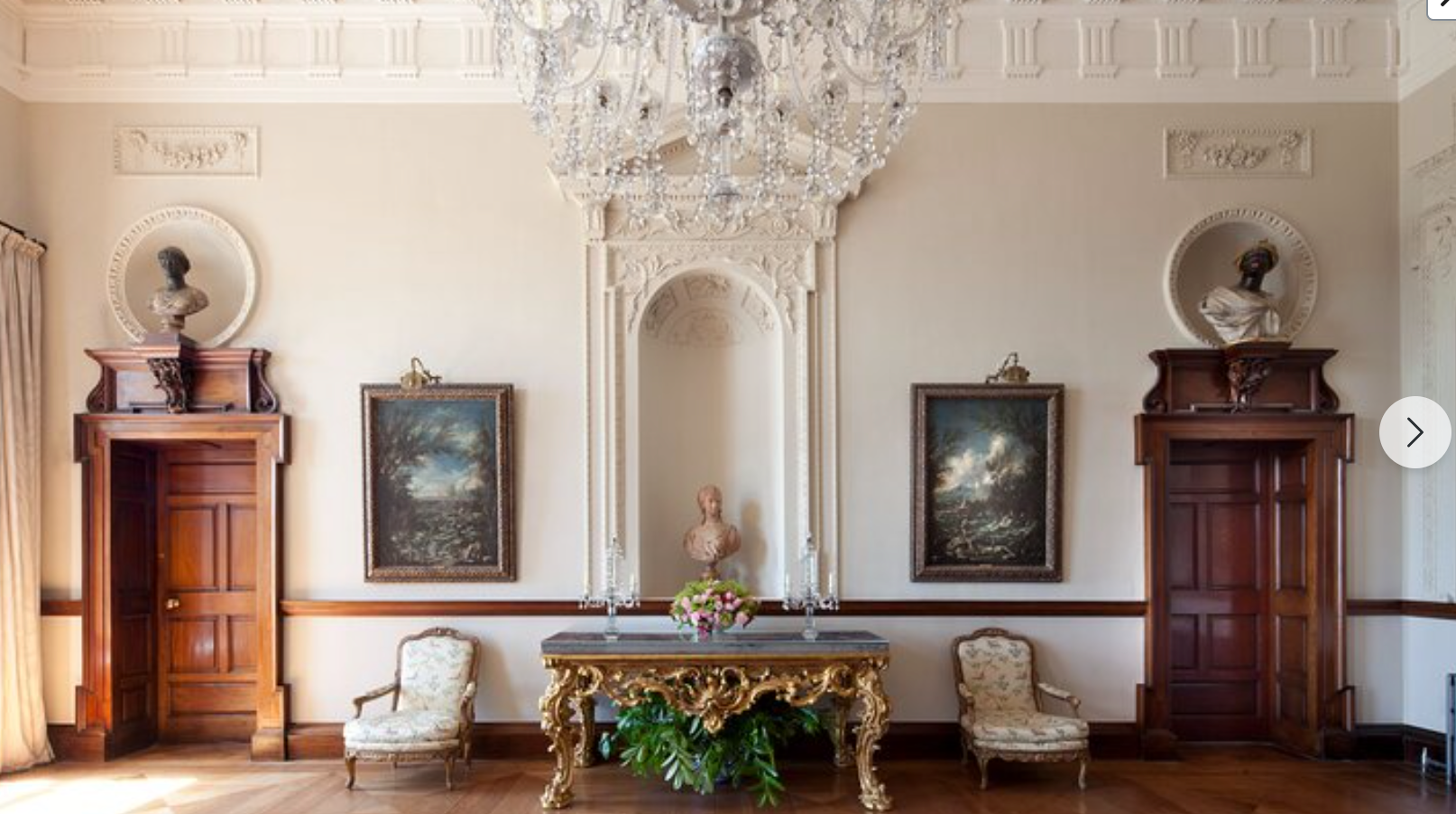
Look closely: Subject: private Georgian country house. Style: Palladian / classical. Technique: central block, wings, sash windows and formal landscape setting. Composition: horizontal balance and symmetry. Meaning/Context: displays elite status, landownership and refined Georgian taste.
Russborough House is useful for comparing private country houses with public civic buildings. Its Palladian symmetry, central block, wings and landscape setting show how Georgian architecture communicated wealth, order, taste and control over land.
- Original function: country residence.
- Type: private.
- Key features: Palladian symmetry, central block, wings, formal landscape.
Casino at Marino
Culture / patronage note: Georgian buildings and interiors often depended on patrons, architects, builders and craftspeople working together. Even when no single artist is named, the design reflects classical taste, social status and urban planning. These works are useful for discussing public identity, private wealth, proportion and refinement.
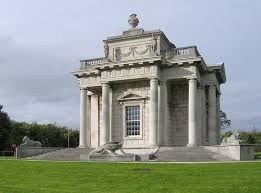
Look closely: Subject: small Georgian architectural jewel. Style: Neo-classical and Palladian. Technique: precise stone design with hidden planning. Composition: compact exterior conceals complex interior. Meaning/Context: shows taste, illusion, classical learning and elite leisure culture.
A compact neoclassical building designed to appear simple while hiding complex planning. It is useful for Doric, Ionic and Corinthian references, proportion, illusion and the Georgian interest in classical design and private leisure.
- Original function: private garden / pleasure house for the Earl of Charlemont.
- Type: private.
- Key idea: classical illusion and elite leisure culture.
Georgian Townhouse and Fanlight
Culture / patronage note: Georgian buildings and interiors often depended on patrons, architects, builders and craftspeople working together. Even when no single artist is named, the design reflects classical taste, social status and urban planning. These works are useful for discussing public identity, private wealth, proportion and refinement.
Georgian houses are defined by strict symmetry, proportion and balanced rectangular forms. Built mainly in brick or stucco, they use repeated sash windows, central doorways, fanlights, granite steps, restrained classical detail and orderly façades to create a calm, elegant image of urban status.
- Exterior: symmetrical façade, centred doorway, red brick or stucco finish, sash windows, fanlight, granite steps, basement level, simple roofline and chimneys.
- Interior: central hallway, staircase, balanced room layout, high ceilings, stucco plaster, ceiling medallions, plaster mouldings and refined joinery.
- Meaning: the townhouse turns domestic architecture into a display of order, class, taste, privacy and Georgian urban refinement.
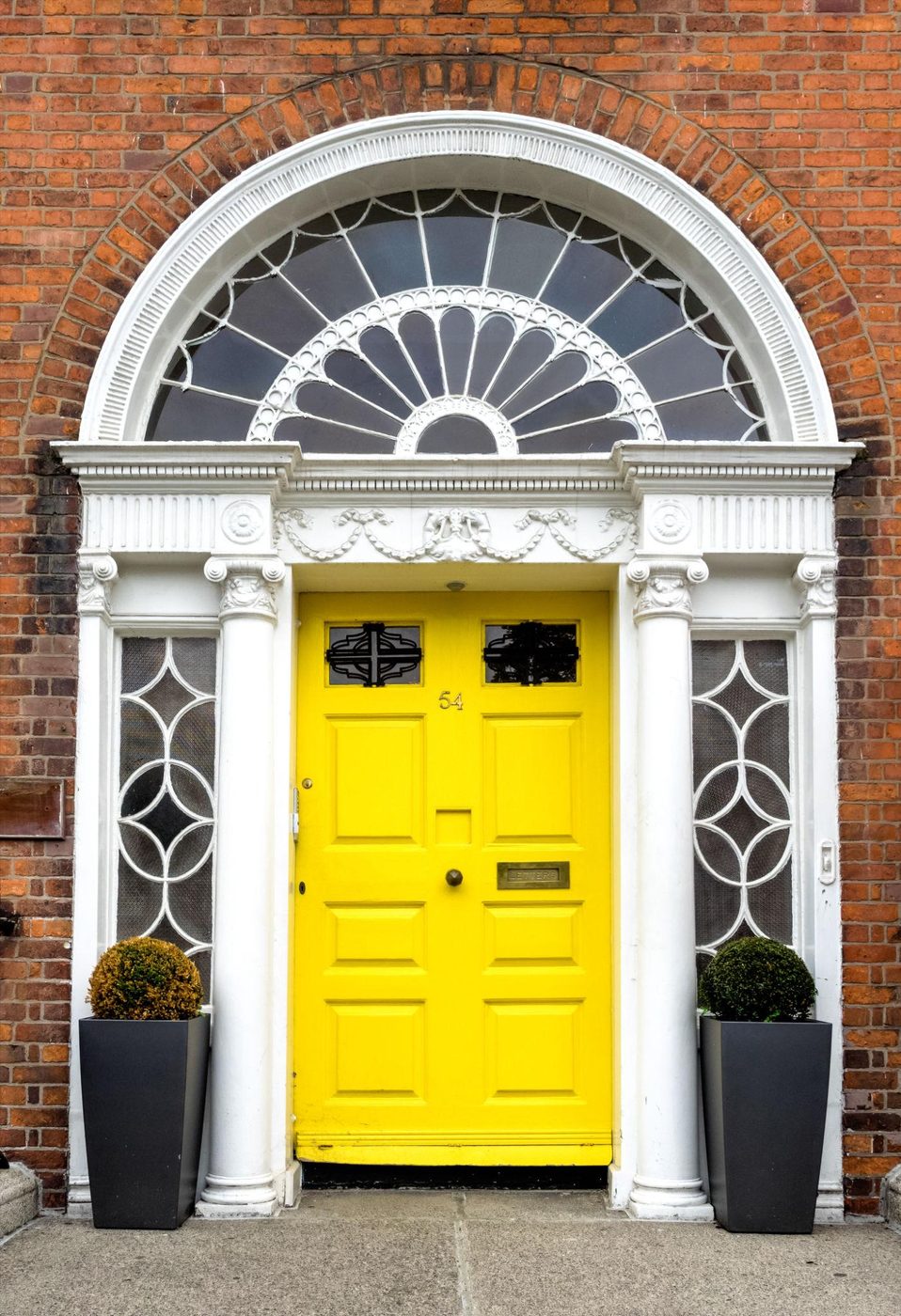
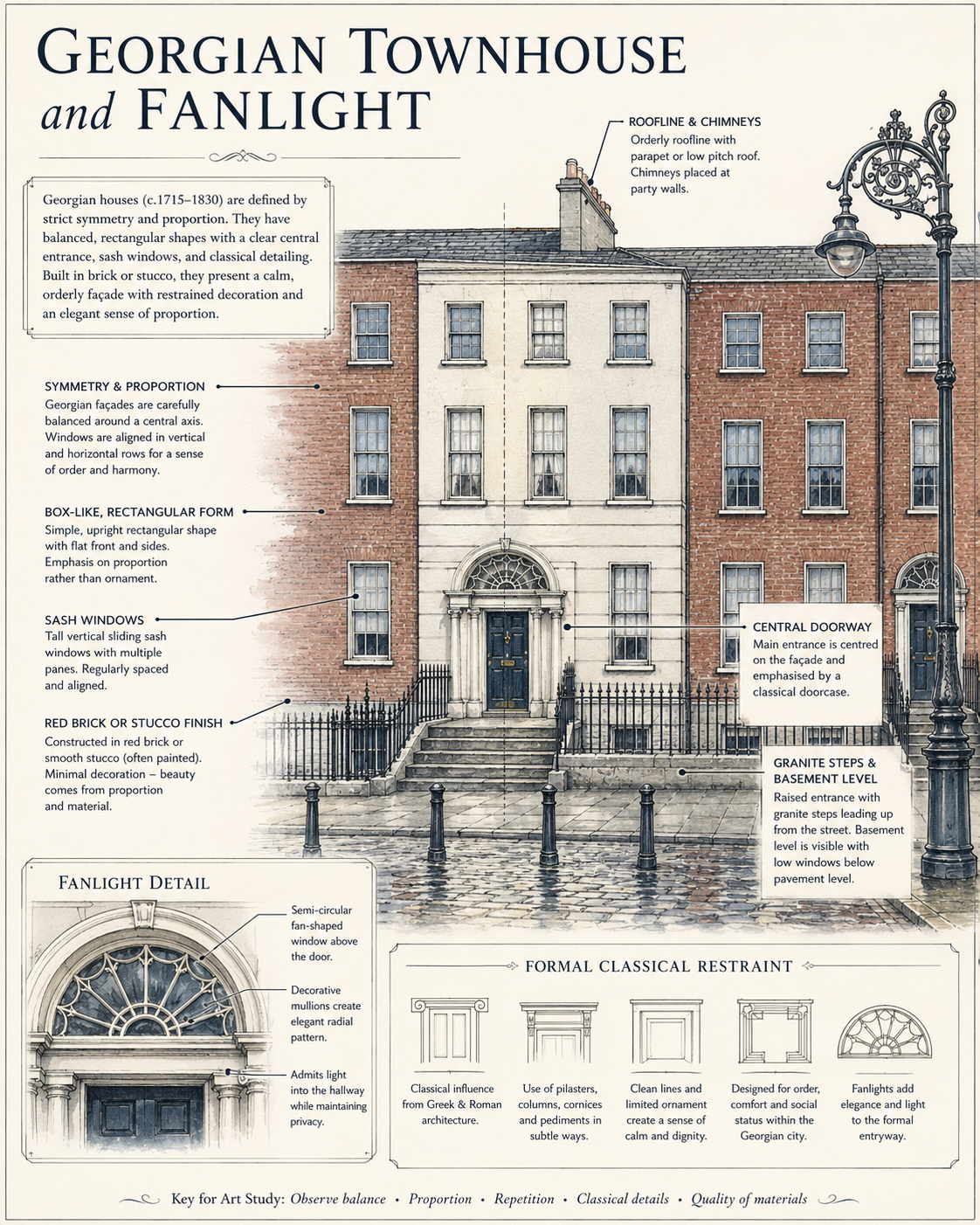
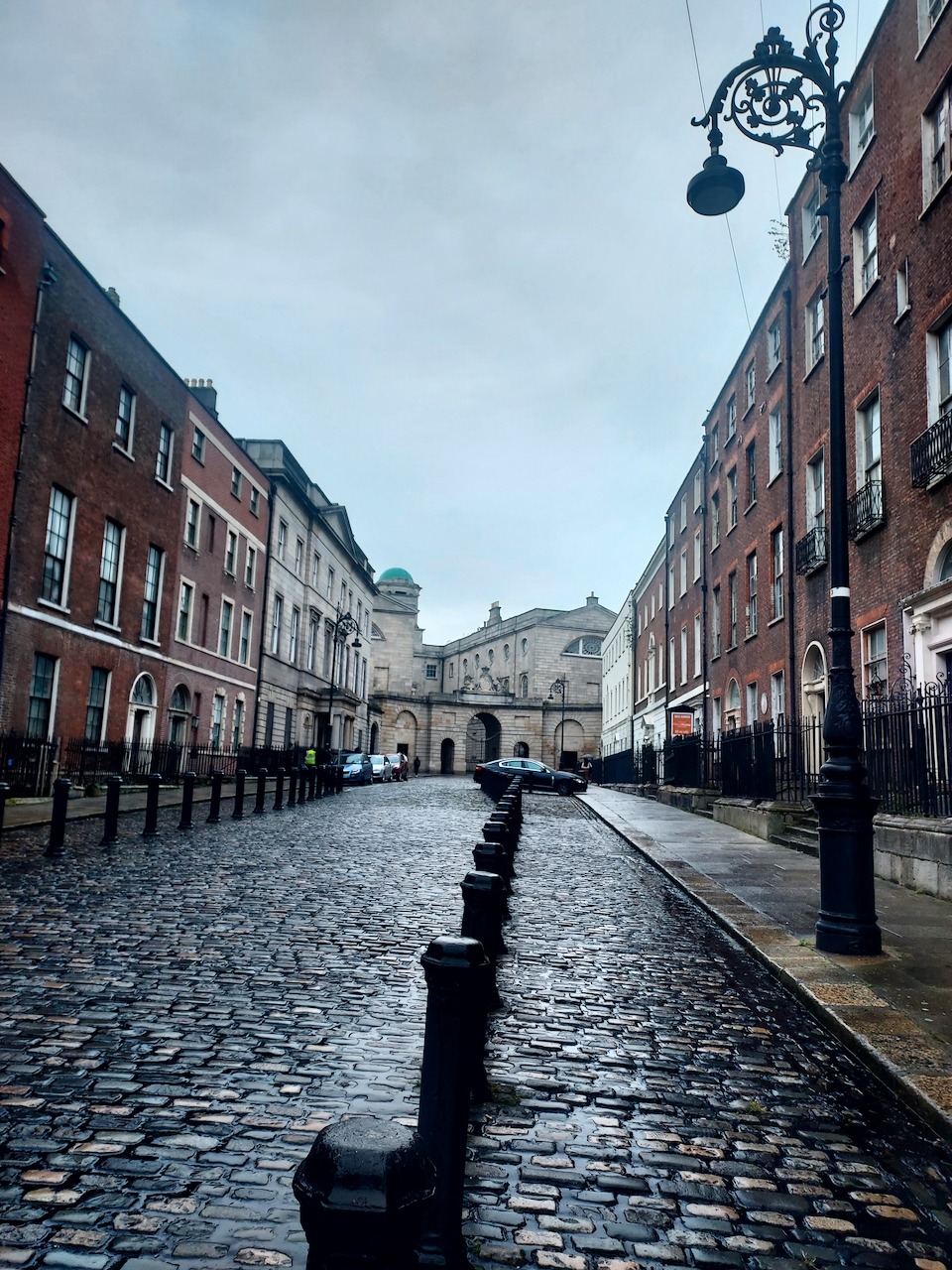
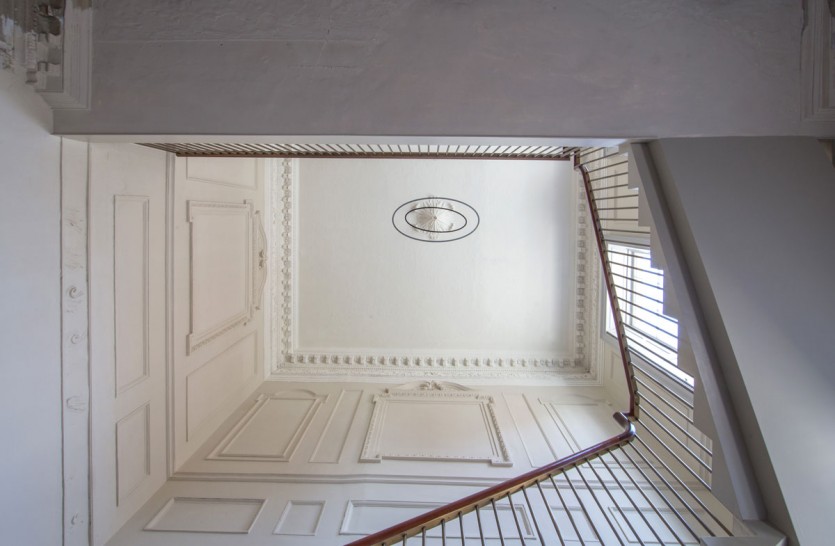
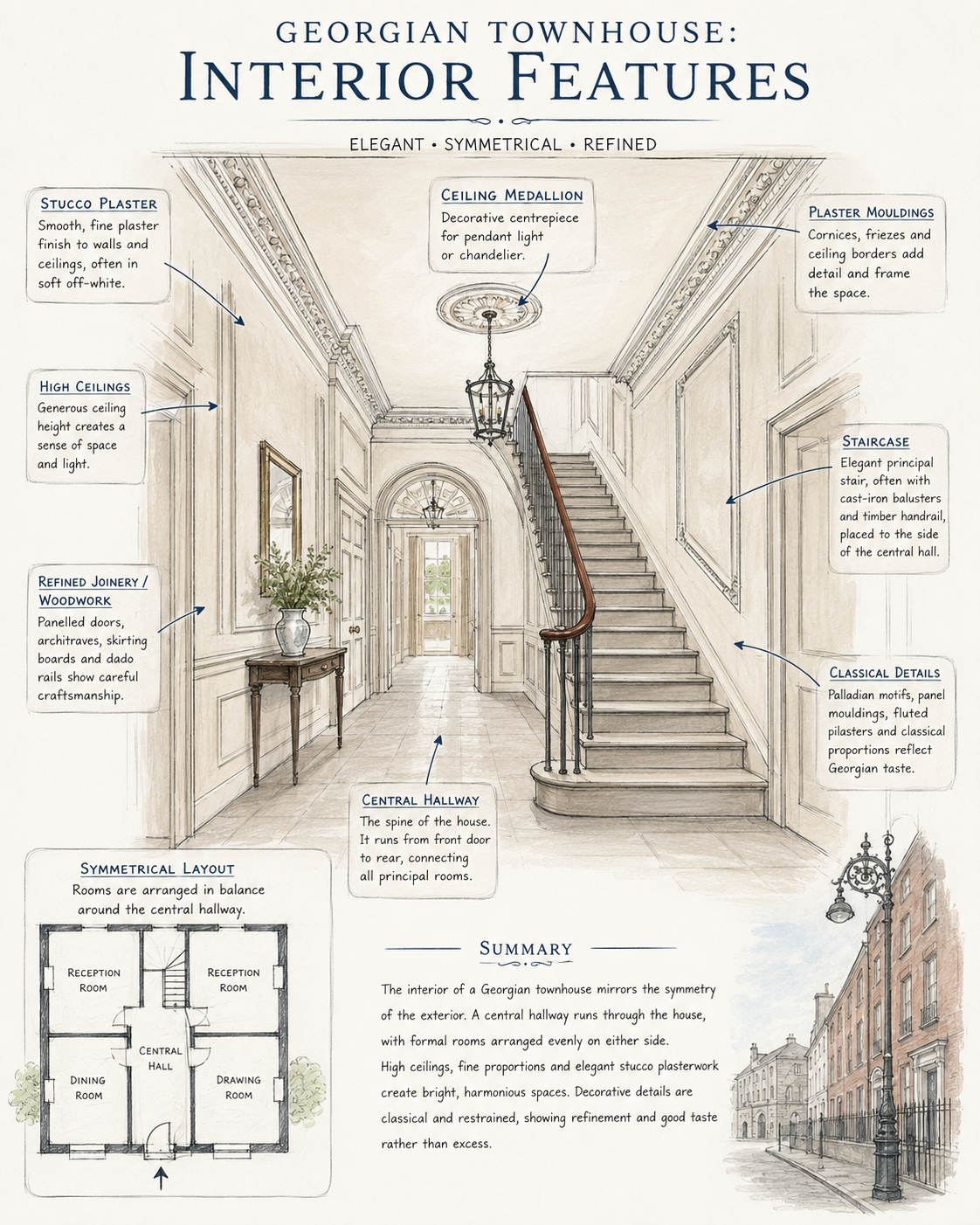
Look closely: Subject: Georgian domestic architecture. Style: symmetrical, classical and restrained. Technique: brick/stucco façade, sash windows and fanlight. Composition: balanced vertical bays around a central doorway. Meaning/Context: communicates status, urban order and refined taste.
The Georgian townhouse combines architecture and design into one controlled visual system. Exterior symmetry, repeated windows and the fanlight create order and identity, while interiors use central planning, high ceilings and stucco plaster to show refinement, comfort and classical taste.
- Original function: urban residence for wealthy families.
- Type: private domestic architecture within planned streets and squares.
- Key idea: repeated terraces create social order and visual unity.
Dublin Urban Planning
Wide Streets Commission — Dublin Urban Planning
Context note: Founded in 1757, the Wide Streets Commission modernised Dublin by cutting new routes through the medieval street pattern and promoting broader, straighter, more hygienic streets.
Technique • Meaning • Process • Idea: Urban planning became a form of design. Axial vistas, wide streets, squares and uniform terraces expressed Enlightenment order, civic control, social hierarchy and Georgian taste.
- Planning focus: wider streets, straighter movement, better light and improved hygiene.
- Key squares: Parnell, Mountjoy, Merrion, Fitzwilliam and St Stephen’s Green.
- Visual language: red brick, repeated bays, sash windows, fanlights, granite steps and balanced proportions.
Interiors, Decorative Arts and Portraiture
Michael Stapleton — Decorative Plasterwork
Key artist note: Michael Stapleton was a leading Irish stuccodore, or decorative plasterworker. His stucco plaster ceilings and walls used swags, floral motifs, classical figures and ceiling medallions to turn interiors into displays of taste, wealth and craft skill.
Look closely: Subject: Georgian interior ornament. Style: elegant, classical and refined. Technique: modelled stucco plasterwork. Composition: repeated borders, medallions and delicate relief create rhythm. Meaning/Context: shows luxury interiors, craft skill and classical taste in Dublin houses.
Stapleton’s plasterwork transformed interiors into displays of taste, wealth and craftsmanship. Swags, medallions, classical motifs and delicate relief created elegance overhead and on walls. The process required modelling, casting and refined hand-finishing. Its innovation lies in making surface decoration architectural, turning rooms into immersive environments of Georgian refinement.
Thomas Chippendale — Georgian Furniture
Key artist note: Thomas Chippendale was an influential cabinetmaker and furniture designer whose published pattern books spread fashionable design ideas across Britain and Ireland. His work combined function, comfort and ornament. He is useful for discussing taste, craftsmanship, global materials such as mahogany and the design of elite domestic interiors.
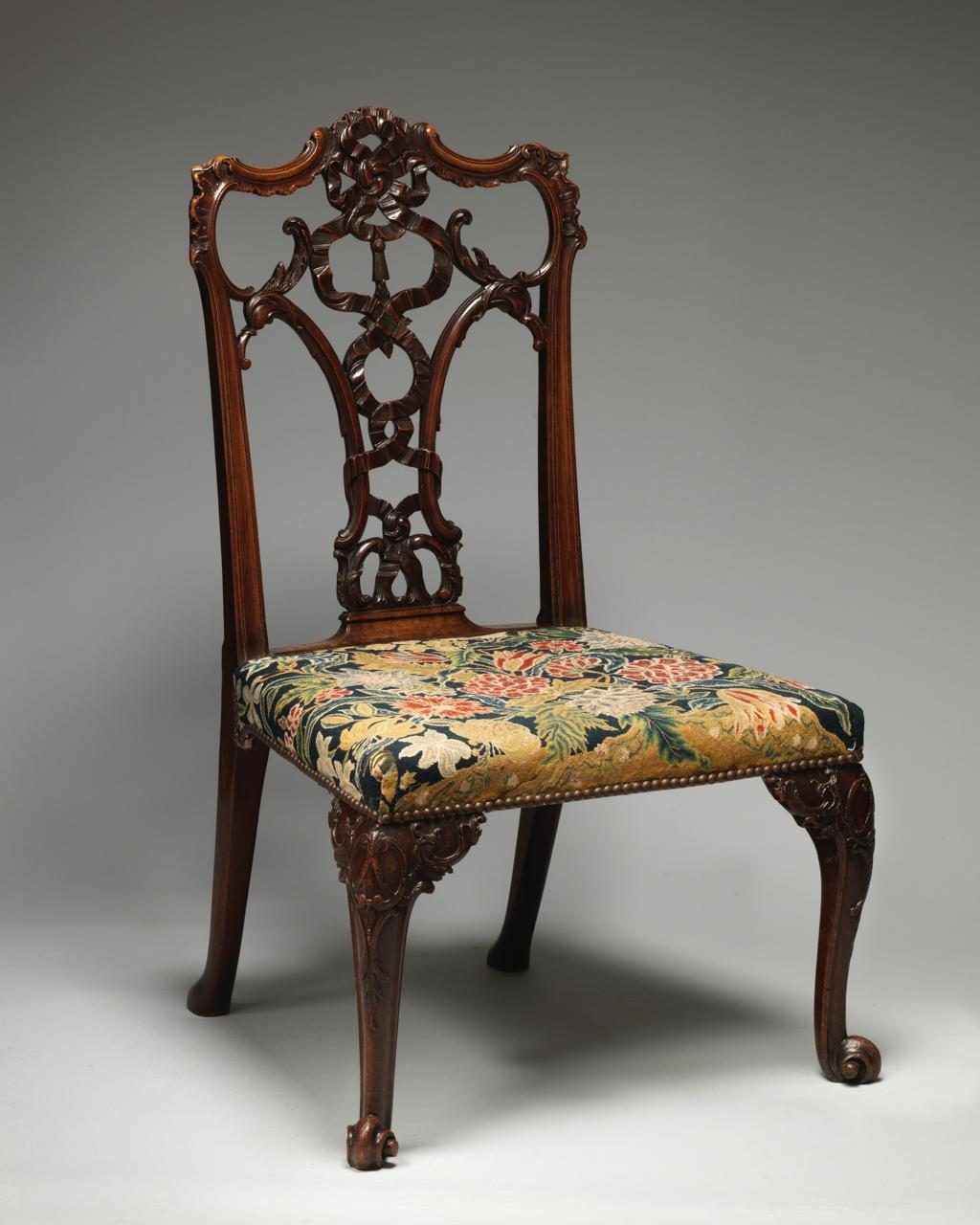
Look closely: Chippendale’s chair shows Georgian design through elegant form, carved decoration and skilled craftsmanship. It links furniture, status, taste and interior design.
Chippendale’s furniture combines function, luxury and design theory. Mahogany, carving, upholstery and elegant proportions created objects of status and comfort. His pattern books spread design ideas widely. The furniture’s curves, ornament and craftsmanship reflect taste, class and global trade, shaping how domestic interiors communicated identity and refinement.
Hugh Douglas Hamilton — Portrait Painting
Key artist note: Hugh Douglas Hamilton was an Irish portrait artist known especially for pastel portraits. His work captured social status, personality and fashionable Georgian identity. He is useful for discussing portraiture, likeness, costume, pose and how art helped elite sitters present refinement and self-image.
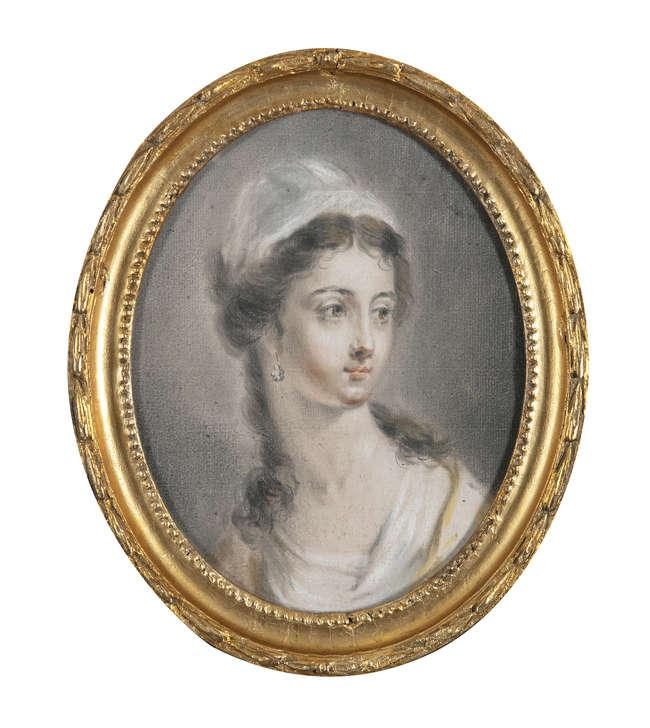
Look closely: Hamilton’s work reflects Georgian taste for refinement, classical subject matter and delicate finish. Use it for portraiture, drawing skill and elite cultural values.
Hamilton’s portraits captured identity, status and personality through pastel and paint. Careful observation, soft colour and controlled pose created intimacy and elegance. His work reflects Georgian society’s interest in self-image and refinement. Composition, costume and expression communicate class, while the viewer encounters both likeness and social performance.
Legacy / influence: Georgian portraiture influenced later Irish painting by developing traditions of likeness, status display and psychological character. It shaped how artists represented public figures, patrons and national identity.
9. Important Terms
| Term | Meaning |
|---|---|
| Palladian | Style inspired by Andrea Palladio |
| Neoclassical | Inspired by Ancient Greece and Rome |
| Pediment | Triangular top section above columns |
| Fanlight | Semi-circular window over door |
| Corinthian Column | Decorative classical column style |
| Stucco | Decorative plaster |
| Patronage | Financial support of artists |
| Grand Tour | Educational journey around Europe |
10. Possible Exam Topics
Possible areas to prepare:
- Georgian architecture in Dublin.
- Classical influence on Irish architecture.
- Urban planning and design.
- Decorative plasterwork and interiors.
- Balance and symmetry in Georgian design.
- The influence of the Grand Tour on Irish art and architecture.
Legacy / influence: Georgian art influenced later Irish architecture through its planning, streetscapes, doorways, interiors and classical language. It remains central to Dublin’s identity and shaped later conservation, urban design and heritage debates.
Late Medieval Architecture and Art in Ireland
Context / main ideas: Late Medieval Irish art and architecture reflect religion, patronage, defence and local craftsmanship. Churches, castles, tomb sculpture and carved details show how European Gothic ideas mixed with Irish needs and materials. The main change is toward more elaborate stone building and memorial sculpture.
Study structure for this section
Students should understand and be able to describe and discuss the context that informed and led to the chosen period/movement using the six elements listed below.
Students should understand and be able to describe and explain the period/movement using the six elements listed below.
The framework is structured around six elements:
Artist, Artwork and Artefact Analysis
Cormac’s Chapel, Cashel
Culture / patronage note: These Irish medieval buildings and sculptures were made by teams of masons, patrons and craftspeople whose names are usually unknown. Their work reflects religion, defence, settlement and status. Architecture and carving are useful for discussing materials, function, community identity and changing social conditions.
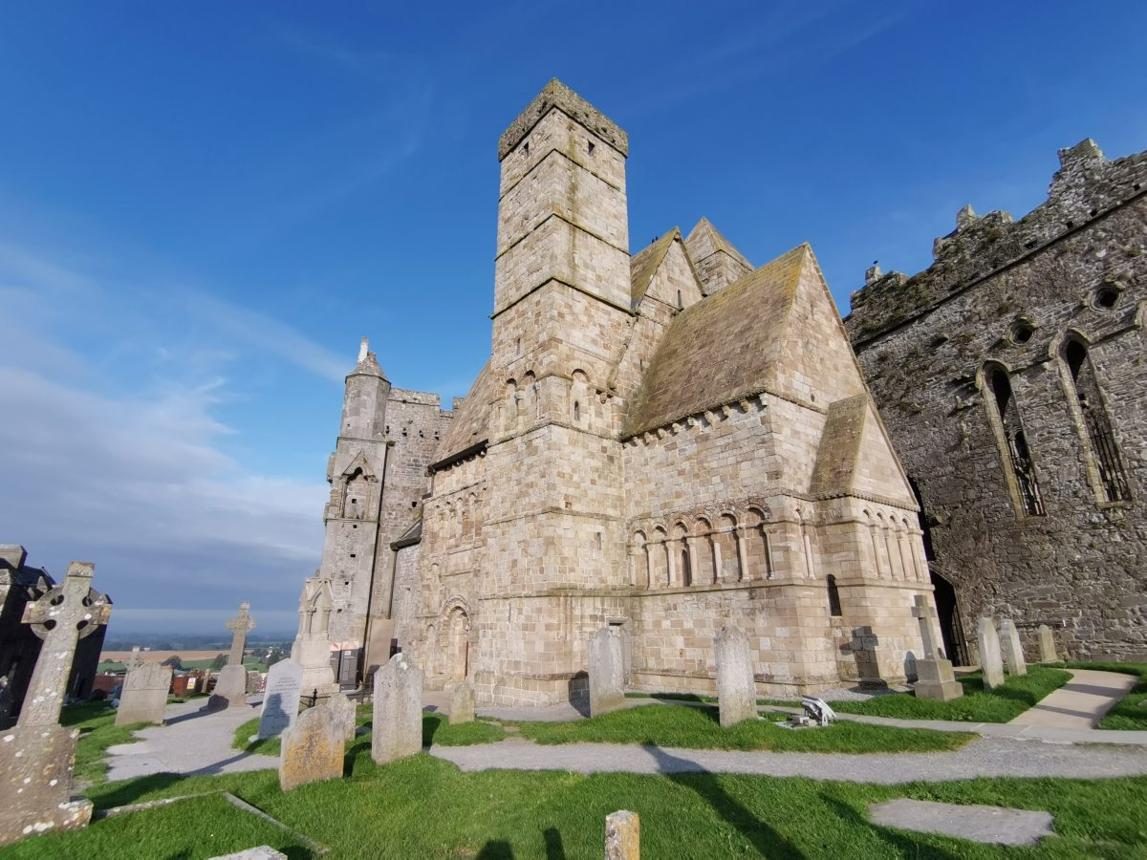
Look closely: Subject: Irish Romanesque chapel. Style: solid, rounded and sculptural. Technique: stone construction, arches and carved details. Composition: compact mass and clear volumes create strength. Meaning/Context: links Irish church architecture with European Romanesque forms.
Cormac’s Chapel combines Romanesque architecture with Irish religious power. Stone vaulting, round arches and carved decoration create solidity and sacred atmosphere. Its scale and craftsmanship show royal and ecclesiastical ambition. The building’s ornament, proportions and location at Cashel communicate authority, devotion and the fusion of politics with religion.
Jerpoint Abbey
Culture / patronage note: These Irish medieval buildings and sculptures were made by teams of masons, patrons and craftspeople whose names are usually unknown. Their work reflects religion, defence, settlement and status. Architecture and carving are useful for discussing materials, function, community identity and changing social conditions.
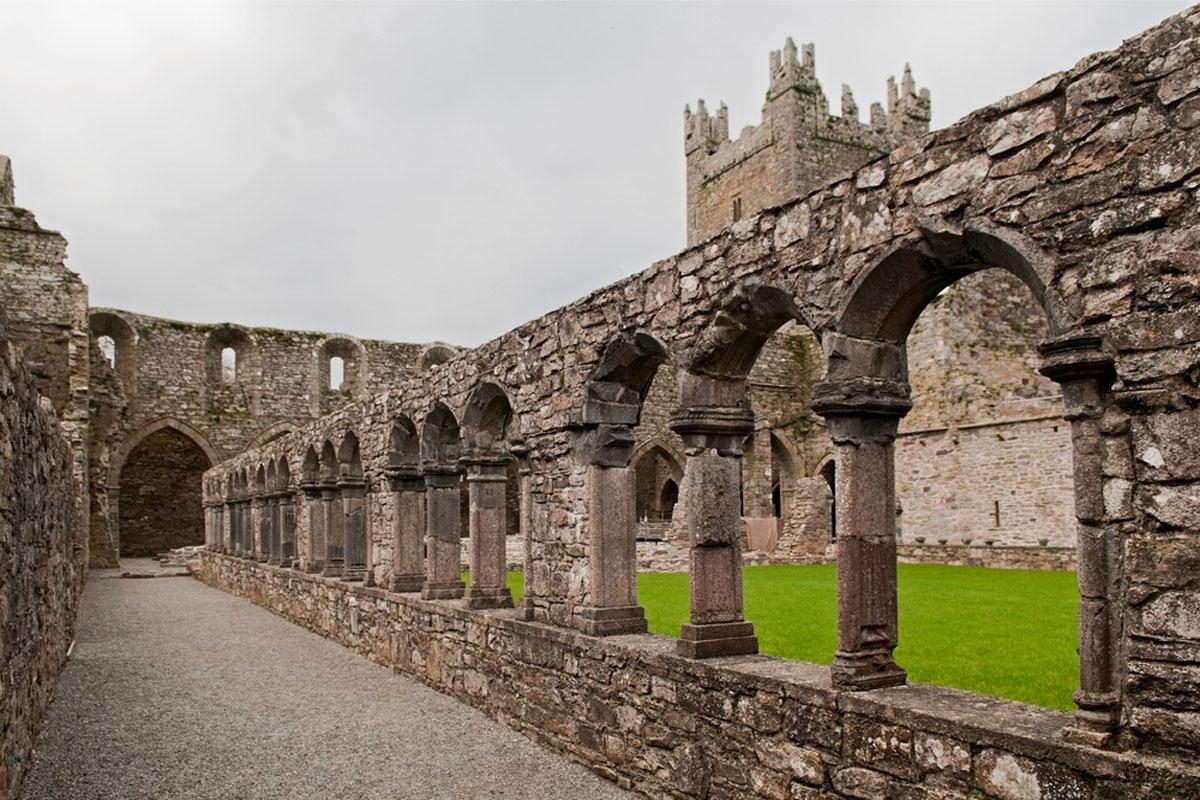
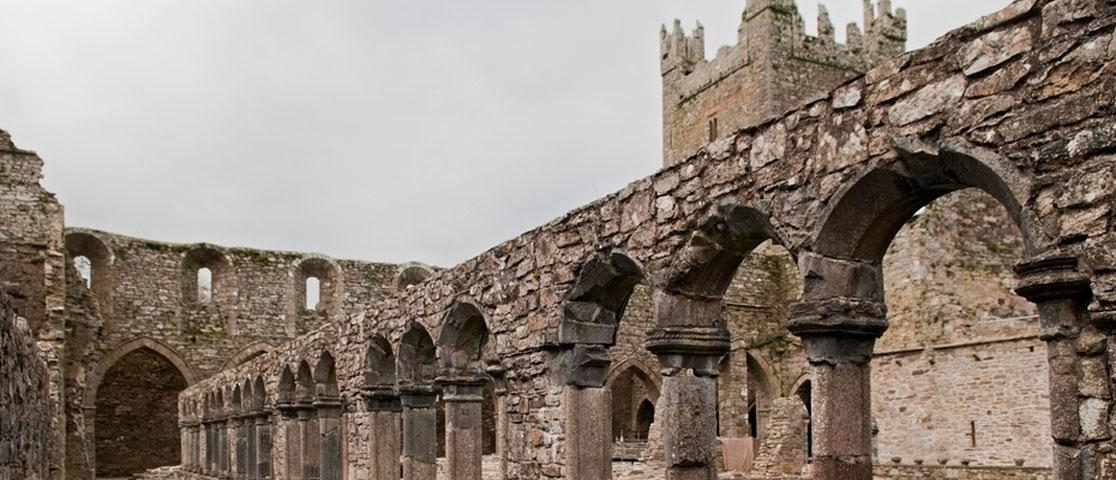
Look closely: Subject: medieval monastic sculpture and cloister. Style: Gothic/Romanesque transition with carved figures. Technique: stone carving and architectural planning. Composition: repeated arches organise space. Meaning/Context: shows religious community, craftsmanship and medieval patronage in Ireland.
Jerpoint Abbey reflects monastic life, patronage and medieval craftsmanship. Its stone arches, cloister sculpture and tomb carvings show religious order and social memory. The architecture balances simplicity with decoration. Light, rhythm and repeated forms create contemplation, while carved figures and details connect spiritual life with local identity and community.
Holycross Abbey
Culture / patronage note: These Irish medieval buildings and sculptures were made by teams of masons, patrons and craftspeople whose names are usually unknown. Their work reflects religion, defence, settlement and status. Architecture and carving are useful for discussing materials, function, community identity and changing social conditions.
Look closely: Subject: medieval Cistercian abbey. Style: Gothic, devotional and architectural. Technique: stone vaults, pointed arches and carved details. Composition: church spaces guide worship and movement. Meaning/Context: reflects monastic life, pilgrimage and medieval religious culture.
Holycross Abbey was designed around relic devotion, pilgrimage and sacred experience. Stone vaults, pointed arches and decorative details create solemnity and movement. Its architecture guides the viewer through ritual space. The building’s meaning lies in faith, relic culture and community worship, making architecture a physical expression of belief.
St Canice’s Cathedral, Kilkenny
Culture / patronage note: These Irish medieval buildings and sculptures were made by teams of masons, patrons and craftspeople whose names are usually unknown. Their work reflects religion, defence, settlement and status. Architecture and carving are useful for discussing materials, function, community identity and changing social conditions.
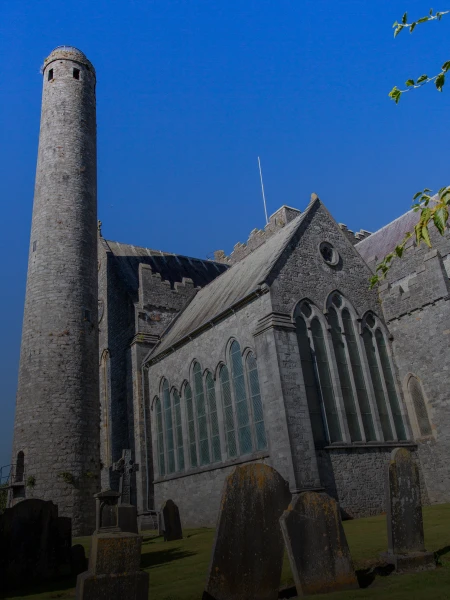
Look closely: Subject: medieval cathedral architecture. Style: Gothic with vertical emphasis. Technique: stone construction, pointed arches and windows. Composition: nave, tower and openings create sacred order. Meaning/Context: shows church authority, urban identity and medieval craftsmanship.
St Canice’s Cathedral uses Gothic structure to express religious authority and civic pride. Pointed arches, tall windows and stone carving create vertical movement and sacred atmosphere. Its craftsmanship reflects medieval skill and long-term building processes. The cathedral’s scale, light and rhythm encourage awe, prayer and awareness of spiritual hierarchy.
Trim Castle
Culture / patronage note: These Irish medieval buildings and sculptures were made by teams of masons, patrons and craftspeople whose names are usually unknown. Their work reflects religion, defence, settlement and status. Architecture and carving are useful for discussing materials, function, community identity and changing social conditions.
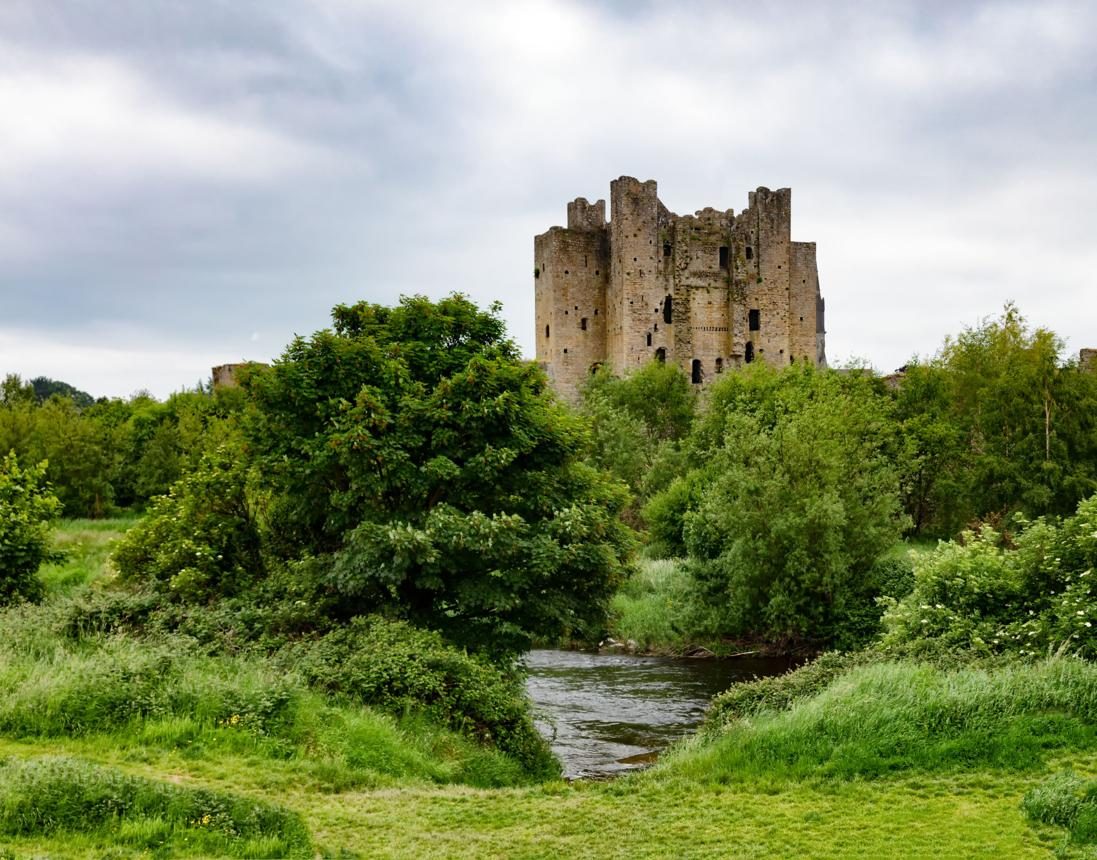
Look closely: Subject: Norman defensive architecture. Style: fortress-like and functional. Technique: stone keep, walls and towers. Composition: mass, height and enclosure communicate power. Meaning/Context: shows conquest, control and feudal authority in medieval Ireland.
Trim Castle expresses Norman military power through stone, scale and strategic planning. Its keep, walls and defensive layout show control of land and people. The architecture is functional but visually commanding. Mass, height, symmetry and enclosure create intimidation, making the viewer aware of authority, conflict and medieval conquest.
Tower Houses
Culture / patronage note: These Irish medieval buildings and sculptures were made by teams of masons, patrons and craftspeople whose names are usually unknown. Their work reflects religion, defence, settlement and status. Architecture and carving are useful for discussing materials, function, community identity and changing social conditions.
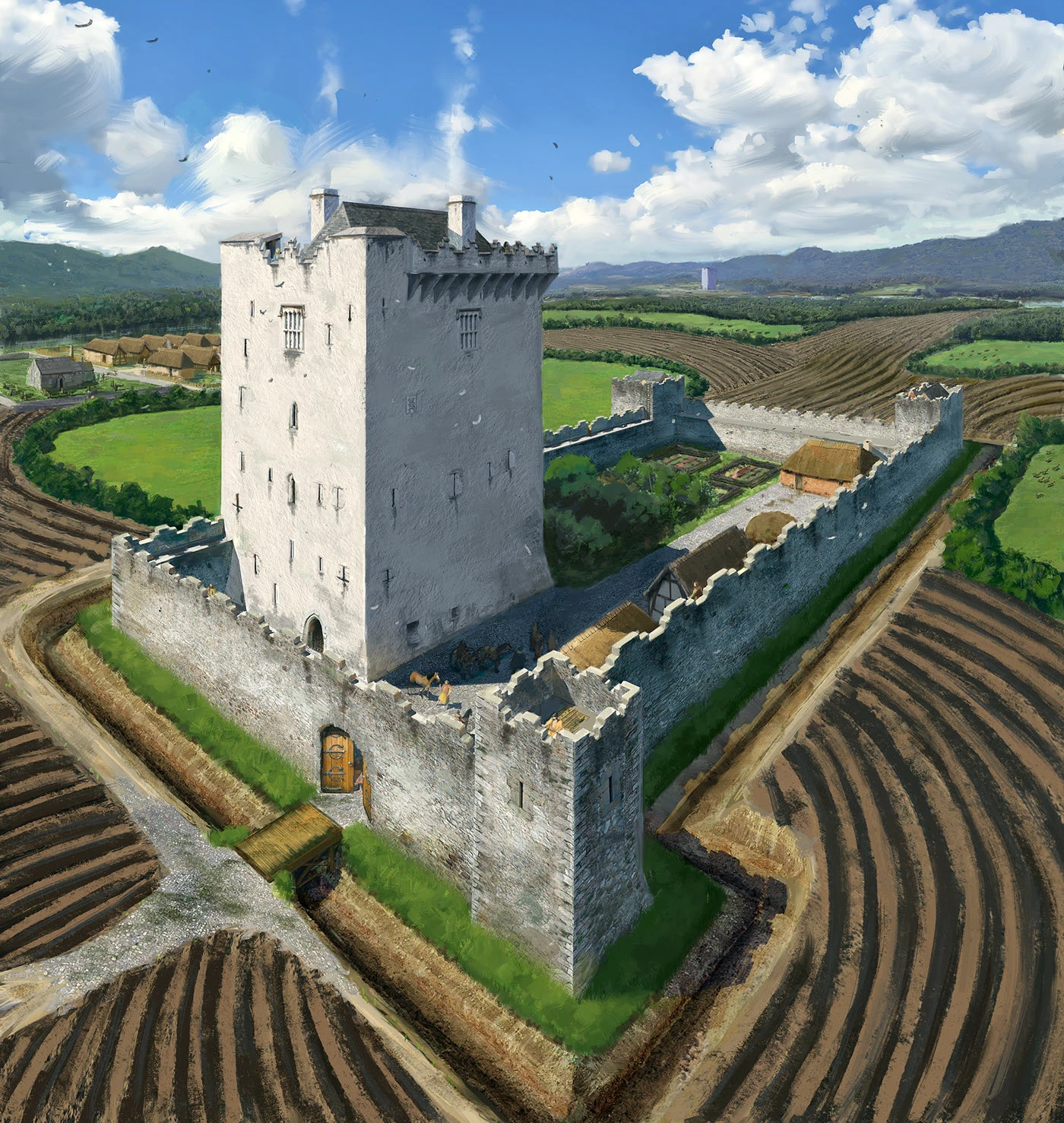
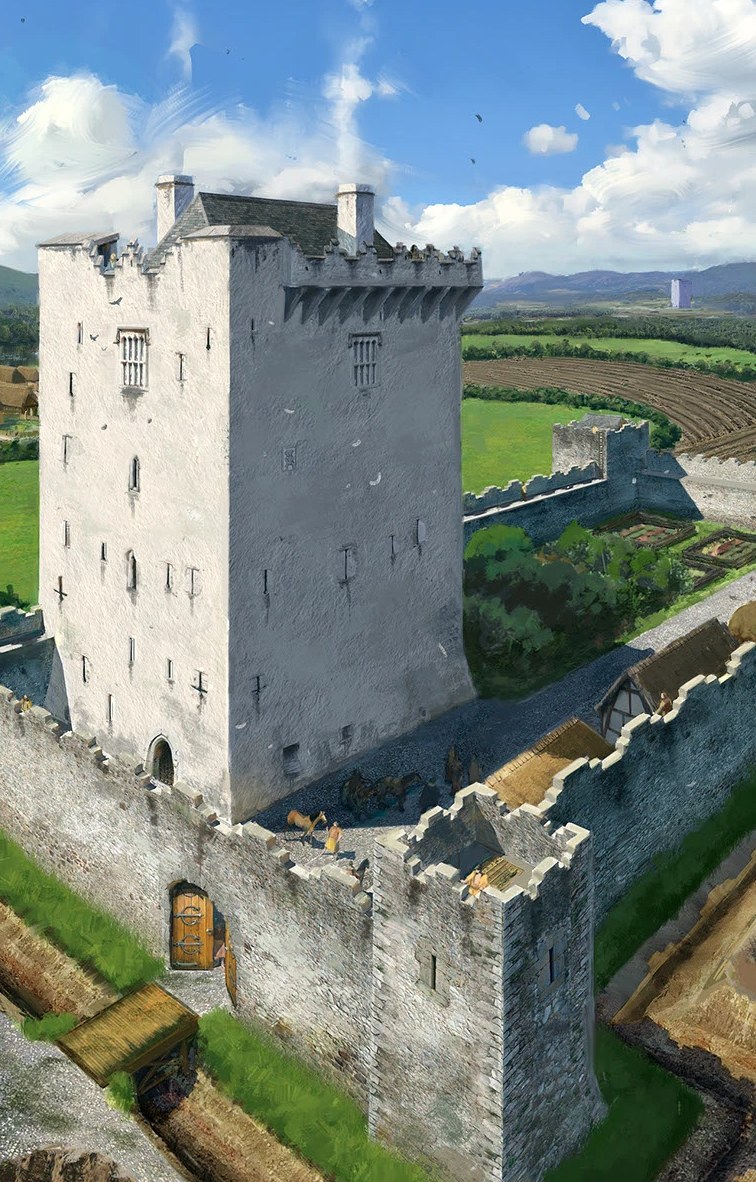
Look closely: Subject: late medieval fortified residence. Style: vertical, defensive and practical. Technique: thick stone walls, small windows and battlements. Composition: compact tower form controls space. Meaning/Context: shows local power, protection and social status in Gaelic and Anglo-Irish Ireland.
Irish tower houses combine defence, status and domestic life. Built in stone, their vertical form, narrow windows and thick walls communicate security and power. They show adaptation to local conflict and landholding. Their compact scale, height and strong silhouettes make social hierarchy visible within the medieval Irish landscape.
Late Medieval Tomb Sculpture
Culture / patronage note: These Irish medieval buildings and sculptures were made by teams of masons, patrons and craftspeople whose names are usually unknown. Their work reflects religion, defence, settlement and status. Architecture and carving are useful for discussing materials, function, community identity and changing social conditions.
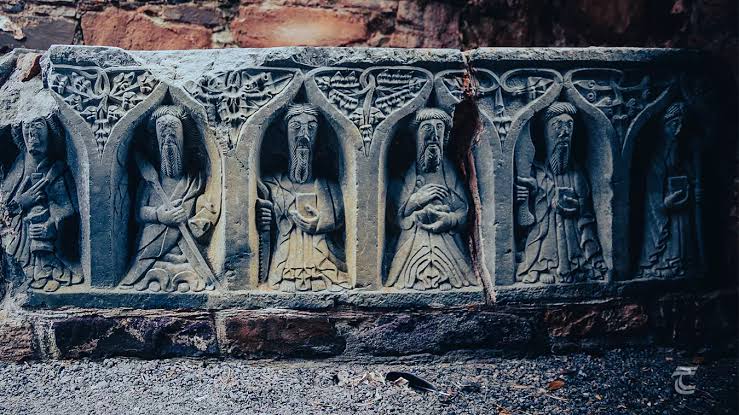
Look closely: Subject: Late medieval tomb sculpture at Jerpoint Abbey showing carved saints/figures in stone. Style: Gothic-influenced, devotional and linear. Technique: shallow relief carving with repeated arches and drapery. Composition: figures sit in niches, creating rhythm and order. Meaning/Context: commemorates faith, status and prayer in medieval Ireland.
Late medieval tomb sculpture preserved memory, identity and status through carved stone. Figures, armour, drapery and inscriptions presented the dead as noble, pious or powerful. The process required skilled carving and symbolic design. These tombs shaped how viewers remembered individuals, blending religious hope with social display.
Legacy / influence: Late Medieval Irish art influenced later heritage through its tomb sculpture, carved stone, church ruins and local craftsmanship. It provides an important bridge between medieval faith culture and later Irish historical identity.
Irish Art and Modernism
Context / main ideas: Irish Art and Modernism shows how Irish artists responded to national identity, landscape, independence, war and modern European styles. The main ideas are place, politics, memory and representation. Change is seen as artists moved from academic realism toward modern composition, colour and symbolism.
Study structure for this section
Students should understand and be able to describe and discuss the context that informed and led to the chosen period/movement using the six elements listed below.
Students should understand and be able to describe and explain the period/movement using the six elements listed below.
The framework is structured around six elements:
Artist, Artwork and Artefact Analysis
Paul Henry — Western Irish Landscapes
Key artist note: Paul Henry was an Irish artist best known for simplified western landscapes that helped shape a visual idea of rural Ireland. His work uses broad forms, calm colour and atmospheric skies. He is useful for discussing national identity, place, memory and landscape as cultural image.
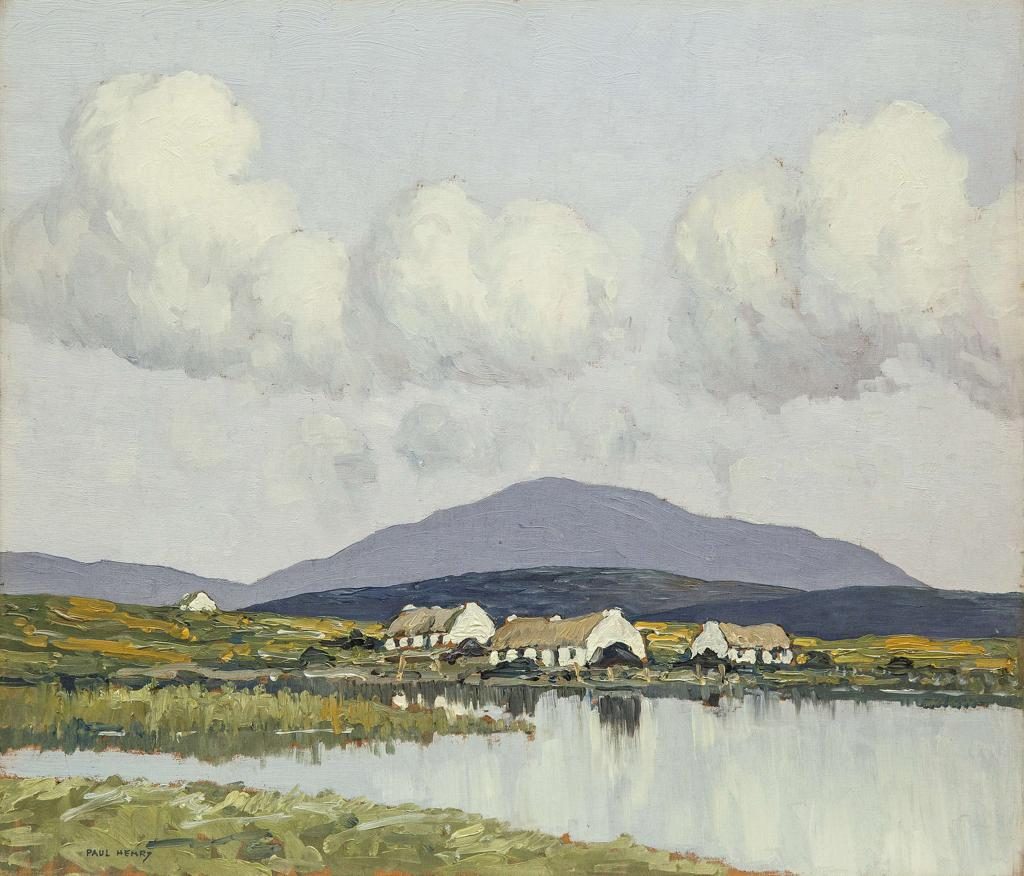
Look closely: Subject: west of Ireland landscape. Style: simplified, atmospheric and modern Irish. Technique: oil paint with broad shapes and soft colour. Composition: sky, mountains and cottages create calm balance. Meaning/Context: shaped an idealised national image of rural Ireland.
Paul Henry used simplified forms, soft light and broad colour to construct an image of the west of Ireland. His landscapes reflect place, identity and national imagination. The process involved observation and simplification rather than detail. Low horizons, heavy clouds and calm rhythm create atmosphere, memory and belonging.
Jack B. Yeats — The Liffey Swim
Key artist note: Jack B. Yeats was one of Ireland’s most important modern painters. His work moved from illustration toward expressive colour and energetic brushwork. He often painted sport, theatre, crowds and Irish history. He is useful for discussing movement, memory, nationalism and modern Irish identity.
Look closely: Subject: public sporting life in Dublin. Style: expressive, colourful and modern. Technique: loose brushwork and energetic paint. Composition: crowd and swimmers create movement. Meaning/Context: celebrates modern urban Ireland, spectatorship and national identity.
Yeats captures modern Dublin through movement, colour and crowd energy. His loose brushwork and compressed composition turn a sporting event into a social scene. The painting reflects urban identity, spectacle and everyday life. Its vigorous rhythm, bright colour and shifting viewpoints make viewers feel part of the crowd.
Jack B. Yeats — Men of Destiny
Key artist note: Jack B. Yeats was one of Ireland’s most important modern painters. His work moved from illustration toward expressive colour and energetic brushwork. He often painted sport, theatre, crowds and Irish history. He is useful for discussing movement, memory, nationalism and modern Irish identity.
Look closely: Subject: symbolic Irish figures and national struggle. Style: expressive and poetic. Technique: loose paint, strong colour and gesture. Composition: figures move through an emotional landscape. Meaning/Context: reflects Irish identity, memory and political aspiration.
Men of Destiny reflects Irish history, struggle and symbolic nationalism. Yeats uses expressive brushwork, dramatic colour and simplified figures to suggest emotional intensity rather than literal detail. The painting’s meaning lies in sacrifice, memory and collective identity. Its movement and atmosphere create a powerful sense of historical urgency.
Mainie Jellett — Decoration
Key artist note: Mainie Jellett helped introduce abstract modernism to Ireland after studying Cubist ideas in Europe. Her work challenged conservative taste by emphasising structure, rhythm and spiritual order. She is useful for discussing abstraction, Irish modernism, geometric composition and the difficulty of bringing new ideas into traditional art culture.
Look closely: Subject: abstract religious/modern form. Style: Cubist-influenced Irish Modernism. Technique: simplified shapes and structured colour. Composition: interlocking forms create rhythm and balance. Meaning/Context: brought European abstraction into Irish art and challenged conservative taste.
Jellett’s Decoration introduced modern abstraction into Irish art. Influenced by Cubism, she used geometric structure, rhythm and colour to move beyond representation. The painting challenges traditional expectations by prioritising form and spiritual order. Its layered shapes and balanced composition invite viewers to think about harmony, abstraction and innovation.
Evie Hone — Stained Glass and Abstract Work
Key artist note: Evie Hone was an Irish modern artist and stained-glass designer whose work combined abstraction with religious feeling. She used colour, light and lead lines to create spiritual intensity. She is useful for discussing craft, modernism, sacred art, stained glass and the emotional power of material process.
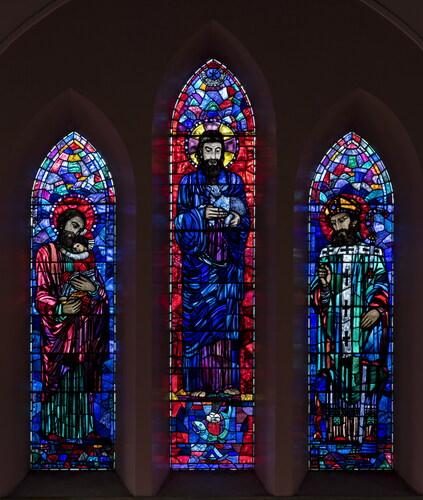
Look closely: Subject: sacred stained glass and modern abstraction. Style: luminous, simplified and spiritual. Technique: coloured glass, lead lines and design planning. Composition: shapes and light create harmony. Meaning/Context: links Irish craft, modernism and religious expression.
Hone’s work connects modern abstraction with spiritual feeling. In stained glass, colour, light and lead lines become expressive materials. Her process required design, cutting, leading and sensitivity to illumination. Abstract shapes and glowing colour create contemplation, showing how modernist experimentation could serve religious, emotional and symbolic meaning.
Louis le Brocquy — A Family and Later Head Images
Key artist note: Louis le Brocquy explored the human figure, identity and memory through painting and tapestry. His later head images suggest inner life rather than surface likeness. He is useful for discussing psychological space, Irish modernism, abstraction, portraiture and the body as a site of meaning.
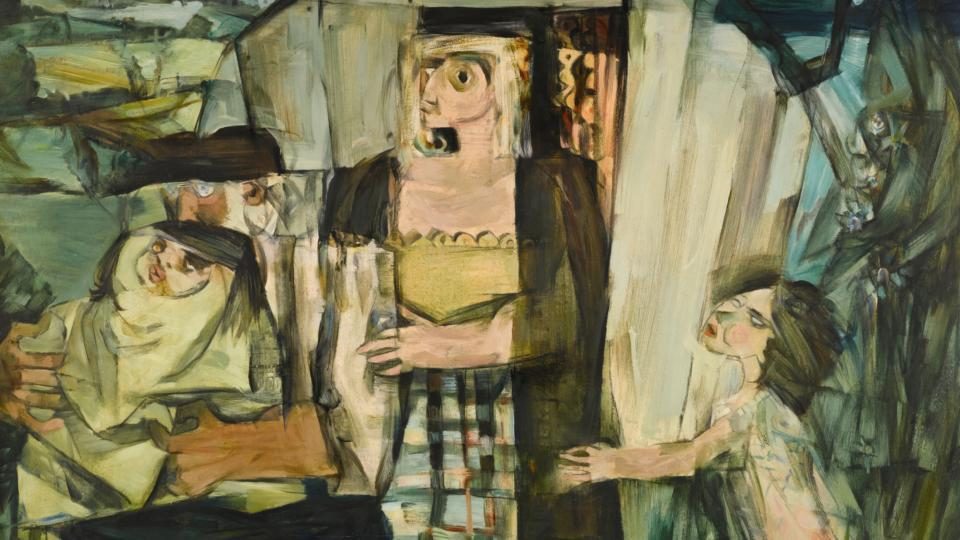
Look closely: Subject: family, identity and human presence. Style: modern, spare and psychological. Technique: paint reduced to tone, shape and gesture. Composition: figures feel isolated within open space. Meaning/Context: explores post-war uncertainty, memory and Irish modernism.
Le Brocquy explored identity, isolation and the human condition. In A Family, pale figures and empty space suggest post-war anxiety. Later head images use fragmented form and soft tonal modelling to evoke memory and consciousness. His work innovates through psychological space, making the body and face sites of meaning.
Seán Keating — Men of the South
Key artist note: Seán Keating was an Irish painter linked to national identity, independence and the west of Ireland. His work often presents strong figures, political themes and carefully structured realism. He is useful for discussing history painting, nationalism, social values and the construction of heroic Irish imagery.
Look closely: Men of the South — Keating links realism with Irish identity, political struggle and history painting. Strong figure grouping, direct poses and landscape setting communicate nationalism, tension and collective purpose.
Keating links realism with Irish identity, political struggle and history painting. Strong figure grouping, direct poses and landscape setting help communicate nationalism, tension and collective purpose.
William Orpen — The Signing of Peace in the Hall of Mirrors
Key artist note: William Orpen was an Irish artist known for portraits, war images and official commissions. His skilled draughtsmanship and access to political events made him an important witness to early twentieth-century history. He is useful for discussing portraiture, power, politics and the artist as observer.
Look closely: The Signing of Peace in the Hall of Mirrors — Orpen’s official painting uses portraiture, ceremony and grand interior space to turn diplomacy into a staged image of political power.
Orpen’s official painting is useful for portraiture, political history and the artist as witness. The formal room, arranged figures and grand setting turn diplomacy into a carefully staged image of power.
Leaving Cert Art Study Guide & Notes
Legacy / influence: Irish modern art influenced later artists by opening space for national identity, social history and personal expression within modern visual language. It helped Irish art move beyond academic tradition.
Realism • Impressionism • Post-Impressionism
Context / main ideas: These three movements show a major shift from academic tradition to modern art. Realism focused on truth and social life, Impressionism on light and modern experience, and Post-Impressionism on structure, emotion and symbolism. Together they show art moving toward modernism.
Study structure for this section
Students should understand and be able to describe and discuss the context that informed and led to the chosen period/movement using the six elements listed below.
Students should understand and be able to describe and explain the period/movement using the six elements listed below.
The framework is structured around six elements:
1. Overview Timeline
| Movement | Dates | Main Idea |
|---|---|---|
| Realism | c. 1840–1880 | Depict ordinary life truthfully |
| Impressionism | c. 1860s–1880s | Capture light and fleeting moments |
| Post-Impressionism | c. 1880s–1905 | Personal expression beyond Impressionism |
2. Realism
Context / main ideas: Realism responds to industrialisation, political change and social inequality. Artists rejected myth, fantasy and idealised history painting in favour of ordinary workers and modern life. The main change is honesty: art becomes a way to observe society and critique injustice.
What is Realism?
Realism developed in Paris during the mid-19th century.
Artists rejected:
- idealised history painting,
- mythology,
- romantic fantasy.
Instead they painted:
- ordinary workers,
- rural life,
- poverty,
- modern society.
Historical Context
Context
- Industrial Revolution changed society.
- Urban poverty increased.
- Political revolutions influenced artists.
- Photography encouraged accurate observation.
Realist artists wanted art to reflect real life honestly.
Characteristics of Realism
- Ordinary subject matter.
- Detailed observation.
- Natural colours.
- Social commentary.
- Large-scale paintings of common people.
Key Artist: Gustave Courbet
The Stone Breakers
Analysis
- Shows labourers breaking stones.
- Focus on harsh working conditions.
- Earthy colours create realism.
- Figures appear heavy and solid.
Themes
- Poverty
- Labour
- Social inequality
A Burial at Ornans
Importance
- Large-scale painting of ordinary funeral.
- Treated common people with importance usually reserved for historical subjects.
Other Realist Artists
Jean-François Millet
- Rural workers and peasant life.
Millet focused on the lives of rural workers and peasants. He treated ordinary agricultural labour as serious subject matter, giving dignity and monumentality to people who were often overlooked in academic art.
- The Gleaners: Shows three women gathering leftover grain after the harvest. The figures are bent low, emphasising hard labour, poverty and endurance.
- The Angelus: Shows two peasants pausing for prayer in a field. The painting links rural work, religion, silence and daily routine.
- Realist importance: Millet helped make rural workers worthy of serious art, connecting Realism with social awareness and respect for ordinary life.
The Gleaners
Honoré Daumier
- Political and social satire.
Daumier was a painter, printmaker and caricaturist whose work criticised politics, class inequality and the legal system. His art is important because it shows Realism as social commentary, not just observation.
- Political cartoons and lithographs: Daumier created powerful satirical images for newspapers, using exaggeration and gesture to expose corruption and hypocrisy.
- The Third-Class Carriage: Shows ordinary passengers in a crowded railway carriage. The compressed space, subdued colour and weary figures communicate poverty and modern urban life.
- Realist importance: Daumier used accessible printed media to reach a wider public and turned everyday social issues into serious artistic subjects.
Realism and the Six Frameworks
Context
Industrialisation, poverty and social change.
Artists and Artworks
Courbet, Millet, Daumier.
Analysis
Truthful observation and social themes.
Art Elements & Principles
- Earth colours,
- texture,
- realistic form,
- balance,
- emphasis on figures.
Media & Areas of Practice
Oil painting, printmaking.
Innovation & Invention
Painting modern life and ordinary people.
Artist, Artwork and Artefact Analysis: Realism
Gustave Courbet — The Stone Breakers
Key artist note: Gustave Courbet was a central figure in Realism who rejected idealised academic subjects in favour of ordinary life, labour and modern society. He believed painting should be based on visible reality. He is useful for discussing social class, truth, scale and the challenge to traditional art institutions.
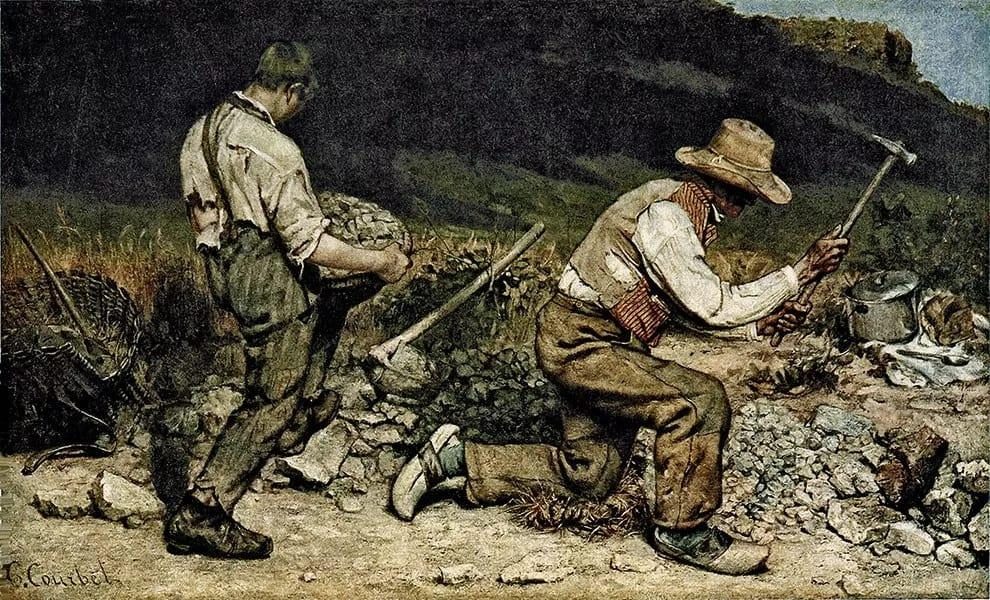
Look closely: Subject: labourers doing harsh manual work. Style: Realist, direct and anti-ideal. Technique: earthy colour and solid forms. Composition: figures dominate the picture plane. Meaning/Context: gives working-class poverty the seriousness of history painting.
Courbet challenged academic art by depicting labourers at monumental scale. Rough realism, earthy colour and ordinary subject matter expose poverty and social inequality. His process emphasised direct observation rather than idealisation. The broken stones, bent bodies and harsh composition make viewers confront the physical hardship of working-class life.
Gustave Courbet — A Burial at Ornans
Key artist note: Gustave Courbet was a central figure in Realism who rejected idealised academic subjects in favour of ordinary life, labour and modern society. He believed painting should be based on visible reality. He is useful for discussing social class, truth, scale and the challenge to traditional art institutions.
Look closely: Subject: ordinary provincial funeral. Style: Realist and monumental. Technique: large scale, dark tones and plain detail. Composition: figures spread across a horizontal frieze. Meaning/Context: treats common people with importance usually reserved for grand history painting.
Courbet transformed a provincial funeral into a large history painting, challenging hierarchy in art. Ordinary mourners are shown without idealisation. Dark tones, horizontal composition and realistic scale create solemnity. The work questions religion, class and social ceremony, forcing viewers to recognise everyday life as historically and artistically significant.
Jean-François Millet — The Gleaners
Key artist note: Jean-François Millet focused on rural workers, poverty and the dignity of agricultural labour. His paintings made peasants serious subjects at a time when academic art often preferred myth, history or wealth. He is useful for discussing social awareness, endurance, religion and respect for ordinary life.
Look closely: Subject: rural women gathering leftover grain. Style: Realist, quiet and dignified. Technique: natural colour and solid modelling. Composition: bent figures repeat across the foreground. Meaning/Context: highlights poverty, labour and respect for peasant life.
Millet presents rural women collecting leftover grain with dignity and restraint. The low viewpoint and monumental figures highlight labour, poverty and survival. Earthy colour, soft light and repeated bending forms create rhythm. The painting critiques social inequality quietly, encouraging viewers to see rural work as noble, exhausting and meaningful.
Jean-François Millet — The Angelus
Key artist note: Jean-François Millet focused on rural workers, poverty and the dignity of agricultural labour. His paintings made peasants serious subjects at a time when academic art often preferred myth, history or wealth. He is useful for discussing social awareness, endurance, religion and respect for ordinary life.
Look closely: Millet links peasant labour, faith and routine. Muted colour and still posture give ordinary rural life dignity and social seriousness.
Millet links rural work, religion and daily routine. Two peasants pause for prayer in a field, creating a quiet moment of dignity and reflection. The subdued light, bowed heads and open landscape connect labour with spirituality, silence and endurance, making ordinary peasant life worthy of serious art.
Honoré Daumier — Rue Transnonain
Key artist note: Honoré Daumier was a painter, printmaker and caricaturist who criticised politics, law and class inequality. His lithographs reached a wide public through newspapers, making his art socially powerful. He is useful for discussing satire, gesture, mass media and Realism as public commentary.
Look closely: Subject: political violence in a domestic room. Style: Realist, dramatic and critical. Technique: lithographic tone and stark contrast. Composition: fallen body fills the scene. Meaning/Context: uses printmaking to expose injustice and state brutality.
Daumier used printmaking to expose state violence and political injustice. The dead family, collapsed bodies and stark interior make the scene brutally direct. Lithography allowed the image to circulate widely as social critique. Strong contrast, diagonal forms and emotional realism make viewers confront the human cost of repression.
Honoré Daumier — Political Cartoons and Lithographs: Gargantua
Key artist note: Honoré Daumier was a painter, printmaker and caricaturist who criticised politics, law and class inequality. His lithographs reached a wide public through newspapers, making his art socially powerful. He is useful for discussing satire, gesture, mass media and Realism as public commentary.
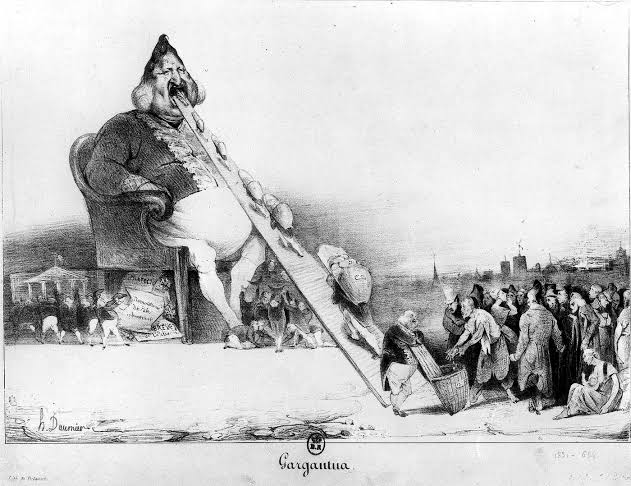
Look closely: Daumier uses caricature and exaggeration to expose political corruption. Printmaking makes the criticism direct, public and accessible.
Daumier used lithography and caricature to criticise power, corruption and class inequality. In Gargantua, exaggerated scale and satirical distortion make political greed visible. Because printed images could circulate widely, his work shows Realism as public social commentary as well as close observation.
Honoré Daumier — The Third-Class Carriage
Key artist note: Honoré Daumier was a painter, printmaker and caricaturist who criticised politics, law and class inequality. His lithographs reached a wide public through newspapers, making his art socially powerful. He is useful for discussing satire, gesture, mass media and Realism as public commentary.
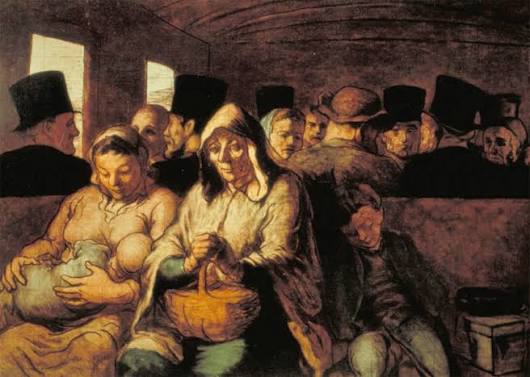
Look closely: Compressed space and weary passengers show poverty and class inequality. Daumier turns everyday travel into Realist social commentary.
Daumier shows ordinary passengers in a crowded railway carriage. The compressed space, subdued colour and tired figures communicate poverty, endurance and modern urban life. The painting turns a public transport scene into a serious image of class, social pressure and the human cost of industrial modernity.
Legacy / influence: Realism influenced later art by making everyday life and social conditions serious subjects. It prepared the way for documentary art, social commentary, photography, Impressionism and modern political image-making.
3. Impressionism
Context / main ideas: Impressionism grew from modern Paris, leisure culture, photography, new pigments and independent exhibitions. Artists painted fleeting light, movement and everyday scenes using broken brushwork and bright colour. The main change is that perception and momentary experience became central to art.
What is Impressionism?
Salon and Independent Exhibitions
The Paris Salon was the official, juried exhibition system in France. It had enormous power because acceptance at the Salon could bring an artist public visibility, critical attention, commissions and professional success. Academic expectations favoured polished finish, carefully modelled figures, historical or mythological subjects, ideal beauty and clear drawing.
Impressionist artists challenged this system by painting modern life, leisure, city streets, cafés, theatres, landscapes, changing weather and fleeting light. Their loose brushwork, broken colour, sketch-like finish and interest in ordinary contemporary subjects often conflicted with Salon expectations.
Many artists associated with Impressionism experienced rejection or criticism through the Salon system. Their decision to exhibit independently from 1874 was important because it allowed them to control how their work was shown and to present a new way of seeing. The independent exhibitions helped shift modern art away from official academic approval and towards artistic experimentation, personal perception and modern experience.
Exam use: refer to the Salon when explaining why Impressionism was seen as radical. It helps connect context, theory and thinking, innovation, technique, subject matter and the artists’ break with academic tradition.
Impressionism began in France in the 1870s.
Artists focused on:
- light,
- colour,
- atmosphere,
- movement,
- fleeting moments.
They often painted outdoors (en plein air).
Historical Context
Context
- Industrial modern life expanded.
- Railways allowed travel.
- Photography influenced composition.
- New paint tubes made outdoor painting easier.
Characteristics of Impressionism
- Loose brushwork.
- Bright colours.
- Visible paint strokes.
- Interest in changing light.
- Everyday modern scenes.
Key Artist: Claude Monet
Impression, Sunrise
Analysis
- Loose brushwork.
- Soft atmospheric light.
- Reflection on water.
- Focus on momentary effect.
Importance
- Gave Impressionism its name.
Water Lilies
Features
- Repeated study of changing light and colour.
- Loose expressive brushwork.
Other Impressionist Artists
Pierre-Auguste Renoir
- Social scenes and figures.
Dance at Le Moulin de la Galette
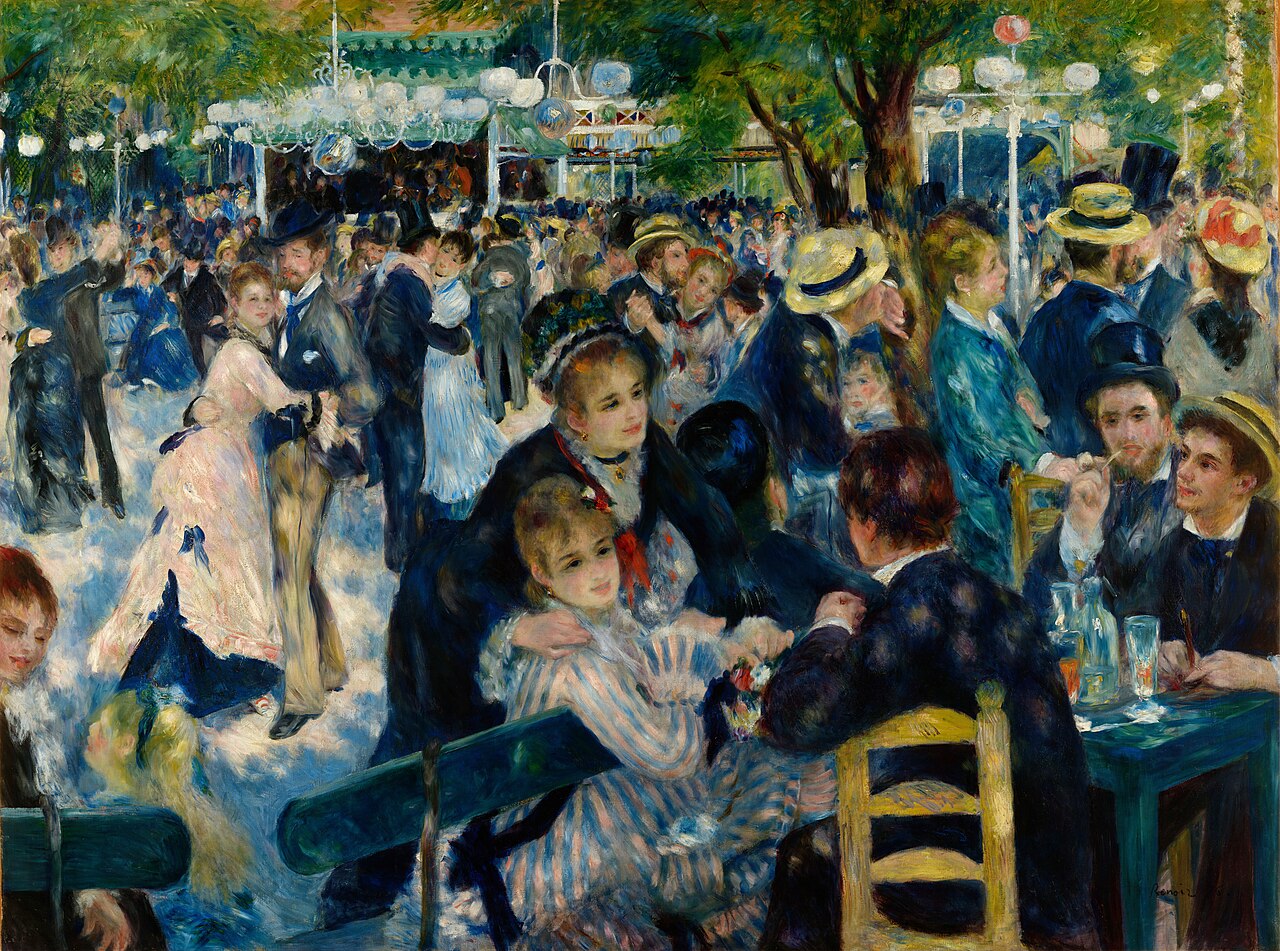
Edgar Degas
- Ballet dancers and movement.
The Ballet Class
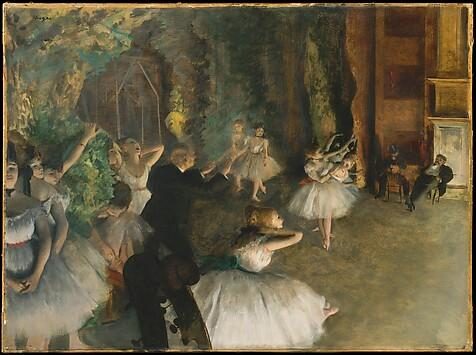
Berthe Morisot
- Domestic scenes and women’s lives.
The Cradle
Impressionism and the Six Frameworks
Context
Modern Paris, leisure culture, industrialisation.
Artists and Artworks
Monet, Renoir, Degas, Morisot.
Analysis
Light, atmosphere and movement.
Art Elements & Principles
- Colour,
- light,
- rhythm,
- movement,
- texture through brushwork.
Media & Areas of Practice
Oil painting outdoors.
Innovation & Invention
En plein air painting and modern colour theory.
Artist, Artwork and Artefact Analysis: Impressionism
Claude Monet — Impression, Sunrise
Key artist note: Claude Monet was a leading Impressionist who explored changing light, atmosphere and perception. He often worked in series, returning to the same subject under different conditions. He is useful for discussing loose brushwork, optical colour, modern seeing and the move away from detailed academic finish.
Look closely: Subject: harbour at dawn. Style: Impressionist, loose and atmospheric. Technique: rapid brushstrokes and broken colour. Composition: orange sun balances blue-grey water. Meaning/Context: captures fleeting light and helped name Impressionism.
Monet captured a fleeting atmospheric moment rather than detailed description. Loose brushstrokes, broken colour and hazy light create immediacy. The orange sun contrasts with blue-grey harbour tones, becoming the focal point. Innovative in its unfinished appearance, the painting made perception, light and modern experience central to art.
Claude Monet — Water Lilies
Key artist note: Claude Monet was a leading Impressionist who explored changing light, atmosphere and perception. He often worked in series, returning to the same subject under different conditions. He is useful for discussing loose brushwork, optical colour, modern seeing and the move away from detailed academic finish.
Look closely: Subject: pond surface and reflected light. Style: late Impressionist and near-abstract. Technique: layered colour and loose brushwork. Composition: no fixed horizon, only floating forms. Meaning/Context: turns nature into a study of perception, time and atmosphere.
Monet’s Water Lilies dissolve landscape into colour, reflection and sensation. Repeated observation of his garden allowed him to explore time, light and perception. Loose brushwork, layered paint and shallow space create immersion. The viewer experiences nature as shifting atmosphere rather than fixed scene, anticipating abstraction.
Pierre-Auguste Renoir — Dance at Le Moulin de la Galette
Key artist note: Pierre-Auguste Renoir painted modern leisure, social life and the pleasure of everyday Paris. His warm colour, broken brushwork and interest in figures made his work accessible and lively. He is useful for discussing Impressionist light, movement, crowds, atmosphere and the modern city.
Look closely: Renoir shows modern Parisian leisure with loose brushwork, dappled light and overlapping figures. The scene captures movement, atmosphere and everyday social life.
Renoir celebrates modern leisure, social life and fleeting light. Broken brushwork and dappled colour create the effect of sunlight moving through trees. The crowded composition feels spontaneous yet carefully organised. The painting reflects Impressionist interest in contemporary Paris, pleasure and atmosphere, inviting viewers into a lively social moment.
Edgar Degas — The Ballet Class
Key artist note: Edgar Degas was associated with Impressionism but was especially interested in drawing, composition and unusual viewpoints. He studied dancers, performers and modern urban life, often showing rehearsal rather than glamour. He is useful for discussing cropping, movement, observation, discipline and the influence of photography.
Look closely: Degas studies movement, rehearsal and modern life. Cropped composition, unusual viewpoint and controlled drawing make the ballet class feel observed rather than staged.
Degas explored rehearsal, discipline and modern performance rather than idealised beauty. His unusual viewpoint, cropped figures and diagonal floorboards suggest observation and experimentation. Pastel-like colour and precise drawing reveal process and movement. The work shows dancers as workers, balancing elegance with fatigue, repetition and physical control.
Berthe Morisot — The Cradle
Key artist note: Berthe Morisot was a founding Impressionist who painted domestic spaces, women’s lives and intimate modern experience. As a woman artist, her viewpoint challenged the male-dominated art world. She is useful for discussing loose brushwork, private life, gender, atmosphere and modern subject matter.
Look closely: Morisot uses soft colour and loose brushwork to show domestic modern life. The intimate subject connects Impressionism with observation, light and women’s experience.
Morisot explored domestic life and women’s experience with sensitivity and modernity. In The Cradle, loose Impressionist brushwork, pale colour and diagonal veiling create intimacy and tenderness. The process values observation and atmosphere over academic finish. The idea is to make private female experience a serious subject for modern painting.
Édouard Manet — Olympia
Key artist note: Édouard Manet was a crucial bridge between Realism and Impressionism. He challenged academic expectations through modern subjects, direct gazes and visible paint handling. His works often caused controversy because they made viewers confront contemporary life rather than idealised myth or history.
Look closely: Subject: modern nude confronting the viewer. Style: modern Realist/Impressionist transition. Technique: flat paint, sharp contrast and simplified modelling. Composition: direct gaze challenges tradition. Meaning/Context: questions academic idealisation, class, sexuality and modern Paris.
A modern-life painting that challenged academic ideals. The direct gaze, flattened space and contemporary setting make the viewer aware of class, gender and social reality. It is useful as a bridge between Realism, modernity and Impressionism.
Édouard Manet — Le Déjeuner sur l’herbe
Key artist note: Édouard Manet was a crucial bridge between Realism and Impressionism. He challenged academic expectations through modern subjects, direct gazes and visible paint handling. His works often caused controversy because they made viewers confront contemporary life rather than idealised myth or history.
Look closely: Subject: modern figures in a picnic scene. Style: provocative, flat and modern. Technique: visible brushwork and awkward spatial contrasts. Composition: nude and clothed figures disrupt convention. Meaning/Context: challenged Salon taste and historical nude traditions.
Manet reworked classical composition using modern Parisian figures and a deliberately unsettling contrast between nude and clothed bodies. The painting is important for modern subject matter, controversy and the rejection of polished academic illusion.
Legacy / influence: Impressionism influenced later art by freeing colour, brushwork and subject matter from academic rules. It led directly to Post-Impressionism and helped modern artists value perception, surface and personal response.
4. Post-Impressionism
Context / main ideas: Post-Impressionism developed from Impressionism but pushed it further. Artists kept bright colour and modern subject matter while adding structure, symbolism, emotion, pattern and personal vision. The main change is from recording appearances to expressing deeper ideas and inner experience.
What is Post-Impressionism?
Post-Impressionists moved beyond Impressionism.
They kept bright colour but explored:
- emotion,
- symbolism,
- structure,
- abstraction,
- personal expression.
Characteristics
- Strong colour.
- Emotional meaning.
- Distortion and stylisation.
- Individual artistic styles.
Key Artist: Vincent van Gogh
The Starry Night
Analysis
- Swirling expressive lines.
- Intense colour contrasts.
- Emotional atmosphere.
- Thick impasto paint.
Themes
- Emotion
- Isolation
- Spiritual feeling
Other Post-Impressionist Artists
Paul Cézanne
Mont Sainte-Victoire
Importance
- Structured form using geometric shapes.
- Influenced Cubism.
Paul Gauguin
Vision After the Sermon
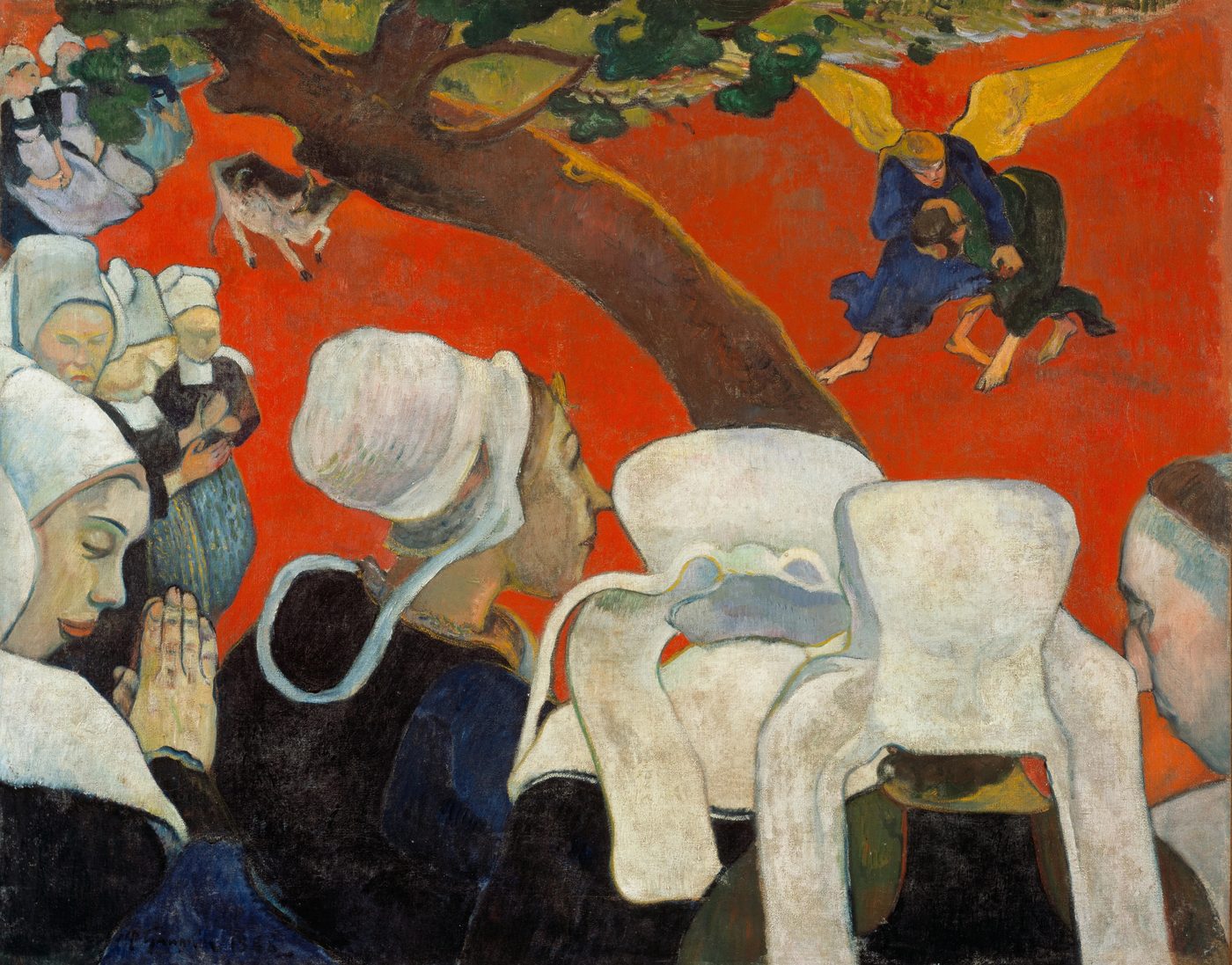
Features
- Symbolism.
- Flat colour areas.
- Non-naturalistic colour.
Georges Seurat
A Sunday Afternoon on the Island of La Grande Jatte
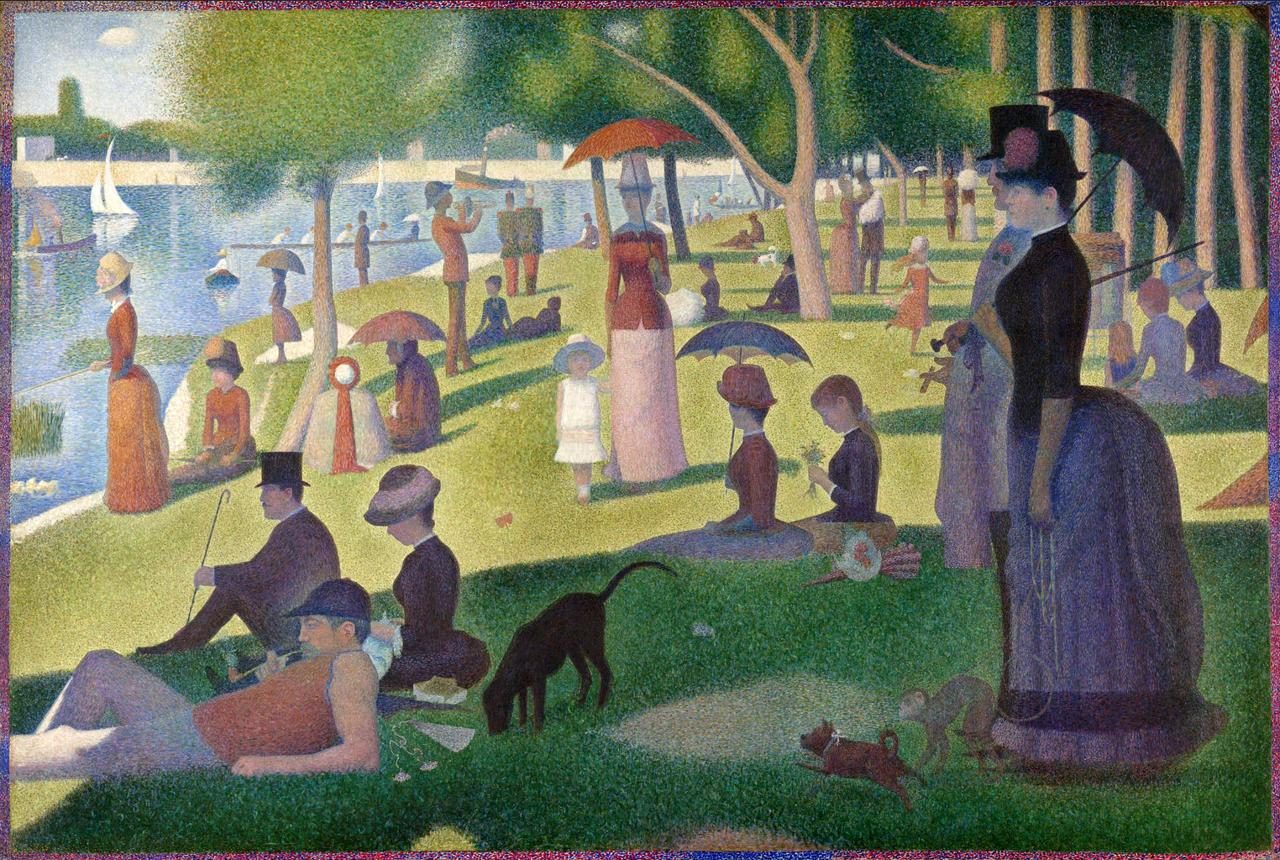
Features
- Pointillism.
- Scientific colour theory.
Post-Impressionism and the Six Frameworks
Context
Reaction against Impressionism.
Artists and Artworks
Van Gogh, Cézanne, Gauguin, Seurat.
Analysis
Emotion, symbolism and structure.
Art Elements & Principles
- Strong colour,
- expressive line,
- texture,
- pattern,
- contrast.
Media & Areas of Practice
Oil painting and experimental techniques.
Innovation & Invention
Expressionism, abstraction and colour experimentation.
Artist, Artwork and Artefact Analysis: Post-Impressionism
Post-Impressionist case studies are grouped around emotional expression, structure, symbolism and colour theory beyond Impressionism.
Vincent van Gogh — The Starry Night
Key artist note: Vincent van Gogh used colour, line and thick paint to express emotion and spiritual intensity. Although he sold little during his lifetime, his work became central to modern art. He is useful for discussing impasto, expressive brushwork, symbolism, mental struggle and personal vision.
Look closely: Van Gogh transforms a night landscape into personal expression. The animated sky, rhythmic line and thick paint suggest movement, anxiety and wonder, while the cypress links earth, death and the heavens.
Van Gogh transformed landscape into emotional and spiritual expression. Thick impasto, swirling lines and intense colour make the sky feel alive. Observation, memory and imagination merge in the creative process. The cypress, village and stars suggest death, hope and cosmic energy, creating a deeply personal viewer response.
Paul Cézanne — Mont Sainte-Victoire
Key artist note: Paul Cézanne investigated how nature could be built through colour, shape and structure. His repeated studies of landscapes and still lifes influenced Cubism and modern abstraction. He is useful for discussing planes, form, shifting viewpoint and the move from Impressionist sensation toward constructed composition.
Look closely: Cézanne uses repeated brushstrokes and colour planes to construct landscape rather than simply record it. The mountain becomes a study of form, perception and structure, influencing Cubism and modern abstraction.
Cézanne repeatedly painted Mont Sainte-Victoire to investigate structure, perception and form. Instead of copying nature, he built it through planes of colour. Brushstrokes create rhythm, depth and solidity. His innovation influenced Cubism by treating landscape as constructed geometry, making viewers aware of seeing as an active process.
Paul Gauguin — Vision After the Sermon
Key artist note: Paul Gauguin rejected naturalism and used flat colour, simplified shapes and symbolism to suggest inner experience. His search for spiritual and “primitive” subjects is important but also raises questions about colonial attitudes. He is useful for discussing symbolism, non-naturalistic colour and constructed identity.
Look closely: Gauguin rejects naturalistic space and colour. The red ground separates vision from reality, while simplified Breton figures and symbolic colour make the painting feel spiritual, decorative and intentionally anti-academic.
Gauguin rejected naturalism in favour of symbolism, flat colour and spiritual imagination. The red ground, simplified figures and distorted space separate vision from reality. Breton women witness Jacob wrestling the angel, blending faith and inner experience. The work’s bold design challenges realism and invites psychological, symbolic interpretation.
Georges Seurat — A Sunday Afternoon on the Island of La Grande Jatte
Key artist note: Georges Seurat developed Neo-Impressionism through pointillism and scientific colour theory. He planned his paintings carefully, using tiny dots to create optical mixing in the viewer’s eye. He is useful for discussing method, perception, colour, composition and modern leisure as structured observation.
Look closely: Seurat applies tiny touches of colour with scientific control. The still figures, balanced composition and optical mixing show Post-Impressionism moving from spontaneous observation toward structure, theory and design.
Seurat used pointillism and colour theory to construct modern leisure scientifically. Tiny dots of colour optically mix in the viewer’s eye. The rigid figures and balanced composition create stillness and social distance. Innovative and controlled, the painting turns everyday recreation into a study of perception, class and modernity.
Vincent van Gogh — Sunflowers
Key artist note: Vincent van Gogh used colour, line and thick paint to express emotion and spiritual intensity. Although he sold little during his lifetime, his work became central to modern art. He is useful for discussing impasto, expressive brushwork, symbolism, mental struggle and personal vision.
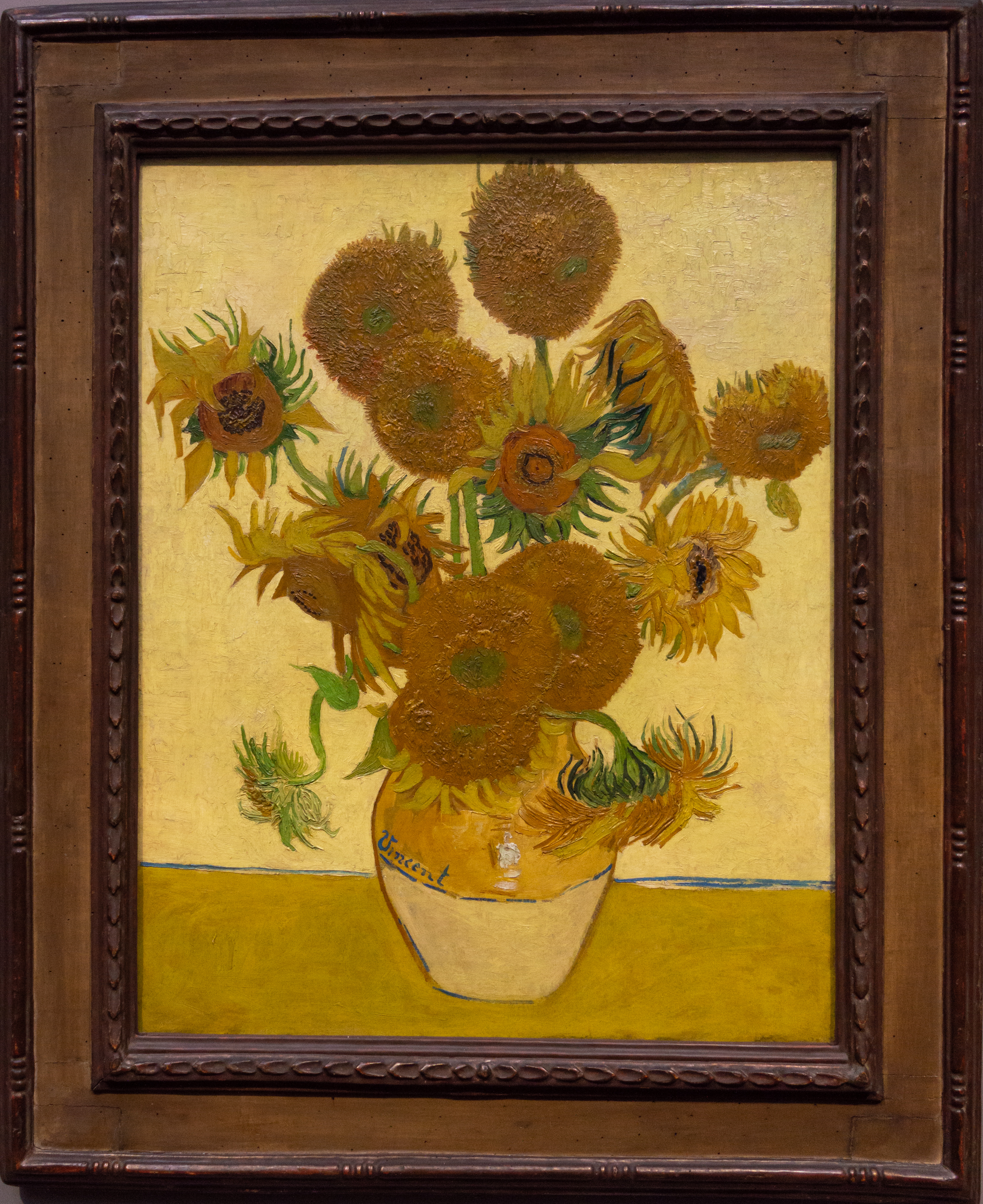
Look closely: Van Gogh uses impasto, limited yellow tones and energetic brushwork to give ordinary flowers emotional force. The painting shows how colour and surface can communicate warmth, vitality and personal expression.
Van Gogh turns still life into emotional expression through intense yellow, thick impasto and energetic brushwork. The repeated flower forms create rhythm and symbolic warmth, showing how Post-Impressionists used colour and surface to communicate feeling.
Paul Cézanne — The Basket of Apples
Key artist note: Paul Cézanne investigated how nature could be built through colour, shape and structure. His repeated studies of landscapes and still lifes influenced Cubism and modern abstraction. He is useful for discussing planes, form, shifting viewpoint and the move from Impressionist sensation toward constructed composition.
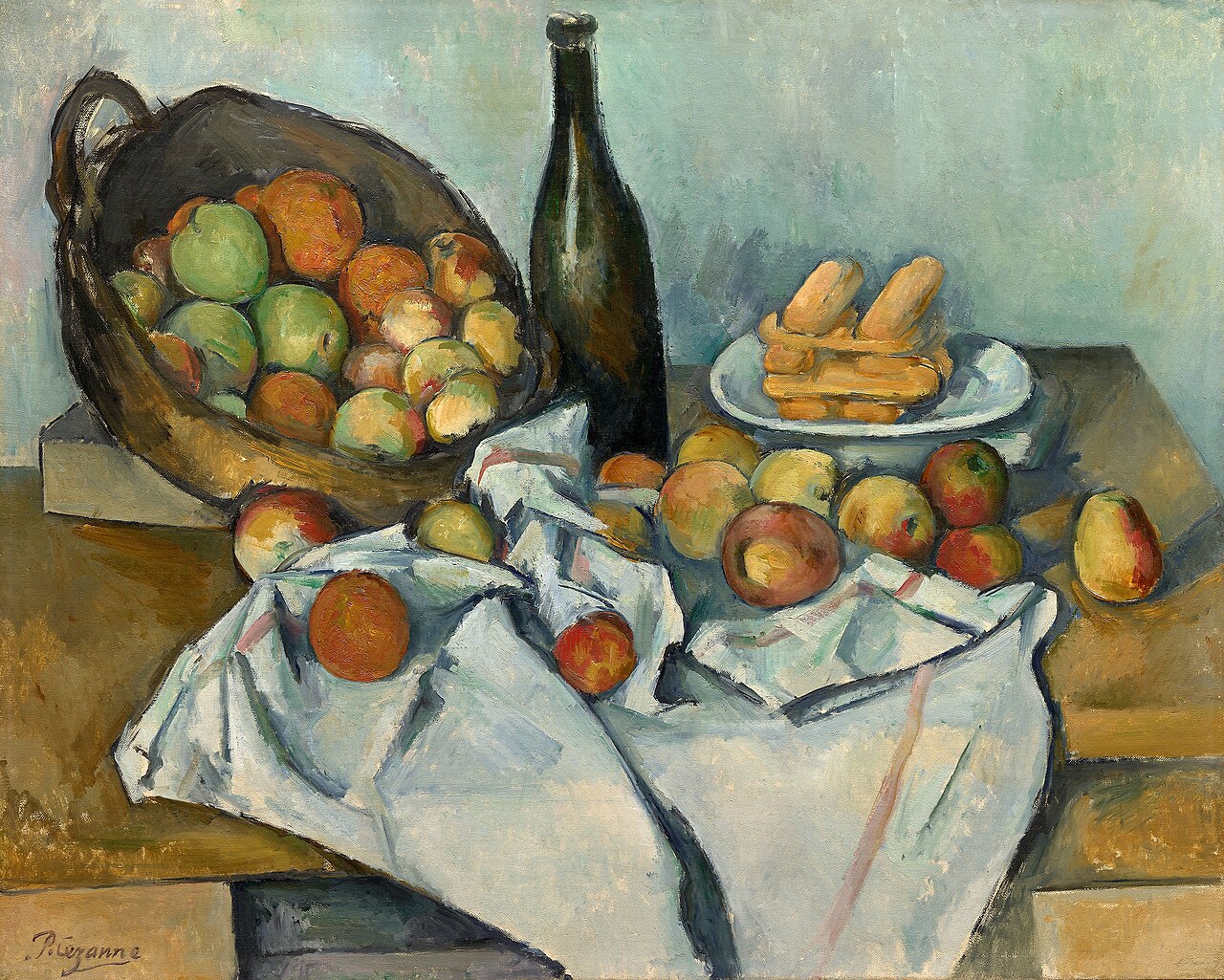
Look closely: Cézanne destabilises perspective while organising objects through colour, planes and form. The table, bottle and fruit reveal his interest in structure and perception, anticipating Cubist ideas about multiple viewpoints.
Cézanne’s still life is important for structure and shifting viewpoint. Forms tilt, edges do not fully align and colour planes build the objects. This makes the viewer aware that painting is constructed, helping lead toward Cubist ways of seeing.
Legacy / influence: Post-Impressionism strongly influenced Fauvism, Cubism, Expressionism and abstraction. Cézanne’s structure, Van Gogh’s emotion, Gauguin’s symbolism and Seurat’s theory helped create the visual language of Modernism.
5. Comparison Table
| Feature | Realism | Impressionism | Post-Impressionism |
|---|---|---|---|
| Subject | Ordinary life | Modern leisure | Personal/emotional themes |
| Colour | Naturalistic | Bright/light | Symbolic/expressive |
| Brushwork | Smooth/detailed | Loose/visible | Experimental |
| Focus | Truth/social issues | Light and atmosphere | Emotion and structure |
| Style | Realistic | Fleeting impressions | Individual expression |
6. Important Terms
| Term | Meaning |
|---|---|
| En Plein Air | Painting outdoors |
| Impasto | Thick paint application |
| Pointillism | Painting with small dots of colour |
| Symbolism | Using imagery to suggest meaning |
| Realism | Accurate depiction of life |
| Atmosphere | Mood created by light and colour |
7. Possible Exam Topics
Possible areas to prepare:
- Depiction of modern life.
- The role of colour.
- Innovation in painting techniques.
- Emotional expression in Post-Impressionism.
- Comparison between movements.
- Influence of industrialisation and modern society.
Leaving Cert Art Study Guide & Notes
Legacy / influence: Together these movements laid the foundations of modern art by challenging idealised subject matter, fixed perspective, smooth finish and academic rules. Later artists built on their realism, colour, brushwork and expressive structure.
Proto-Renaissance • Renaissance • High Renaissance • Mannerism
Context / main ideas: These periods trace the move from medieval spirituality toward humanism, perspective, classical revival and artistic individuality. They show how artists changed representation, space, anatomy, patronage and meaning from Giotto to Mannerism.
Study structure for this section
Students should understand and be able to describe and discuss the context that informed and led to the chosen period/movement using the six elements listed below.
Students should understand and be able to describe and explain the period/movement using the six elements listed below.
The framework is structured around six elements:
1. Overview Timeline
| Period | Dates | Main Features |
|---|---|---|
| Proto-Renaissance | c. 1200–1400 | Move toward realism and human emotion |
| Early Renaissance | c. 1400–1490 | Perspective, humanism, classical influence |
| High Renaissance | c. 1490–1520 | Balance, harmony and ideal beauty |
| Mannerism | c. 1520–1600 | Distortion, tension and artificiality |
2. Proto-Renaissance
Context / main ideas: The Proto-Renaissance marks the move away from flat medieval convention towards naturalism, space and human feeling. Giotto and other artists began to give figures weight, emotion and believable settings. The major change is that religious scenes start to look more human, dramatic and physically real.
What is the Proto-Renaissance?
The Proto-Renaissance was the transition from medieval art to Renaissance art.
Artists began to:
- observe nature more carefully,
- show emotion,
- create realistic figures,
- introduce depth and space.
The movement developed mainly in Florence and Padua.
Historical Context
Context
- Europe was still deeply religious.
- Towns and trade expanded.
- Wealthy patrons supported artists.
- Interest in classical learning began to grow.
Characteristics
- Greater realism.
- Emotional figures.
- Early attempts at perspective.
- Natural drapery and gesture.
- Religious subject matter remained dominant.
Key Artist: Giotto di Bondone
Lamentation
Analysis
- Fresco from the Arena Chapel.
- Emotional grieving figures.
- Natural body weight and drapery.
- Use of shallow space and rocky landscape.
Importance
- Major step toward Renaissance naturalism.
Artist, Artwork and Artefact Analysis: Proto-Renaissance
Proto-Renaissance case studies focus on the move from medieval convention towards observation, space, emotion and narrative clarity.
Giotto — The Lamentation
Key artist note: Giotto is often seen as a key Proto-Renaissance painter because he gave religious scenes greater weight, emotion and spatial clarity. His figures feel human and psychologically present. He is useful for discussing the movement from medieval flatness toward observation, narrative drama and early naturalism.
Look closely: Subject: mourning over Christ. Style: Proto-Renaissance naturalism. Technique: fresco with solid bodies and emotional faces. Composition: diagonal rock leads to Christ. Meaning/Context: moves medieval art toward human emotion, space and narrative realism.
Giotto humanised religious art through grief, gesture and emotional realism. Figures gather around Christ in a shallow stage-like space, directing attention to Mary’s embrace. Fresco technique allowed strong colour and monumental form. The diagonal rock, expressive faces and compressed composition make viewers feel the human tragedy of the scene.
Giotto — Ognissanti Madonna
Key artist note: Giotto is often seen as a key Proto-Renaissance painter because he gave religious scenes greater weight, emotion and spatial clarity. His figures feel human and psychologically present. He is useful for discussing the movement from medieval flatness toward observation, narrative drama and early naturalism.
Look closely: Subject: Virgin and Child enthroned. Style: Proto-Renaissance with increasing volume. Technique: tempera and gold with modelled forms. Composition: central throne creates hierarchy and depth. Meaning/Context: bridges Byzantine tradition and Renaissance naturalism.
Giotto’s Ognissanti Madonna gives sacred figures weight, volume and presence. Mary sits on a throne that suggests believable space, moving beyond flat Byzantine tradition. Tempera and gold create richness, while modelling gives the body structure. The work innovates through naturalism, making divine authority feel physically and emotionally present.
Santa Trinita Maestà
Key artist note: Cimabue worked in the Byzantine tradition but began to introduce more softness, volume and emotional presence into sacred images. He is important as a bridge between medieval style and later naturalism. He is useful for discussing gold grounds, hierarchy, spirituality and gradual stylistic change.
Look closely: Subject: enthroned Madonna and Child. Style: Italo-Byzantine with early naturalism. Technique: tempera and gold ground. Composition: symmetrical throne and angels create sacred order. Meaning/Context: shows the transition toward more human, spatial religious painting.
Cimabue’s Santa Trinita Maestà retains Byzantine grandeur while moving toward naturalism. The Virgin is monumental, frontal and sacred, surrounded by angels. Gold ground, tempera and patterned drapery create splendour. Subtle modelling and spatial hints mark innovation, helping viewers sense both divine distance and emerging human presence.
Cimabue — Crucifix of Santa Croce
Key artist note: Cimabue worked in the Byzantine tradition but began to introduce more softness, volume and emotional presence into sacred images. He is important as a bridge between medieval style and later naturalism. He is useful for discussing gold grounds, hierarchy, spirituality and gradual stylistic change.
Look closely: Subject: crucified Christ. Style: Byzantine tradition softened by human suffering. Technique: tempera on panel with elongated anatomy. Composition: bowed body creates pathos. Meaning/Context: anticipates Proto-Renaissance interest in emotion and physical presence.
Cimabue’s crucifix emphasises Christ’s suffering body with curved form and emotional weight. Tempera on wood, gold detail and elongated anatomy create spiritual drama. The work challenges more rigid medieval images by showing pain and humanity. Its bowed body and solemn expression invite empathy, devotion and reflection on sacrifice.
Maestà
Key artist note: Duccio was a Sienese painter known for elegance, delicate colour and devotional feeling. His work retained Byzantine richness while adding narrative tenderness and human detail. He is useful for discussing Siena, panel painting, gold backgrounds, sacred storytelling and the transition toward Renaissance naturalism.
Look closely: Subject: Virgin and Child with saints/angels. Style: Sienese, elegant and decorative. Technique: tempera, gold and refined line. Composition: hierarchical panels organise devotion. Meaning/Context: combines medieval splendour with narrative tenderness and civic religious pride.
Duccio’s Maestà combines Byzantine elegance with softer human feeling. Tempera, gold and refined line create sacred beauty. The Virgin’s throne, surrounding saints and narrative panels express devotion and civic pride. Duccio’s innovation lies in emotional tenderness, decorative rhythm and storytelling that draws viewers into sacred history.
Nicola Pisano — Pisa Baptistery Pulpit
Key artist note: Nicola Pisano helped bridge medieval Gothic sculpture and early Renaissance naturalism. His work is important because he looked back to Roman sculpture, giving figures weight, drapery and physical presence. He is useful for discussing the earliest revival of Classical form in Italian sculpture.
Look closely: Pisano revives classical weight, drapery and relief carving. The pulpit’s marble figures show early movement from Gothic stylisation toward Renaissance naturalism and sculptural depth.
The marble pulpit uses high relief, carved figures, architectural supports and classical drapery. Its subject matter is biblical, but the figures feel solid and human. The innovation is the renewed interest in Roman naturalism, spatial depth and sculptural weight before the full Renaissance.
Legacy / influence: The Proto-Renaissance influenced the Early Renaissance by showing that sacred stories could feel human, physical and emotionally direct. It opened the path toward perspective, naturalism and greater artist individuality.
3. Early Renaissance
Context / main ideas: The Early Renaissance was influenced by humanism, classical antiquity, scientific observation and wealthy patrons. Artists explored linear perspective, anatomy, proportion and balanced composition. The major change is a new confidence in the human figure, rational space and the artist as an intellectual creator.
What is the Renaissance?
The Renaissance means “rebirth.”
Artists rediscovered:
- Ancient Greek and Roman ideas,
- science,
- mathematics,
- anatomy,
- perspective,
- humanism.
Main centre:
- Florence
Historical Context
Context
- Growth of wealthy merchant families like the Medici.
- Humanism encouraged study of humanity and nature.
- Scientific observation increased.
- Printing spread knowledge.
Characteristics
- Linear perspective.
- Realistic anatomy.
- Classical architecture.
- Balance and harmony.
- Human-centred subjects.
Key Artist: Masaccio
The Holy Trinity
Analysis
- Famous use of linear perspective.
- Realistic figures and architecture.
- Creates illusion of depth.
Importance
- Revolutionary use of mathematics in art.
Other Important Early Renaissance Artists
Donatello
David
- First free-standing nude since antiquity.
Sandro Botticelli
The Birth of Venus
Features
- Mythological subject.
- Graceful flowing lines.
- Ideal beauty.
Filippo Brunelleschi
Innovation
- Developed linear perspective.
- Designed Florence Cathedral dome.
Artist, Artwork and Artefact Analysis: Renaissance
Renaissance case studies are grouped around perspective, humanism, classical revival, patronage and technical innovation.
Lorenzo Ghiberti — Gates of Paradise
Key artist note: Lorenzo Ghiberti was a Florentine sculptor famous for bronze doors created for the Baptistery. His reliefs combine classical detail, narrative clarity and technical mastery. He is useful for discussing public commissions, competition, perspective in sculpture and the prestige of bronze casting.
Sculpture reminder: Ghiberti’s gilded bronze doors are key for Renaissance relief sculpture. Use them for bronze casting, linear perspective, low and high relief, biblical narrative and the combination of sculpture with architecture.
Look closely: Subject: Old Testament stories in bronze doors. Style: Early Renaissance classicism. Technique: gilded bronze relief and perspective. Composition: framed panels organise narrative depth. Meaning/Context: shows innovation in relief, perspective and public religious art.
Ghiberti’s Gates of Paradise demonstrate Early Renaissance innovation in gilded bronze relief. The panels combine biblical narrative with perspective, naturalistic figures and intricate detail. Technique involved casting, chasing, gilding and workshop collaboration. The meaning links sacred storytelling with civic pride, showing how Renaissance artists united sculpture, architecture, process and humanist observation.
The Tribute Money
Key artist note: Masaccio was an Early Renaissance painter who used linear perspective, light and solid forms with unusual power. His figures feel weighty and believable. He is useful for discussing scientific space, human emotion, fresco technique and the shift toward a more realistic visual world.
Look closely: Subject: biblical story of tax payment. Style: Early Renaissance naturalism. Technique: fresco, modelling and one-point perspective. Composition: repeated Christ figure unifies time and space. Meaning/Context: shows moral narrative, civic order and new spatial realism.
Masaccio used linear perspective, light and natural gesture to make biblical narrative believable. Figures occupy a coherent landscape, with Christ as the central moral focus. Fresco technique supports clarity and monumentality. The work innovates through realism, spatial unity and human drama, making sacred teaching feel immediate and rational.
Masaccio — Holy Trinity
Key artist note: Masaccio was an Early Renaissance painter who used linear perspective, light and solid forms with unusual power. His figures feel weighty and believable. He is useful for discussing scientific space, human emotion, fresco technique and the shift toward a more realistic visual world.
Look closely: Subject: Trinity, donors and salvation. Style: Early Renaissance realism. Technique: fresco with mathematical perspective. Composition: barrel-vault illusion creates depth. Meaning/Context: demonstrates perspective, human presence and Christian theology through architecture.
Masaccio’s Holy Trinity demonstrates mathematical perspective and Renaissance belief in order. The painted architecture creates an illusionistic chapel space. Fresco, proportion and light guide the viewer toward Christ, God and salvation. Its innovation lies in combining theology with scientific space, making faith appear logical, monumental and visually convincing.
Donatello — Gattamelata
Key artist note: Donatello was a major Renaissance sculptor who revived classical ideas while giving figures individuality and psychological energy. He worked in marble, bronze and wood. He is useful for discussing naturalism, contrapposto, public monuments, relief technique and the human figure as expressive form.
Look closely: Subject: mounted military leader. Style: Renaissance classical revival. Technique: bronze casting and naturalistic detail. Composition: rider and horse form a balanced monument. Meaning/Context: revives ancient equestrian sculpture and celebrates civic power.
Donatello’s Gattamelata revives the classical equestrian monument to honour military leadership. Bronze casting, controlled anatomy and balanced proportion create authority. The rider appears calm and rational rather than wildly heroic. The work innovates by placing Renaissance human achievement in public space, communicating power, memory and civic identity.
The Birth of Venus
Key artist note: Sandro Botticelli worked in Florence and is known for graceful line, mythological subjects and elegant figures. His art reflects humanist culture and elite patronage. He is useful for discussing classical mythology, beauty, rhythm, linear design and Renaissance interest in poetry and antiquity.
Look closely: Subject: Venus arriving from the sea. Style: Early Renaissance, linear and mythological. Technique: tempera, graceful line and pale colour. Composition: central nude balanced by flanking figures. Meaning/Context: revives classical myth and ideal beauty in humanist Florence.
Botticelli’s Birth of Venus presents myth, beauty and idealised love. Tempera on canvas, flowing line and pale colour create elegance and poetry. Venus’s pose recalls classical sculpture, while the flattened space feels decorative. The work innovates by making pagan mythology a refined Renaissance subject for contemplation and pleasure.
Sandro Botticelli — Primavera
Key artist note: Sandro Botticelli worked in Florence and is known for graceful line, mythological subjects and elegant figures. His art reflects humanist culture and elite patronage. He is useful for discussing classical mythology, beauty, rhythm, linear design and Renaissance interest in poetry and antiquity.
Look closely: Subject: mythological spring garden. Style: elegant, linear and decorative. Technique: tempera with delicate contour and pattern. Composition: figures arranged like a graceful frieze. Meaning/Context: reflects Renaissance humanism, classical myth and courtly symbolism.
Primavera combines classical mythology, humanist learning and symbolic fertility. Botticelli uses graceful line, delicate colour and rhythmic figures to create an enchanted garden. The painting’s layered meanings include love, marriage, spring and beauty. Its elegance and complexity invite viewers to decode myth while enjoying decorative harmony.
Dome of Florence Cathedral
Key artist note: Filippo Brunelleschi was an architect and engineer central to the Early Renaissance. He studied classical architecture and developed practical solutions to difficult building problems, especially the Florence dome. He is useful for discussing proportion, innovation, engineering, perspective and the revival of classical forms.
Look closely: Subject: cathedral dome as civic landmark. Style: Early Renaissance engineering and classical order. Technique: double-shell brick dome and herringbone construction. Composition: vast curve crowns the city. Meaning/Context: symbolises innovation, faith and Florentine civic pride.
Brunelleschi’s dome solved an engineering problem through innovation, mathematics and daring design. Brick, stone, ribs and a double-shell structure allowed huge scale without traditional wooden centring. The dome symbolised Florentine ambition and Renaissance intellect. Its balanced form dominates the city, inspiring awe through structure, proportion and invention.
Filippo Brunelleschi — Ospedale degli Innocenti
Key artist note: Filippo Brunelleschi was an architect and engineer central to the Early Renaissance. He studied classical architecture and developed practical solutions to difficult building problems, especially the Florence dome. He is useful for discussing proportion, innovation, engineering, perspective and the revival of classical forms.
Look closely: Subject: charitable hospital façade. Style: Early Renaissance classicism. Technique: arches, columns and proportional planning. Composition: repeated bays create calm rhythm. Meaning/Context: applies classical order to public welfare and civic humanism.
Brunelleschi’s Ospedale degli Innocenti expresses Renaissance humanism through clarity, proportion and public purpose. Rounded arches, columns and modular spacing create calm order. The building used classical language for a charitable institution, linking beauty with civic responsibility. Its harmonious façade shaped Renaissance architecture and invited trust, dignity and care.
Domenico Ghirlandaio — The Visitation
Key artist note: Domenico Ghirlandaio was a Florentine painter known for fresco cycles, portrait-like figures and detailed settings. His workshop trained important artists, including Michelangelo. He is useful for discussing patronage, narrative clarity, fashionable clothing, civic identity and the connection between sacred stories and contemporary society.
Look closely: Subject: meeting of Mary and Elizabeth. Style: Renaissance narrative clarity. Technique: fresco/tempera-like modelling, colour and architectural setting. Composition: figures and perspective organise the scene. Meaning/Context: connects sacred story with contemporary Florentine life.
Ghirlandaio’s Visitation presents a religious meeting with calm Renaissance order and narrative clarity. Tempera on panel, architectural framing and controlled figure grouping create dignity and balance. The process shows careful drawing, colour layering and symbolic storytelling. The idea is to make sacred history readable, emotionally respectful and visually harmonious for viewers.
Jan van Eyck — The Arnolfini Portrait
Key artist note: Jan van Eyck was a Northern Renaissance painter celebrated for oil technique, minute detail and complex symbolism. His surfaces make fabrics, glass, jewels and skin appear intensely real. He is useful for discussing realism, patronage, religious meaning, domestic space and the power of close observation.
Look closely: Subject: wealthy couple in a domestic interior. Style: Northern Renaissance realism. Technique: oil paint, fine detail and glazing. Composition: mirror, figures and objects create symbolic depth. Meaning/Context: explores marriage, wealth, piety and social status.
A key Northern Renaissance work. Oil paint allows tiny details, polished surfaces and symbolic objects such as the mirror, dog and chandelier. Domestic space becomes a record of status, identity and observation, making realism and meaning work together.
Jan van Eyck — Ghent Altarpiece
Key artist note: Jan van Eyck was a Northern Renaissance painter celebrated for oil technique, minute detail and complex symbolism. His surfaces make fabrics, glass, jewels and skin appear intensely real. He is useful for discussing realism, patronage, religious meaning, domestic space and the power of close observation.
Look closely: Subject: complex Christian salvation imagery. Style: Northern Renaissance realism and splendour. Technique: oil glazing, detail and luminous colour. Composition: multi-panel structure organises sacred themes. Meaning/Context: unites devotion, patronage and technical innovation.
A major religious polyptych that shows early oil-paint mastery, jewel-like colour and complex symbolism. Its panels combine sacred narrative with detailed landscape and naturalistic observation, making it useful for discussing devotion, patronage and Northern Renaissance realism.
Donatello — David
Key artist note: Donatello was a leading Early Renaissance sculptor who revived classical ideas through naturalistic bodies, contrapposto and expressive character. His work is important because it helped make sculpture independent, human and psychologically alive rather than purely symbolic.
Look closely: Subject: biblical hero after victory. Style: Early Renaissance, classical and naturalistic. Technique: bronze casting with contrapposto. Composition: relaxed standing pose contrasts with triumph. Meaning/Context: revives free-standing nude sculpture and expresses civic courage.
David is a free-standing bronze nude with contrapposto, elegant curves and controlled balance. The subject is biblical victory, but the treatment is classical and human. The new idea is the revival of the free-standing nude and a confident individual body in sculpture.
Donatello — Penitent Magdalene
Key artist note: Donatello was a leading Early Renaissance sculptor who made religious figures feel physically present and emotionally human. His late wooden Magdalene is very different from idealised marble or bronze; it is raw, thin and intensely expressive, making suffering and repentance visible through material and surface.
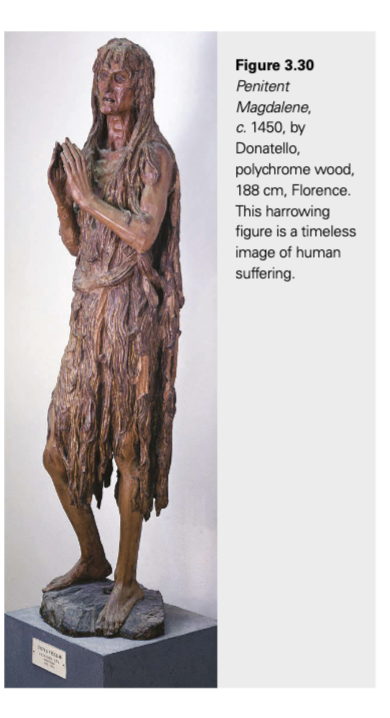
Look closely: Donatello — Penitent Magdalene: polychrome wood, suffering and emotional realism
This sculpture uses polychrome wood, rough texture and an emaciated body to communicate penitence and spiritual suffering. The subject is Mary Magdalene after repentance, shown without ideal beauty. Donatello’s process makes the wood grain, thin limbs and clasped hands part of the emotional meaning, extending Renaissance naturalism into psychological realism.
Classical Sculpture Influence — Apollo Belvedere and Laocoön
Context note: Renaissance sculptors studied ancient Greek and Roman works to understand ideal proportion, contrapposto, anatomy, drapery and dramatic movement. Classical sculpture gave artists models for beauty, heroism and expressive bodies, helping them move beyond medieval stylisation.
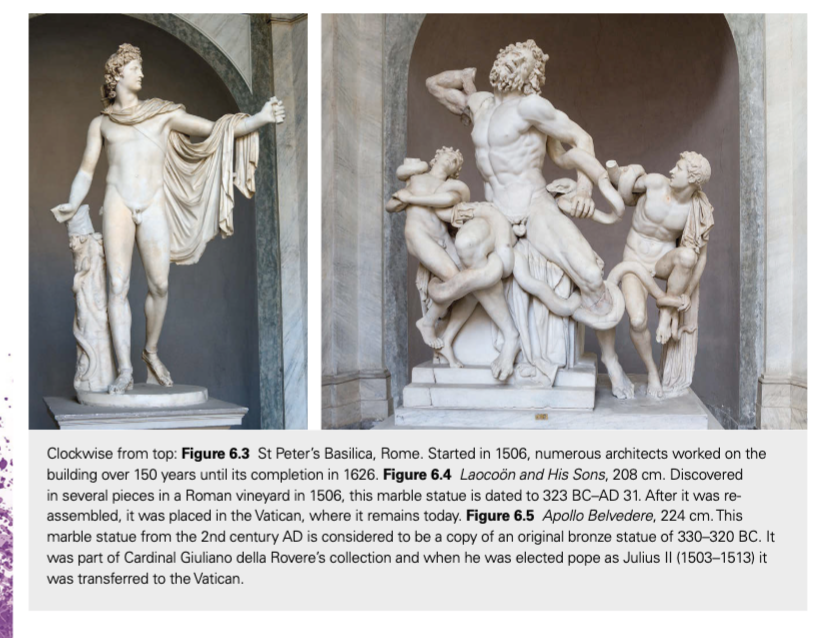
Look closely: Classical influence — Apollo Belvedere and Laocoön: ideal form and dramatic anatomy
These ancient sculptures offered Renaissance artists examples of ideal anatomy, balanced pose and powerful expression. Apollo suggests calm beauty and contrapposto, while Laocoön shows muscular tension, twisting movement and emotional drama. Studying such works encouraged new ideas about the human body, realism, heroic scale and sculpture in the round.
Legacy / influence: The Early Renaissance influenced later art through perspective, classical form and scientific observation. Its discoveries became essential tools for High Renaissance balance and later academic training.
4. High Renaissance
Context / main ideas: The High Renaissance brings harmony, ideal beauty and technical mastery to their fullest form. Leonardo, Michelangelo and Raphael combined anatomy, perspective, composition and emotional restraint. The major change is the balance between scientific observation and idealised perfection, creating artworks seen as models of classical order.
What is the High Renaissance?
The High Renaissance represents the peak of Renaissance art.
Artists achieved:
- perfect balance,
- harmony,
- ideal beauty,
- mastery of anatomy and perspective.
Main centre:
- Rome
Characteristics
- Monumental figures.
- Balanced composition.
- Calm harmony.
- Idealised beauty.
- Technical perfection.
Key Artists
Leonardo da Vinci
The Last Supper
Features
- Linear perspective.
- Psychological emotion.
- Balanced composition.
Innovation
- Sfumato technique.
- Scientific observation.
Michelangelo
David
Sistine Chapel Ceiling
Features
- Powerful anatomy.
- Monumental scale.
- Dramatic movement.
Raphael
The School of Athens
Features
- Perfect harmony and balance.
- Classical architecture.
- Philosophers from Ancient Greece.
High Renaissance and the Six Frameworks
Context
Humanism and papal patronage.
Artists and Artworks
Leonardo, Michelangelo, Raphael.
Analysis
Harmony, realism and ideal beauty.
Art Elements & Principles
- Balance,
- proportion,
- perspective,
- ideal form.
Media & Areas of Practice
Painting, sculpture, architecture.
Innovation & Invention
Anatomy studies, sfumato, perspective.
Artist, Artwork and Artefact Analysis: High Renaissance
High Renaissance case studies are grouped around harmony, ideal proportion, mastery of anatomy and balanced composition.
David
Key artist note: Michelangelo was a sculptor, painter, architect and poet whose work defines High Renaissance ambition. He studied anatomy intensely and treated the human body as a vehicle for power, beauty and spiritual struggle. He is useful for discussing ideal form, scale, tension and artistic genius.
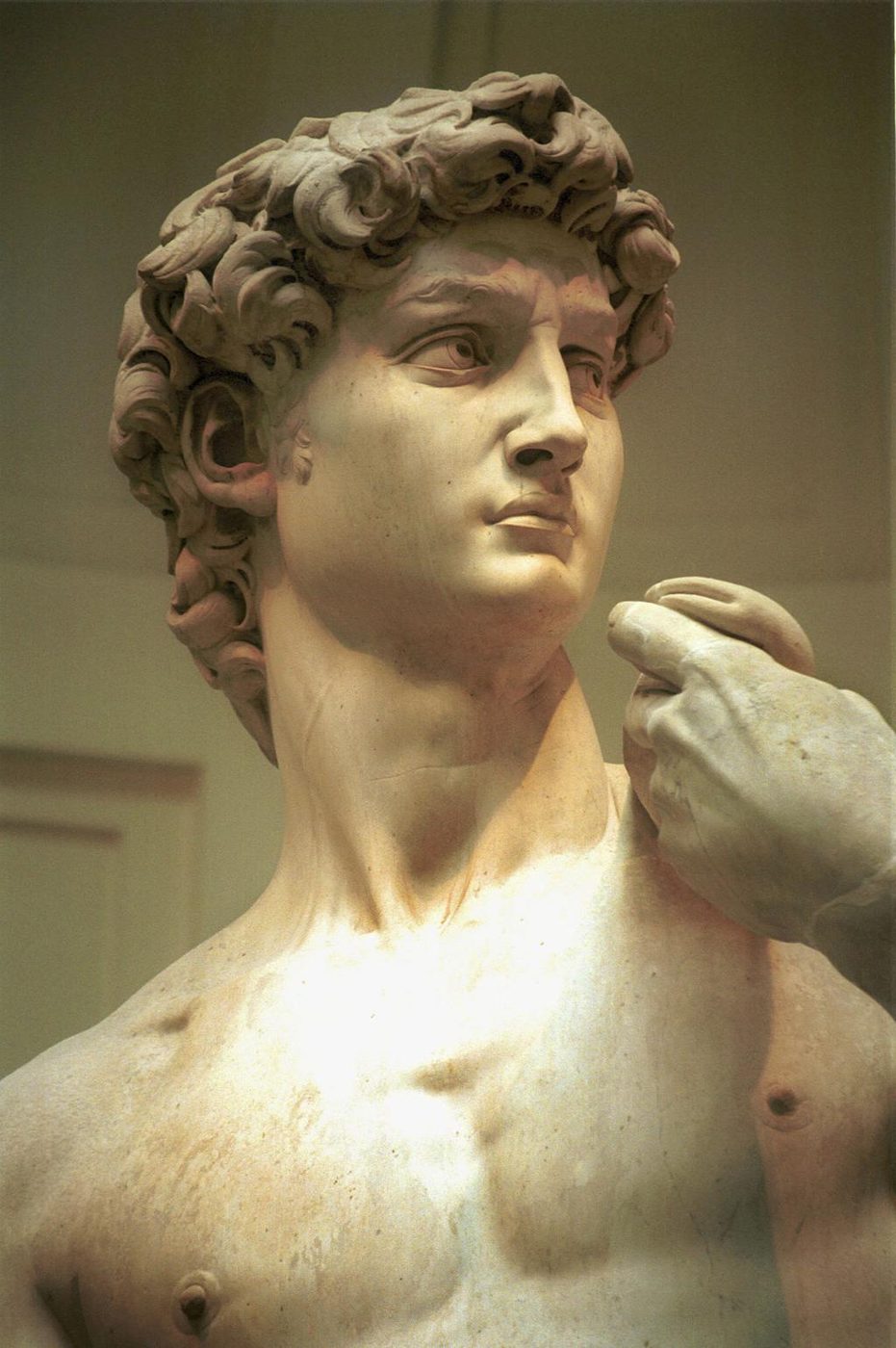
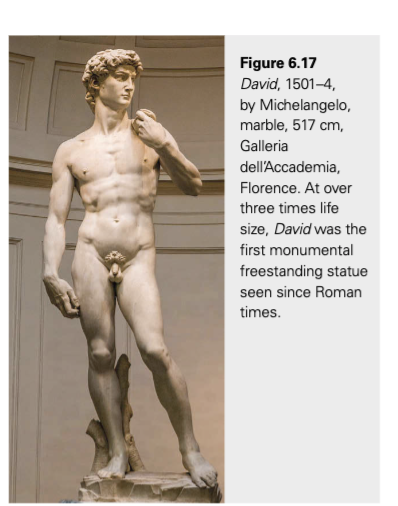
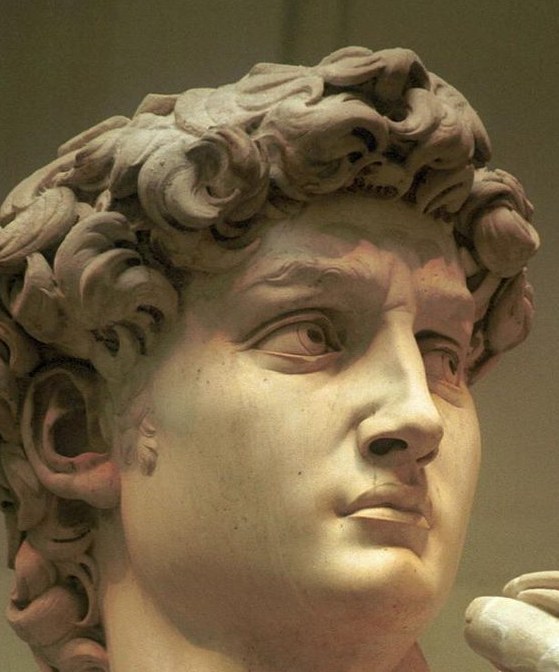
Look closely: Subject: heroic biblical youth. Style: High Renaissance idealism and anatomy. Technique: marble carving with precise surface finish. Composition: contrapposto pose creates tension before action. Meaning/Context: symbolises courage, civic freedom and human potential.
Michelangelo’s David presents heroic tension before action. Carved from marble, the figure combines ideal anatomy with psychological concentration. The enlarged hands, contrapposto and focused gaze communicate readiness and civic courage. Innovative in scale and emotional force, the sculpture became a symbol of human potential and Florentine resistance.
Mona Lisa
Key artist note: Leonardo da Vinci was a painter, engineer, anatomist and inventor whose art grew from close observation and scientific curiosity. He studied light, movement, anatomy and expression. He is useful for discussing sfumato, composition, psychological depth and the Renaissance ideal of the artist as thinker.
Look closely: Subject: seated portrait. Style: High Renaissance naturalism and psychological subtlety. Technique: oil glazing and sfumato. Composition: triangular pose and landscape unify figure and space. Meaning/Context: shows Leonardo’s interest in observation, mood and human presence.
Leonardo’s Mona Lisa explores identity, psychology and the mystery of human presence. Oil technique, sfumato and subtle modelling create lifelike softness. The sitter’s ambiguous smile and atmospheric landscape suggest inner thought. Innovative in emotional complexity, the portrait holds viewers through balance, gaze, light and unresolved interpretation.
Michelangelo — Sistine Chapel Ceiling
Key artist note: Michelangelo was a sculptor, painter, architect and poet whose work defines High Renaissance ambition. He studied anatomy intensely and treated the human body as a vehicle for power, beauty and spiritual struggle. He is useful for discussing ideal form, scale, tension and artistic genius.
Look closely: Subject: Genesis, prophets, sibyls and salvation history. Style: High Renaissance grandeur. Technique: fresco, foreshortening and sculptural anatomy. Composition: painted architecture organises many scenes. Meaning/Context: links creation, humanity, prophecy and Christian redemption.
Michelangelo’s ceiling transforms fresco into a vast theological and human drama. Prophets, sibyls, ignudi and Genesis scenes display muscular bodies, complex poses and monumental design. The process demanded physical endurance and invention. Its innovation lies in uniting architecture, painting and sculpture-like form, overwhelming viewers with divine creation.
The School of Athens
Key artist note: Raphael was admired for harmony, clarity and ideal beauty. His frescoes balance figures, architecture and meaning with calm control. The School of Athens is useful for discussing High Renaissance composition, classical influence, perspective, humanism and the way art can make complex intellectual ideas appear ordered and accessible.
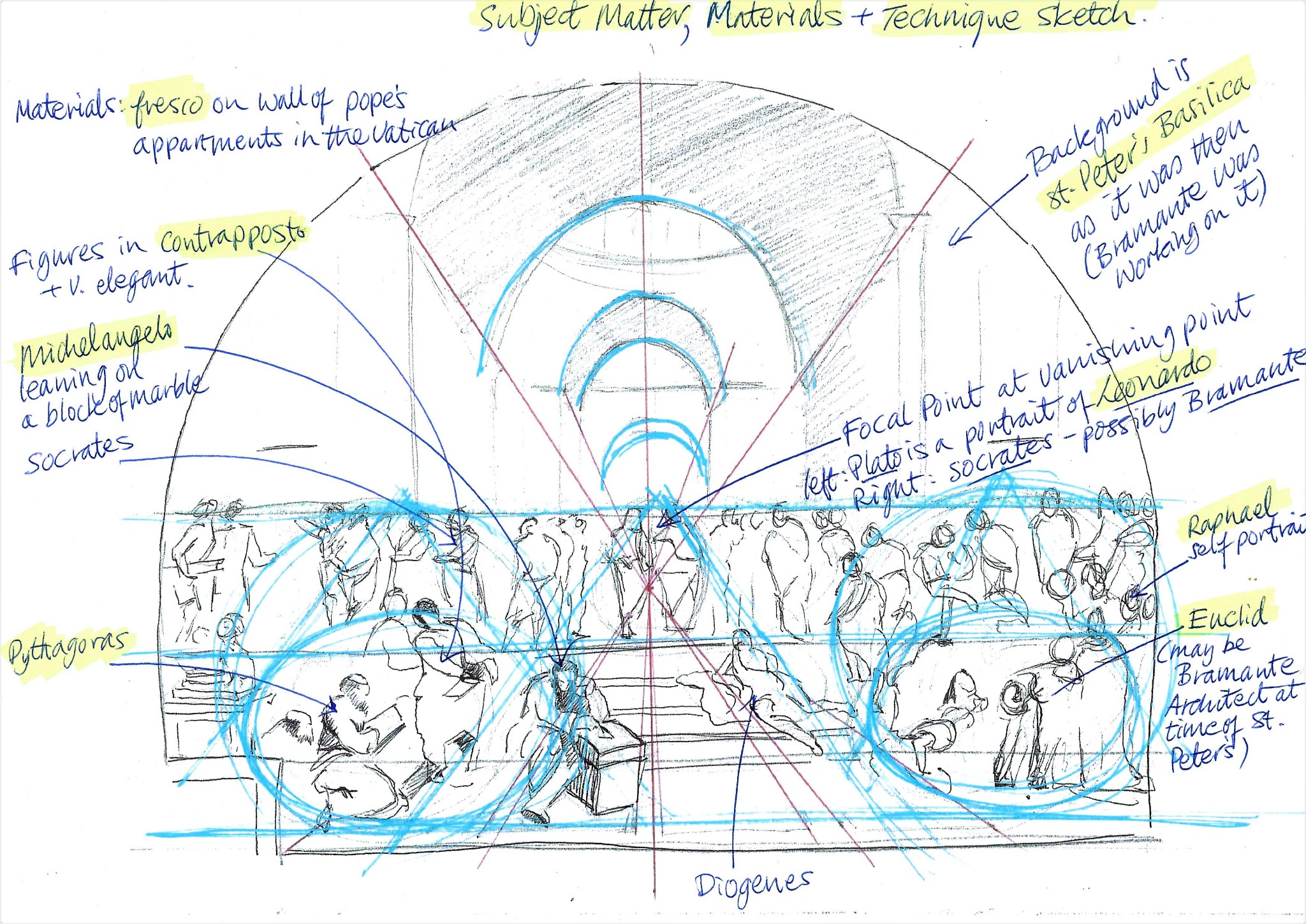
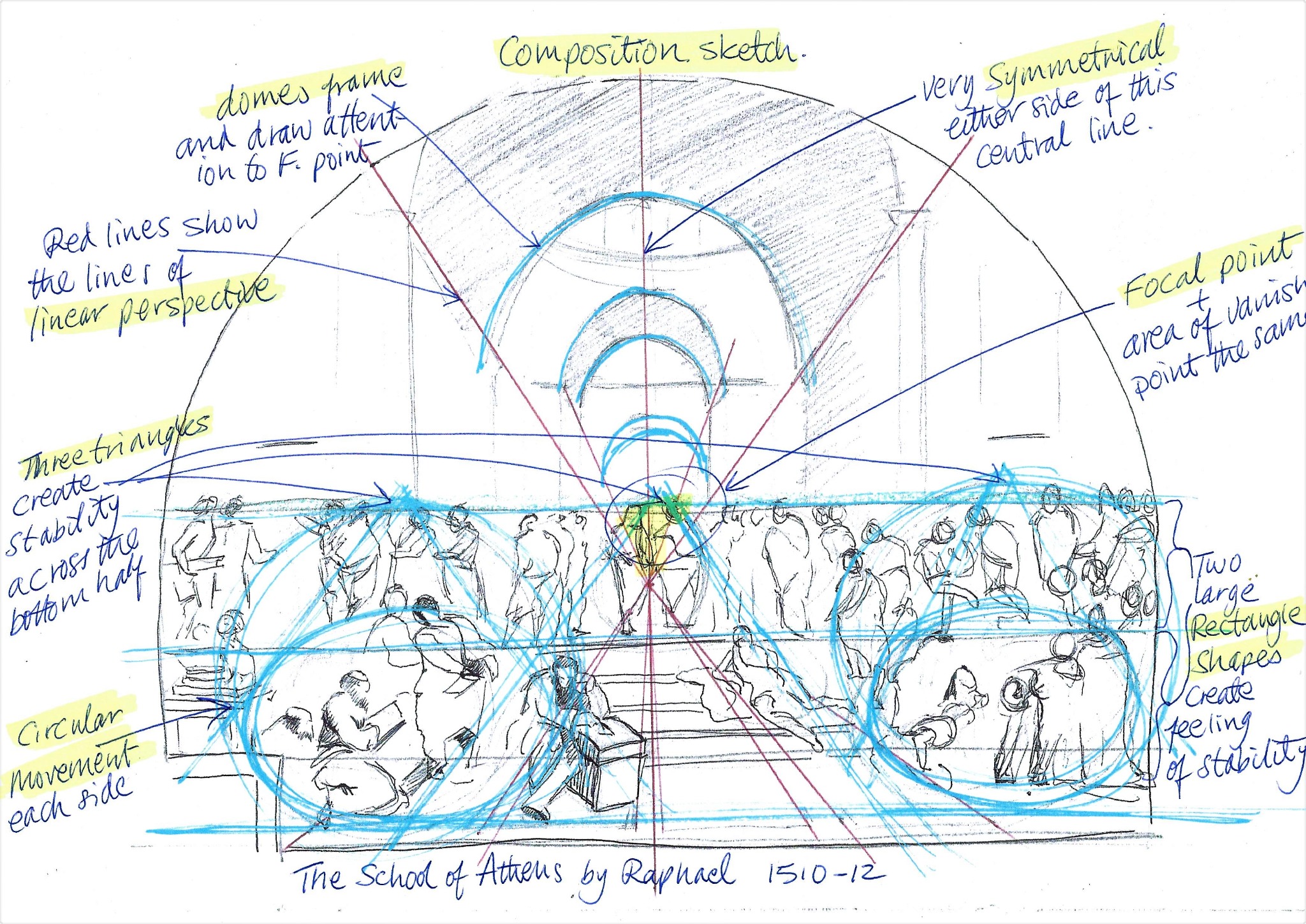
Look closely: Subject: ancient philosophers in an ideal architectural space. Style: High Renaissance harmony. Technique: fresco, perspective and classical figure design. Composition: central vanishing point focuses on Plato and Aristotle. Meaning/Context: celebrates reason, learning and Renaissance humanism.
Raphael’s School of Athens celebrates philosophy, reason and Renaissance humanism. Classical architecture, perspective and balanced grouping create intellectual order. Plato and Aristotle form the central focus, while surrounding thinkers embody knowledge. Fresco technique gives clarity and harmony. The work inspires viewers through beauty, balance and the dignity of thought.
Raphael — Sistine Madonna
Key artist note: Raphael was admired for harmony, clarity and ideal beauty. His paintings and frescoes balance figures, architecture and meaning with calm control. He is useful for discussing High Renaissance composition, classical influence, humanism, grace and the way art can make complex ideas appear effortless.
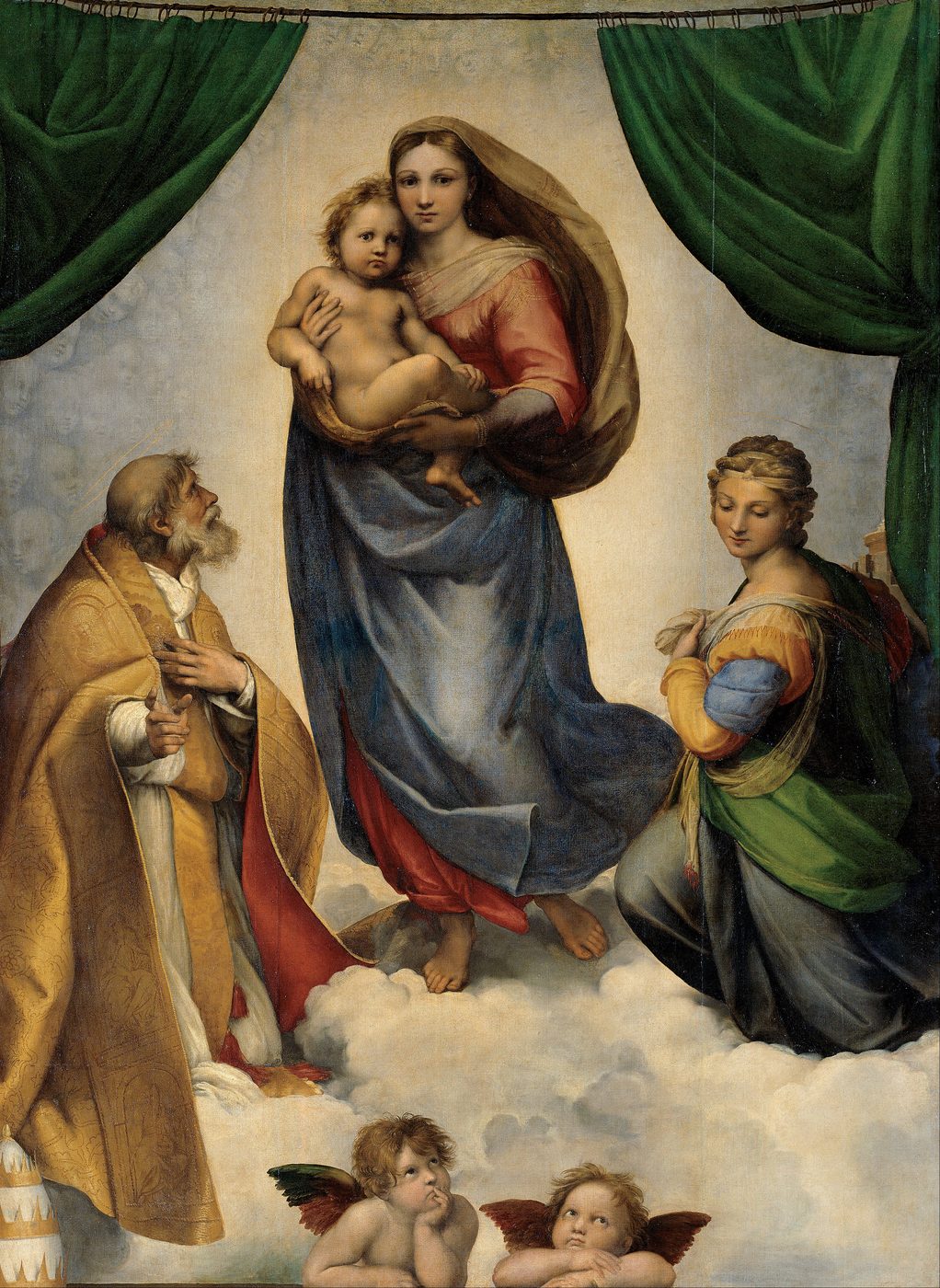
Look closely: Subject: Virgin, Child and saints. Style: High Renaissance grace and softness. Technique: oil/painting with gentle modelling and colour. Composition: central Madonna descends through curtains and clouds. Meaning/Context: blends devotion, ideal beauty and emotional accessibility.
Raphael’s Sistine Madonna combines spiritual vision with human tenderness. Mary appears to move forward through clouds, carrying Christ toward the viewer. Soft colour, balanced composition and idealised figures create grace. The work’s innovation lies in emotional accessibility, making divine figures feel present, compassionate and visually harmonious.
Michelangelo — Pietà
Key artist note: Michelangelo was central to High Renaissance sculpture because he combined anatomical knowledge, ideal beauty and emotional control. His marble works show extreme technical skill and a belief that the human body could express spiritual meaning, power and perfection.
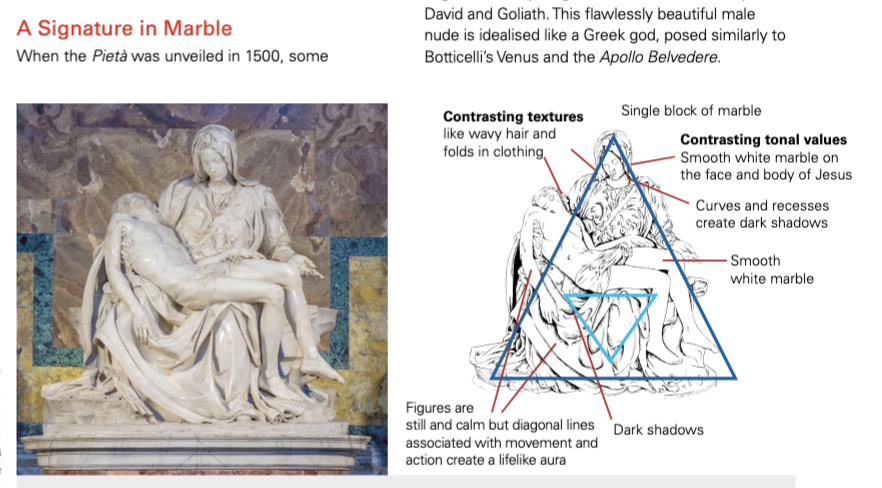
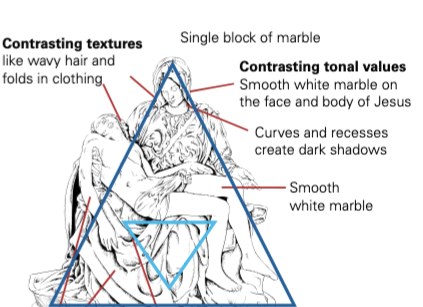
Look closely: Michelangelo — Pietà: triangular composition, marble texture and tonal contrast
The Pietà shows Mary holding the dead Christ in a calm triangular composition. The polished marble, smooth surfaces and balanced forms create restrained emotion. Its innovation lies in combining believable grief, ideal beauty and technical mastery within a single carved marble group.
Legacy / influence: The High Renaissance influenced later art by becoming a model of perfection, proportion and artistic genius. Baroque, academic and Neoclassical artists repeatedly studied its composition, anatomy and ideal beauty.
5. Mannerism
Context / main ideas: Mannerism developed after the High Renaissance and deliberately moved away from perfect balance and calm. Artists used elongated figures, unstable space, unusual colour and artificial elegance. The major change is that style becomes more expressive, complex and self-conscious, often creating tension instead of harmony.
What is Mannerism?
Mannerism developed from the technical mastery of the High Renaissance but deliberately unsettled its ideals. Artists stretched proportion, complicated poses and made space less stable, often favouring elegance, virtuosity and expressive tension over natural balance.
A useful comparison is: High Renaissance stability → Mannerist instability; ideal proportion → elongation; calm pose → twisting movement; clear space → ambiguity; effortless harmony → visible artistic difficulty.
Historical Context
Context
- Political instability in Italy.
- Sack of Rome (1527).
- Religious tensions during the Reformation.
Characteristics
- Elongated or deliberately distorted anatomy.
- Twisting poses and figura serpentinata.
- Compressed, crowded or ambiguous space.
- Unexpected scale relationships and sophisticated colour.
- Elegance, tension, theatricality and technical virtuosity.
- Compositions designed to reward multiple viewpoints, especially in sculpture.
Key Artist: Parmigianino
Madonna with the Long Neck
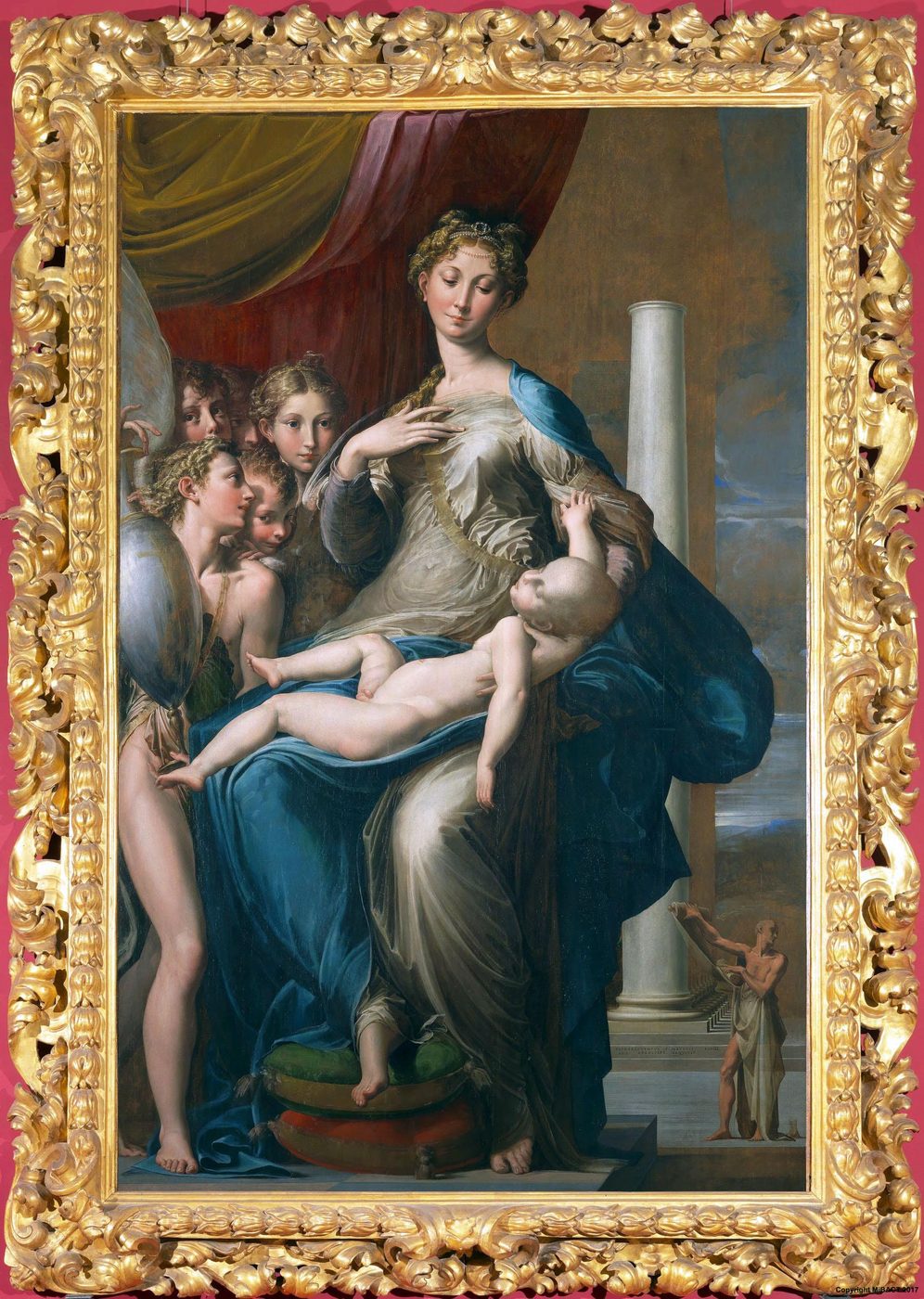
Analysis
- Elongated neck and body.
- Unnatural proportions.
- Elegant but unsettling composition.
Importance
- Classic example of Mannerist distortion.
Artist, Artwork and Artefact Analysis: Mannerism
Mannerist case studies are grouped around distortion, elegance, tension, elongated form and complex composition.
Madonna with the Long Neck
Key artist note: Parmigianino was a Mannerist painter known for elegance, distortion and technical skill. His elongated figures and refined surfaces move away from High Renaissance balance toward artificial beauty and tension. He is useful for discussing style, exaggeration, ambiguity and the idea of sophistication over naturalism.
Look closely: Parmigianino’s elongated figures, elegant distortion and unstable space show Mannerist style. Beauty is artificial, graceful and deliberately non-naturalistic.
Parmigianino’s Madonna with the Long Neck deliberately distorts proportion to create elegance, tension and artificial beauty. Elongated bodies, compressed space and cool colour reject High Renaissance balance. The painting’s Mannerist innovation lies in style over naturalism. Viewers sense refinement, spirituality and unease through graceful distortion.
Self-Portrait in a Convex Mirror
Key artist note: Parmigianino was a Mannerist painter known for elegance, distortion and technical skill. His elongated figures and refined surfaces move away from High Renaissance balance toward artificial beauty and tension. He is useful for discussing style, exaggeration, ambiguity and the idea of sophistication over naturalism.
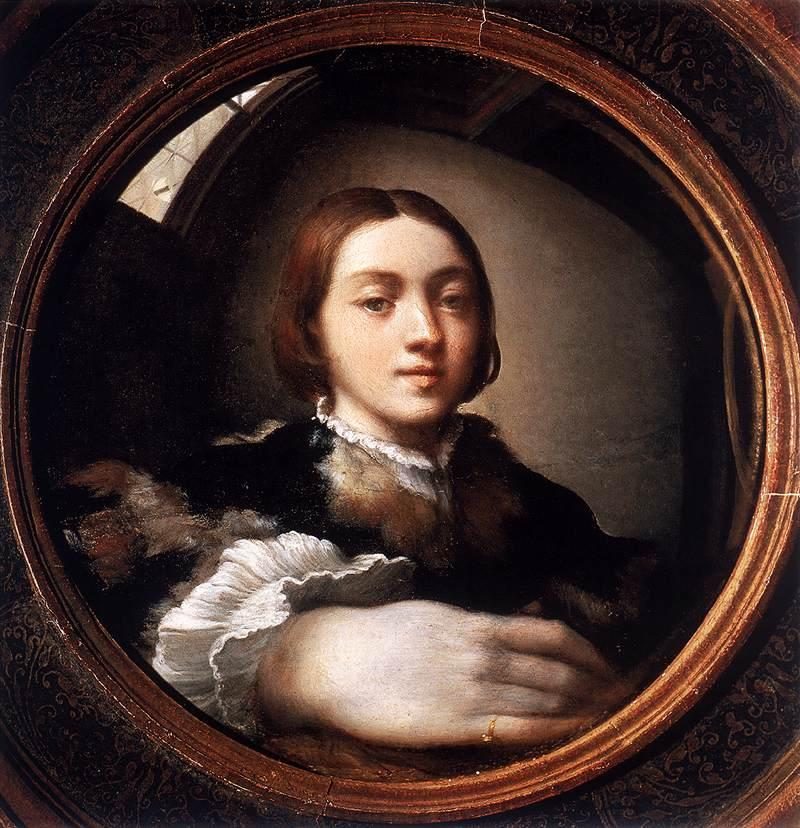
Look closely: Subject: artist’s reflection in a curved mirror. Style: Mannerist, witty and distorted. Technique: oil painting mimicking convex reflection. Composition: enlarged hand and curved space challenge realism. Meaning/Context: explores illusion, skill and artistic identity.
Parmigianino’s self-portrait uses distortion as invention and self-promotion. Painted on a convex wooden panel, it imitates a curved mirror. The enlarged hand, warped space and refined surface display technical brilliance. The work explores identity, illusion and artistic skill, making the viewer aware of perception itself.
Pontormo — The Deposition from the Cross
Key artist note: Pontormo was a Florentine Mannerist whose work is marked by unusual colour, emotional tension and unstable composition. His figures often seem weightless or psychologically unsettled. He is useful for discussing Mannerism as a reaction against High Renaissance order, balance and calm.
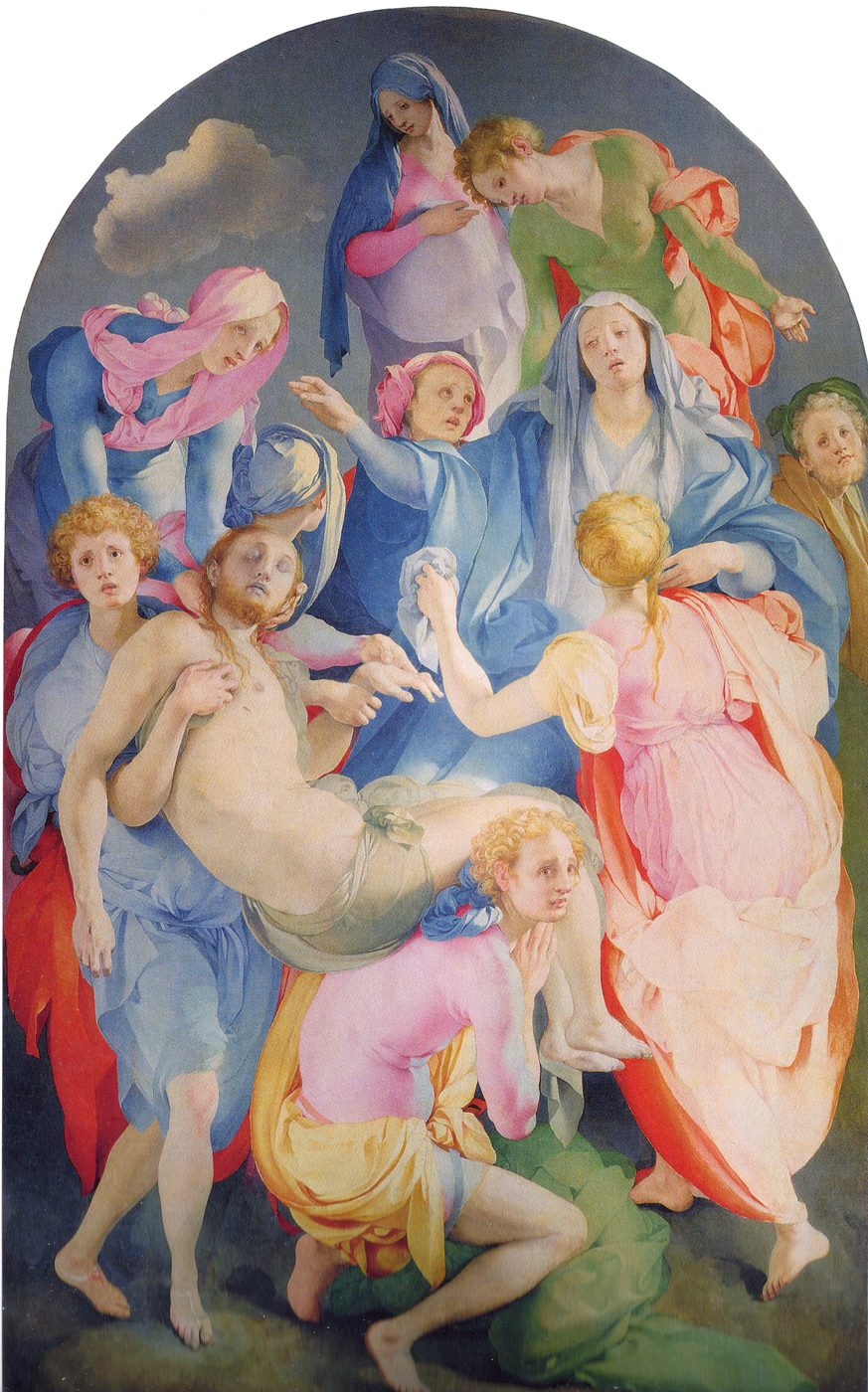
Look closely: Subject: mourners carrying Christ. Style: Mannerist, elongated and emotional. Technique: unusual colour, twisting figures and compressed space. Composition: unstable grouping creates anxiety. Meaning/Context: rejects calm Renaissance balance for spiritual tension.
Pontormo’s Deposition rejects stable Renaissance space in favour of emotional uncertainty. Floating figures, pastel colour and twisting bodies create spiritual tension. The composition lacks a clear cross or ground, making grief feel suspended. Its Mannerist innovation lies in expressive distortion, unsettling viewers through beauty, sorrow and instability.
The Crucifixion
Key artist note: Tintoretto was a Venetian painter known for dramatic movement, daring perspective and theatrical light. His rapid brushwork and energetic compositions pushed religious painting toward emotional intensity. He is useful for discussing Mannerist drama, Venetian colour, spirituality and the viewer’s sense of being pulled into the scene.
Look closely: Subject: Christ’s crucifixion with dramatic crowd. Style: Mannerist, theatrical and dynamic. Technique: strong diagonals, light and crowded figures. Composition: sweeping movement creates intensity. Meaning/Context: heightens religious drama and emotional participation.
Tintoretto’s Crucifixion is vast, crowded and emotionally intense. Multiple figures, diagonal movement and dramatic light create chaos around Christ’s sacrifice. Oil paint allows rich tonal depth and atmosphere. The work innovates through scale and theatrical composition, making viewers feel surrounded by the violence, grief and spiritual significance of the scene.
Benvenuto Cellini — Perseus with the Head of Medusa
Key artist note: Benvenuto Cellini was a Mannerist sculptor and goldsmith known for technical ambition, drama and virtuosity. His work is useful for discussing bronze casting, mythological subject matter, elite patronage and the Mannerist taste for complexity and theatrical display.
Perseus uses bronze, dramatic narrative and polished surface detail. The subject is mythological triumph, with Medusa’s severed head creating theatrical impact. The innovation is the difficult large-scale casting and the confident, complex figure designed for public viewing.
Giambologna — The Rape of the Sabine Women
Key artist note: Giambologna developed Mannerist sculpture through twisting movement, elegant proportion and multi-viewpoint design. His work is important because it moves beyond High Renaissance balance into spiral movement and complexity, encouraging viewers to walk around the sculpture.
This marble group uses figura serpentinata, interlocking bodies and deep undercutting. The subject is dramatic abduction, but the main visual idea is movement. Its innovation is a composition designed to be seen from all sides rather than from one fixed viewpoint.
Mannerist Sculpture: Key Examples
Mannerism and the Six Frameworks
1. Context
Mannerism developed after the achievements of the High Renaissance, especially in the decades around and after the Sack of Rome in 1527. Artists increasingly valued sophistication, invention, difficulty and expressive artificiality rather than simply repeating High Renaissance balance.
2. Artists & Artworks
Parmigianino's Madonna with the Long Neck demonstrates elongation and unstable scale; Cellini's Perseus uses theatrical bronze virtuosity; Giambologna's Rape of the Sabine Women turns intertwined bodies into a multi-viewpoint spiral.
3. Analysis
Look for deliberate departures from natural stability: stretched bodies, compressed or ambiguous space, unexpected scale, twisting poses and compositions that resist a single calm viewpoint. Explain how these choices create elegance, tension or theatricality.
4. Art Elements & Principles
High Renaissance balance gives way to asymmetry or instability; calm pose becomes twisting movement; ideal proportion becomes elongation; clear spatial recession may become compressed or uncertain. Line, silhouette and rhythm often become more conspicuous and decorative.
5. Media & Areas of Practice
Painting, bronze and marble sculpture all support Mannerist experimentation. Bronze casting allows Cellini a complex silhouette and projecting limbs; marble carving and deep undercutting allow Giambologna to interlock three bodies into a continuous upward movement.
6. Innovation & Invention
Mannerist artists made difficulty itself expressive. Figura serpentinata, multi-viewpoint sculpture, exaggerated anatomy and deliberately artificial space show artists testing how far Renaissance skills could be pushed beyond naturalism and equilibrium.
Legacy / influence: Mannerism influenced later art by showing that distortion, tension and artificiality could be expressive choices. It helped lead toward Baroque drama and later modern experiments with form and psychological unease.
6. Comparison Table
| Feature | Proto-Renaissance | Renaissance | High Renaissance | Mannerism |
|---|---|---|---|---|
| Style | Transitional realism | Balanced realism | Ideal perfection | Distortion/artificiality |
| Space | Limited depth | Linear perspective | Perfect perspective | Unstable space |
| Figures | Emotional | Naturalistic | Idealised | Elongated |
| Mood | Religious emotion | Calm balance | Harmony | Tension/drama |
7. Important Terms
| Term | Meaning |
|---|---|
| Humanism | Focus on human potential and learning |
| Linear Perspective | Mathematical illusion of depth |
| Sfumato | Soft smoky blending |
| Fresco | Painting on wet plaster |
| Chiaroscuro | Strong light and dark contrast |
| Contrapposto | Natural weight shift in figure |
| Mannerism | Stylised distorted Renaissance style |
8. Possible Exam Topics
Possible areas to prepare:
- Development of realism.
- Humanism and classical influence.
- Perspective and scientific observation.
- Patronage and the Medici/Pope.
- Comparison between Renaissance and Mannerism.
- The changing representation of the human figure.
Leaving Cert Art Study Guide & Notes
Legacy / influence: The Renaissance sequence influenced almost every later European art tradition. Perspective, anatomy, classical ideals, artist status and expressive style became foundations for academic art, Baroque drama and modern art history.
Romanesque Art & Architecture • Gothic Art & Architecture
Context / main ideas: Romanesque and Gothic art show how medieval Europe used architecture, sculpture, manuscripts and stained glass to teach Christianity. The major change is from heavy, fortress-like Romanesque buildings to taller, lighter Gothic structures.
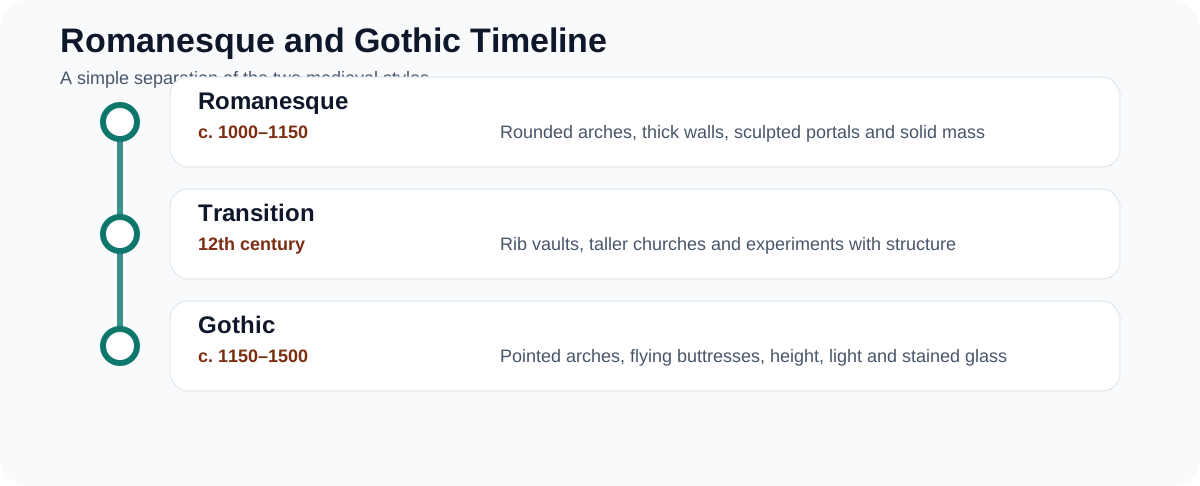
Study structure for this section
Students should understand and be able to describe and discuss the context that informed and led to the chosen period/movement using the six elements listed below.
Students should understand and be able to describe and explain the period/movement using the six elements listed below.
The framework is structured around six elements:
1. Overview Timeline
| Style | Dates | Main Features |
|---|---|---|
| Romanesque | c. 1000–1150 | Thick walls, rounded arches, solid forms |
| Gothic | c. 1150–1500 | Height, light, pointed arches, stained glass |
2. Romanesque Art & Architecture
Context / main ideas: Romanesque art developed in a medieval society shaped by pilgrimage, monasteries and church authority. Buildings used rounded arches, thick walls, small windows, barrel vaults and carved portals. The major idea is protection and instruction: architecture feels solid, while sculpture teaches religious stories to worshippers.
What is Romanesque Art?
Romanesque art developed across Europe during the Middle Ages.
The name “Romanesque” means “Roman-like” because the style was inspired by Ancient Roman architecture.
Romanesque churches were designed to:
- inspire religious devotion,
- accommodate pilgrims,
- demonstrate the power of the Church.
Historical Context
Context
- Christianity dominated medieval Europe.
- Pilgrimages became important.
- Monasteries grew in power.
- Europe was politically unstable after the fall of Rome.
Churches became centres of religion, education and community life.
Characteristics of Romanesque Architecture
- Thick stone walls.
- Rounded arches.
- Barrel vaults.
- Small windows.
- Heavy solid appearance.
- Decorative stone carving.
- Symmetrical plans.
Key Building: Durham Cathedral
Analysis
- Massive thick walls.
- Rounded arches create rhythm.
- Stone vaulting gives strength and monumentality.
- Small windows create dim spiritual atmosphere.
Importance
- One of the finest Romanesque buildings in Europe.
- Early use of rib vaulting influenced Gothic architecture.
Romanesque Sculpture
Tympanum Sculpture
Autun Cathedral
Last Judgement Tympanum
Features
- Carved above church doorway.
- Religious scenes taught biblical stories.
- Elongated expressive figures.
- Dramatic symbolism of Heaven and Hell.
Function
- Educated largely illiterate population.
- Inspired fear and devotion.
Romanesque Painting & Manuscripts
- Religious themes dominated.
- Flat stylised figures.
- Strong outlines and decorative pattern.
- Illuminated manuscripts remained important.
Romanesque and the Six Frameworks
Context
Power of the Church and pilgrimage culture.
Artists and Artworks
Durham Cathedral, Gislebertus.
Analysis
Solid forms, symbolism and religious teaching.
Art Elements & Principles
- Repetition,
- symmetry,
- texture,
- mass,
- rhythm through arches.
Media & Areas of Practice
Stone architecture, sculpture, manuscripts.
Innovation & Invention
Stone vaulting and large-scale church construction.
Legacy / influence: Romanesque art influenced later architecture through its structural clarity, monumental sculpture and narrative church portals. Gothic builders developed many Romanesque ideas while seeking greater height, light and complexity.
3. Gothic Art & Architecture
Context / main ideas: Gothic art grew from changing urban life, cathedral building and new engineering. Pointed arches, rib vaults, flying buttresses and stained glass allowed buildings to rise higher and fill with light. The major change is from heavy protective mass to verticality, luminosity, detail and spiritual aspiration.
What is Gothic Art?
Gothic art developed in France in the 12th century and spread across Europe.
Gothic cathedrals aimed to create:
- height,
- light,
- spiritual awe,
- heavenly atmosphere.
Historical Context
Context
- Growth of towns and cities.
- Increased wealth and trade.
- Strong Church influence.
- Advances in engineering.
Cathedrals became symbols of civic pride and religious devotion.
Characteristics of Gothic Architecture
- Pointed arches.
- Rib vaults.
- Flying buttresses.
- Tall stained-glass windows.
- Vertical emphasis.
- Ornate decoration.
Key Building: Chartres Cathedral
Analysis
- Strong vertical movement draws eye upward.
- Stained glass fills interior with coloured light.
- Pointed arches create elegance and height.
- Flying buttresses support thinner walls.
Importance
- Masterpiece of Gothic architecture.
- Demonstrates engineering innovation.
Gothic Sculpture
Reims Cathedral
Features
- More naturalistic figures.
- Greater movement and realism.
- Figures integrated into architecture.
Gothic Stained Glass
Sainte-Chapelle
Features
- Coloured biblical storytelling.
- Light symbolised divine presence.
- Decorative geometric patterns.
Gothic Painting
- More naturalism and emotion.
- Greater interest in space and realism.
- Rich colours and gold backgrounds.
Gothic and the Six Frameworks
Context
Urban growth and Church power.
Artists and Artworks
Chartres Cathedral, Reims Cathedral.
Analysis
Height, light and spirituality.
Art Elements & Principles
- Verticality,
- rhythm,
- light,
- pattern,
- emphasis.
Media & Areas of Practice
Architecture, stained glass, sculpture.
Innovation & Invention
Flying buttresses, rib vaults, stained glass engineering.
1. Romanesque Art & Architecture
Romanesque examples are grouped around mass, rounded arches, pilgrimage, carved portals and sacred authority.
Durham Cathedral
Culture / patronage note: Romanesque buildings were created by teams of masons, sculptors and patrons rather than modern named artists. Their culture centred on pilgrimage, monastic life and church authority. Heavy stone, rounded arches and carved portals helped communicate protection, sacred power and Christian teaching to medieval communities.
Look closely: Subject: Romanesque cathedral architecture. Style: massive, rounded and protective. Technique: stone vaulting, piers and arches. Composition: nave rhythm leads the viewer forward. Meaning/Context: expresses Norman power, pilgrimage and medieval Christian order.
Durham Cathedral expresses Romanesque strength through massive stone walls, rounded arches and ribbed vaulting. Its structure communicates religious authority and engineering innovation. Repeated columns, carved patterns and strong rhythm guide the viewer through sacred space. The building’s scale and solidity create awe, protection and spiritual permanence.
Autun Cathedral
Culture / patronage note: Romanesque buildings were created by teams of masons, sculptors and patrons rather than modern named artists. Their culture centred on pilgrimage, monastic life and church authority. Heavy stone, rounded arches and carved portals helped communicate protection, sacred power and Christian teaching to medieval communities.
Look closely: Subject: Romanesque Last Judgement tympanum. Style: expressive, carved and didactic. Technique: stone relief with elongated figures. Composition: Christ dominates the portal centre. Meaning/Context: teaches salvation and warning to worshippers entering the church.
Autun Cathedral uses Romanesque architecture and sculpture to teach Christian belief. Heavy stone, rounded arches and carved portals create authority. Its design reflects pilgrimage culture and fear of judgement. The building’s mass, darkness and relief sculpture shape a powerful emotional response, making faith visible through structure and narrative.
Gislebertus — Last Judgement Tympanum
Key artist note: Gislebertus is associated with Romanesque sculpture at Autun, although medieval authorship can be complex. His name is linked to expressive carving, elongated figures and moral drama. He is useful for discussing church portals, pilgrimage audiences and sculpture as a teaching tool for Christian belief.
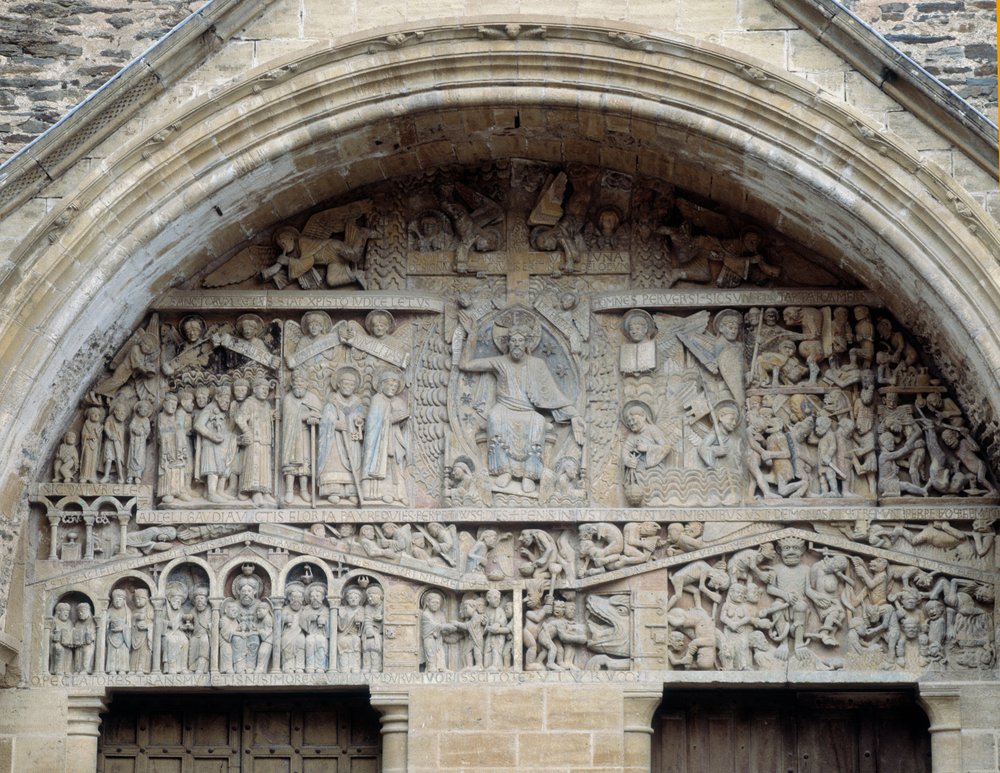
Look closely: The tympanum uses crowded relief, hierarchy and expressive figures to teach judgement and salvation. Its portal position made sculpture a powerful public religious warning.
The Last Judgement Tympanum uses dramatic carving to warn viewers about salvation and damnation. Elongated figures, expressive gestures and hierarchical scale heighten spiritual fear. Stone relief made theology public and immediate. The composition directs attention to Christ as judge, creating moral urgency for medieval worshippers entering the church.
Bayeux Tapestry
Culture / patronage note: Romanesque buildings were created by teams of masons, sculptors and patrons rather than modern named artists. Their culture centred on pilgrimage, monastic life and church authority. Heavy stone, rounded arches and carved portals helped communicate protection, sacred power and Christian teaching to medieval communities.
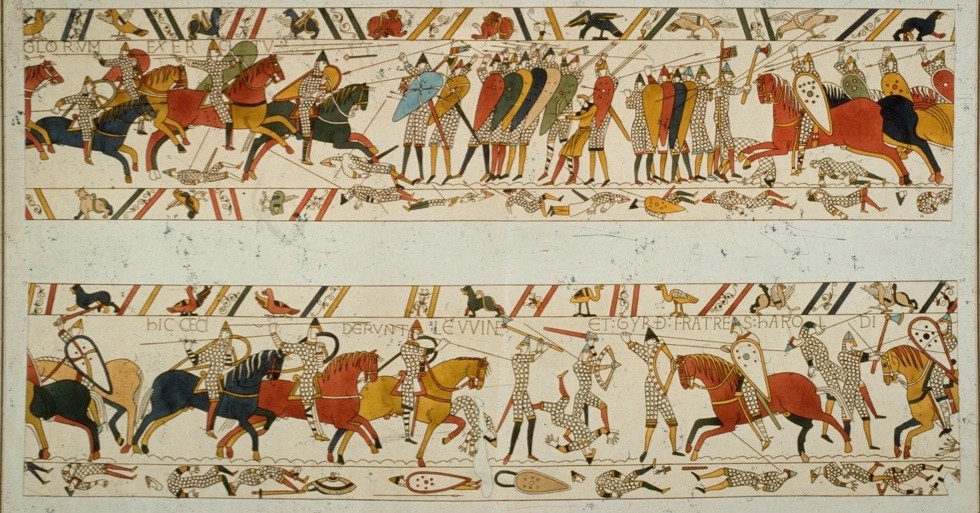
Look closely: Subject: Norman conquest narrative. Style: Romanesque, linear and storytelling. Technique: embroidery on linen. Composition: continuous scenes and inscriptions guide the viewer. Meaning/Context: records political propaganda, warfare and medieval visual communication.
A long narrative textile showing conquest, power and visual storytelling. Repeated figures, inscriptions and sequential scenes make it useful for discussing medieval communication, patronage, propaganda and the ability of craft to record historical events.
2. Gothic Art & Architecture
Gothic examples are grouped around height, light, pointed arches, stained glass, sculptural detail and spiritual elevation.
Chartres Cathedral
Culture / patronage note: Gothic cathedrals were collective achievements involving patrons, master masons, glass makers and sculptors. Their culture valued light, height and sacred storytelling. Pointed arches, stained glass and flying buttresses made churches feel visually uplifting, turning architecture into an experience of divine order and urban pride.
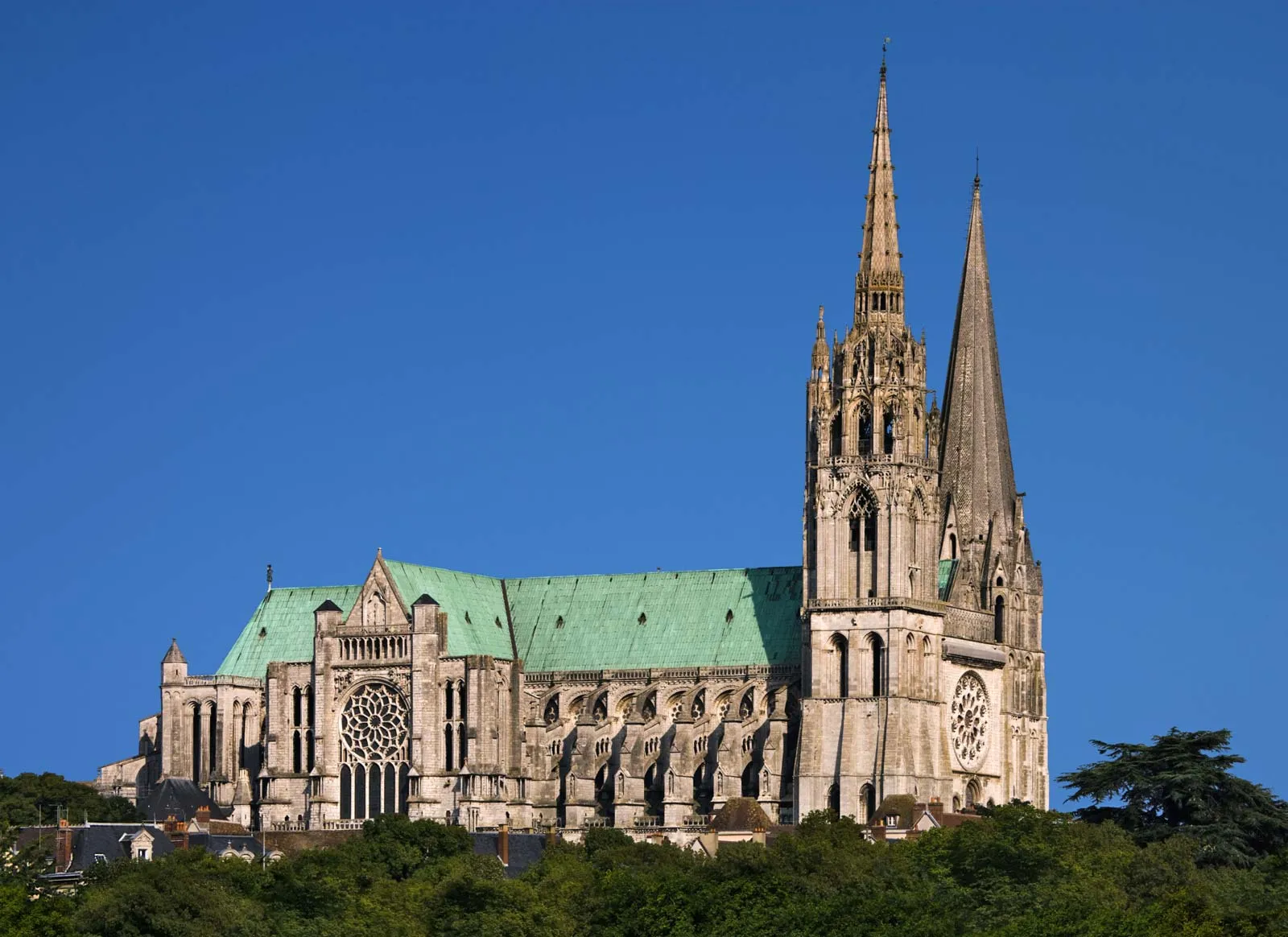
Look closely: Chartres shows Gothic height, pointed arches, flying buttresses and stained glass. Structure and light work together to create spiritual elevation and civic pride.
Chartres Cathedral embodies Gothic ambition through height, light and sacred geometry. Pointed arches, rib vaults, flying buttresses and stained glass create vertical movement and divine atmosphere. The building innovates structurally and spiritually, transforming stone into a framework for coloured light. Viewers experience awe, order and heavenly symbolism.
Reims Cathedral
Culture / patronage note: Gothic cathedrals were collective achievements involving patrons, master masons, glass makers and sculptors. Their culture valued light, height and sacred storytelling. Pointed arches, stained glass and flying buttresses made churches feel visually uplifting, turning architecture into an experience of divine order and urban pride.
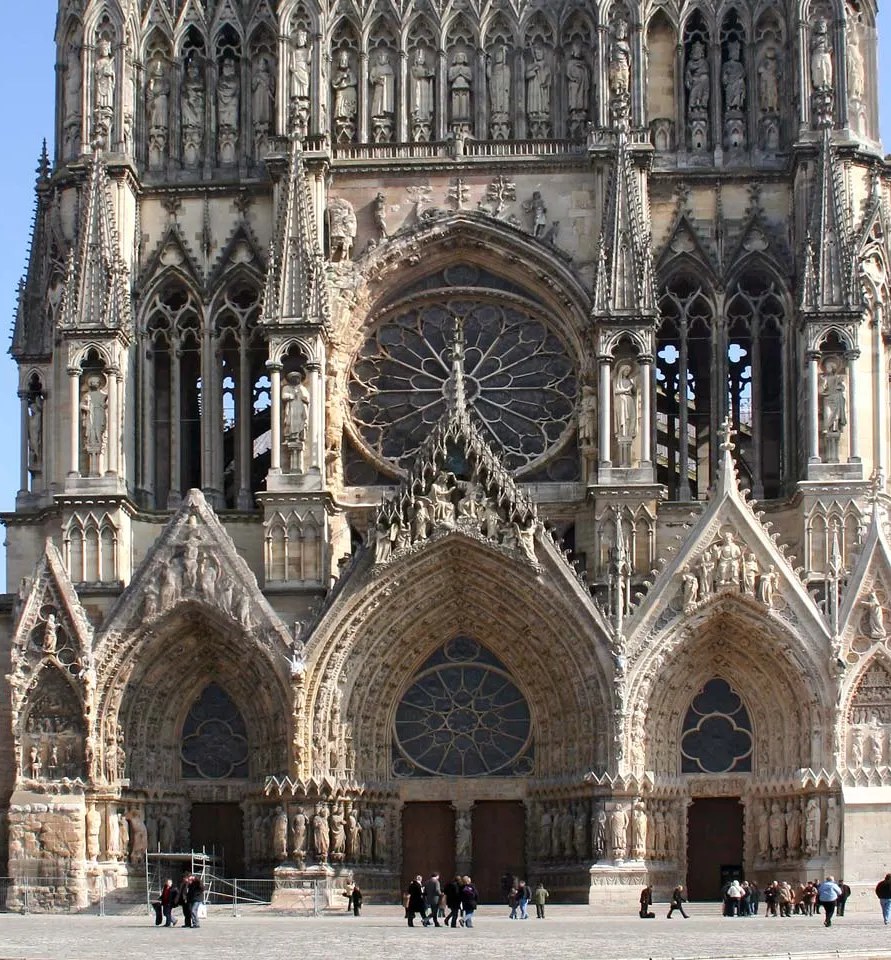
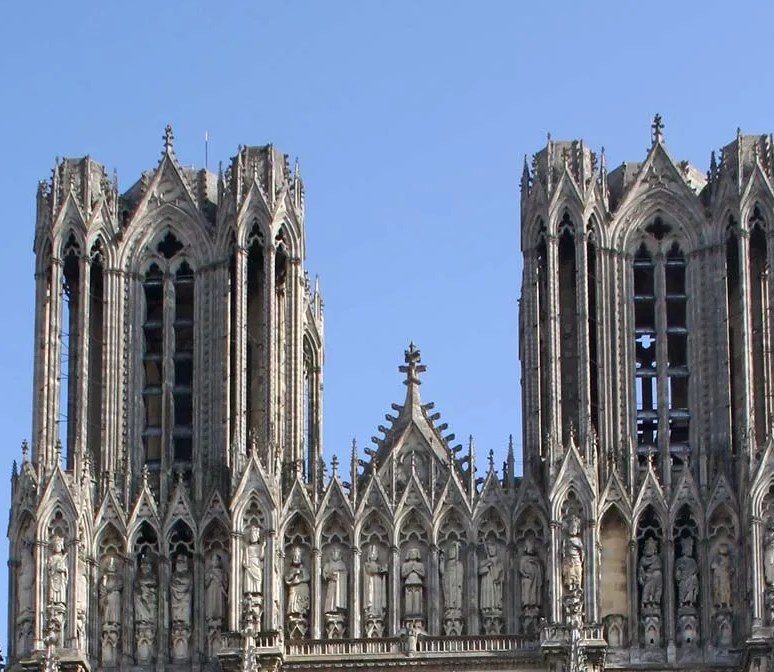
Look closely: Reims emphasises verticality, sculptural portals and royal symbolism. Pointed forms and façade sculpture create a richly decorated Gothic image of authority and faith.
Reims Cathedral combines Gothic architecture with royal and religious symbolism. Its tall façade, sculpted portals and stained glass communicate power and sacred authority. The smiling angel and figure sculpture show increasing naturalism. Vertical lines, pointed arches and decorative richness make the building both a coronation site and spiritual theatre.
Sainte-Chapelle
Culture / patronage note: Gothic cathedrals were collective achievements involving patrons, master masons, glass makers and sculptors. Their culture valued light, height and sacred storytelling. Pointed arches, stained glass and flying buttresses made churches feel visually uplifting, turning architecture into an experience of divine order and urban pride.
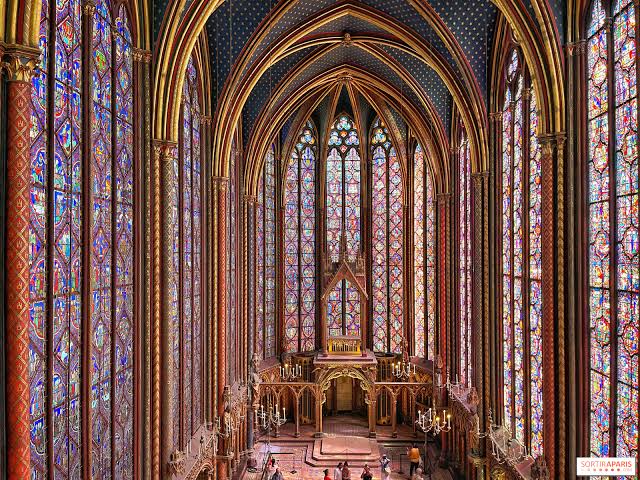
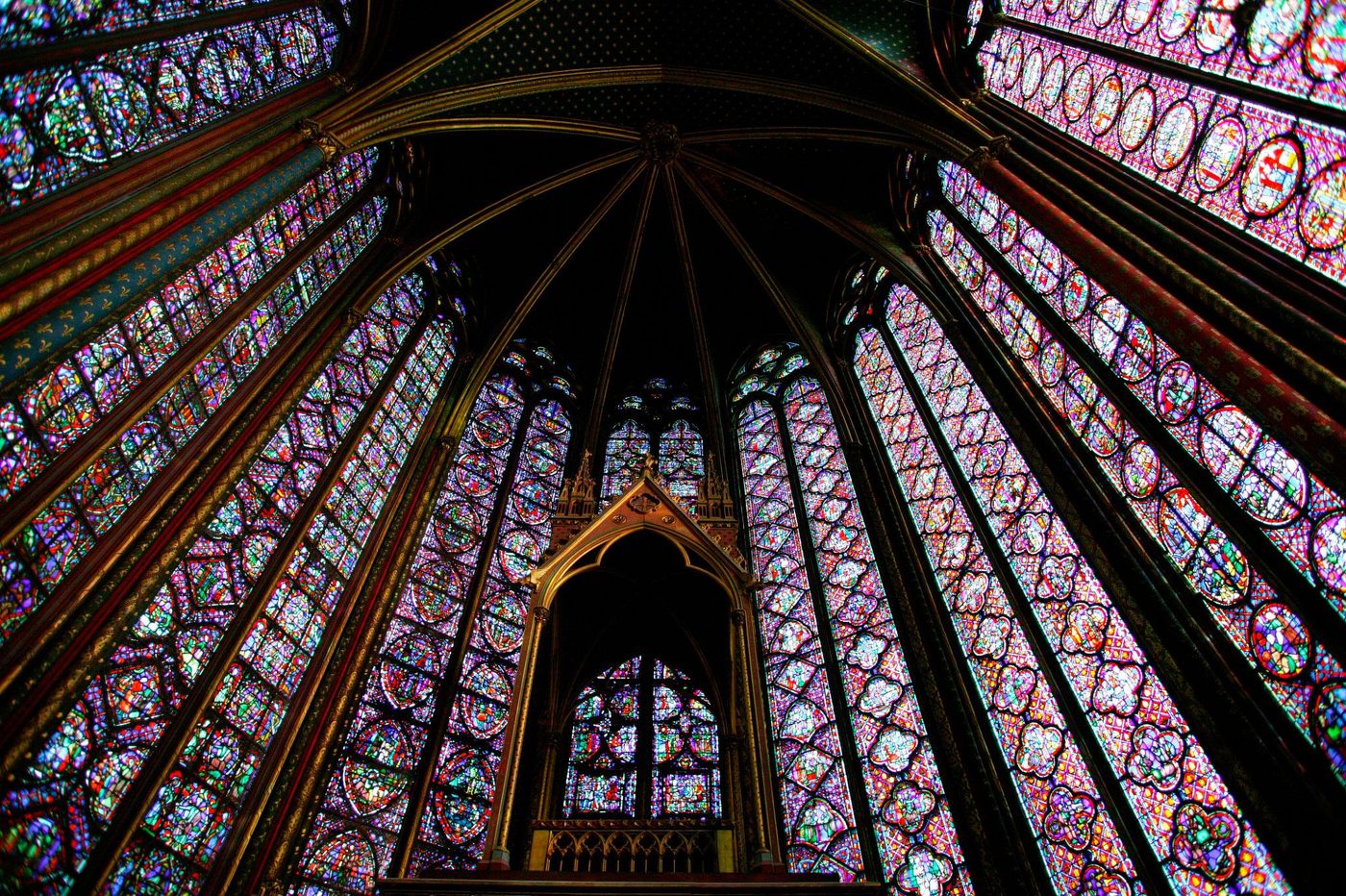
Look closely: Sainte-Chapelle turns architecture into coloured light. Tall windows, stained glass and delicate structure create an immersive sacred space focused on brilliance and devotion.
Sainte-Chapelle turns architecture into a container for light and relic devotion. Thin stone supports vast stained-glass windows, creating a jewel-like interior. Colour, height and biblical imagery surround the viewer. Its innovation lies in reducing wall mass, making glass, light and royal spirituality the dominant experience.
Notre-Dame de Paris
Culture / patronage note: Gothic cathedrals were collective achievements involving patrons, master masons, glass makers and sculptors. Their culture valued light, height and sacred storytelling. Pointed arches, stained glass and flying buttresses made churches feel visually uplifting, turning architecture into an experience of divine order and urban pride.
Look closely: Subject: Gothic cathedral architecture. Style: vertical, ornate and light-filled. Technique: pointed arches, rib vaults and flying buttresses. Composition: towers, portals and rose windows create symmetry. Meaning/Context: expresses civic faith, engineering and medieval spirituality.
A major Gothic cathedral associated with pointed arches, flying buttresses, rose windows, sculpture and height. Its structure turns stone into a framework for light and urban spectacle, helping students compare Gothic elevation with Romanesque solidity.
Legacy / influence: Gothic art influenced later architecture through verticality, stained glass, structural daring and immersive sacred space. It returned strongly in the Gothic Revival and still shapes cathedral conservation and design.
4. Romanesque vs Gothic Comparison
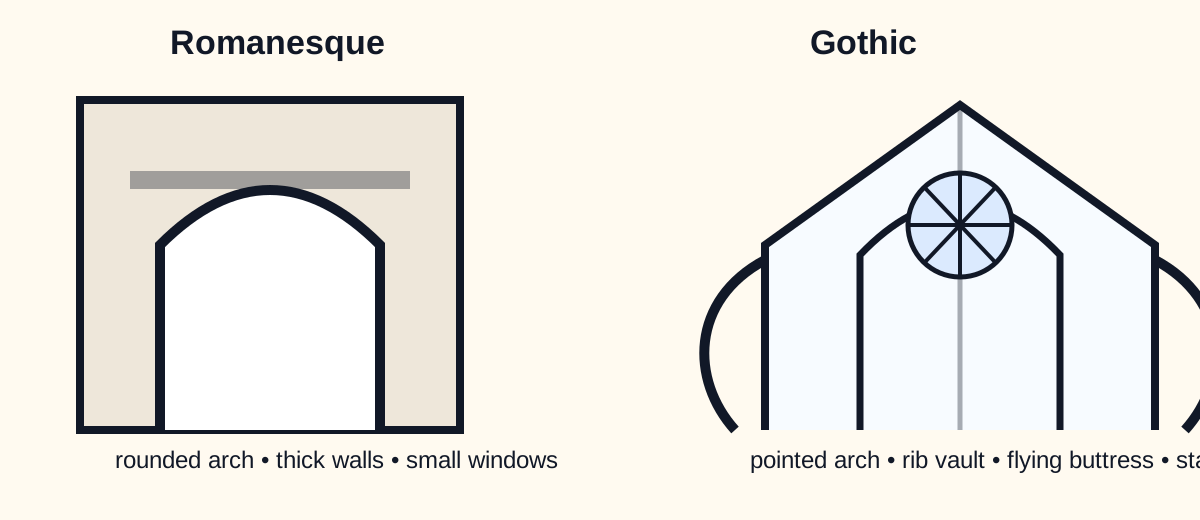
| Feature | Romanesque | Gothic |
|---|---|---|
| Arches | Rounded | Pointed |
| Walls | Thick/heavy | Thin/tall |
| Windows | Small | Large stained glass |
| Mood | Solid and protective | Light and spiritual |
| Decoration | Simple/heavy | Ornate/detailed |
| Structure | Barrel vault | Rib vault and flying buttress |
5. Important Terms
| Term | Meaning |
|---|---|
| Barrel Vault | Tunnel-shaped ceiling |
| Rib Vault | Vault supported by ribs |
| Flying Buttress | External support structure |
| Tympanum | Sculpted area above doorway |
| Nave | Main body of church |
| Clerestory | Upper window section |
| Pilgrimage | Religious journey |
6. Possible Exam Topics
Possible areas to prepare:
- Comparison of Romanesque and Gothic architecture.
- The role of religion in medieval art.
- Development of church engineering.
- Sculpture as religious teaching.
- Light and symbolism in Gothic cathedrals.
- The changing representation of the human figure.
Leaving Cert Art Study Guide & Notes
Legacy / influence: These medieval styles influenced later church building, Gothic Revival architecture and ideas about sacred space. Their arches, portals, stained glass and sculptural programmes remain key models for religious architecture.
Modernism (c. 1860–1970)
Context / main ideas: Modernism developed as artists responded to industrialisation, urban life, photography, war, psychology and the breakdown of traditional authority. It rejected fixed academic rules and experimented with colour, form, abstraction, materials and meaning.
Study structure for this section
Students should understand and be able to describe and discuss the context that informed and led to the chosen period/movement using the six elements listed below.
Students should understand and be able to describe and explain the period/movement using the six elements listed below.
The framework is structured around six elements:
1. What is Modernism?
Modernism was a major movement in art where artists rejected traditional academic styles and experimented with:
- colour,
- abstraction,
- new materials,
- distortion,
- technology,
- personal expression.
Modern artists wanted to create art that reflected the modern world.
Historical Context
Context
Modernism developed during:
- industrialisation,
- urbanisation,
- scientific discoveries,
- photography,
- world wars,
- political change.
Artists questioned traditional ideas about:
- beauty,
- realism,
- society,
- religion,
- representation.
Main artistic centres included:
- Paris
- Berlin
- New York City
2. Characteristics of Modernism
- Rejection of tradition.
- Experimentation.
- Abstraction.
- Simplification of form.
- Expressive colour.
- Interest in psychology and emotion.
- New perspectives and techniques.
3. Major Modernist Movements
A. Fauvism
Context / main ideas: Fauvism was influenced by Post-Impressionist colour and a desire for direct emotional impact. Matisse and other artists used intense non-naturalistic colour, simplified shapes and flat decorative space. The major change is that colour becomes expressive and independent rather than simply describing reality.
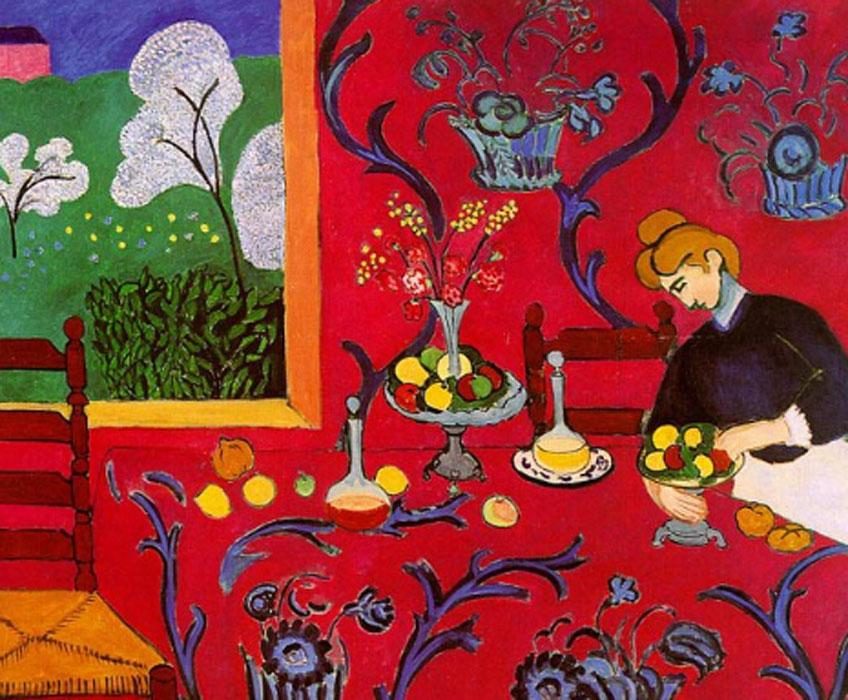
What is Fauvism?
Fauvism focused on:
- bold colour,
- simplified forms,
- emotional expression.
The name means “wild beasts.”
Key Artist: Henri Matisse
The Red Room
Features
- Flat decorative colour.
- Strong outlines.
- Simplified forms.
Innovation
- Colour used emotionally rather than realistically.
Legacy / influence: Fauvism influenced Expressionism, abstraction and modern design by proving colour could carry emotion and structure. It helped free painters from descriptive realism.
B. Expressionism
Context / main ideas: Expressionism grew from anxiety about modern life, psychology and emotional intensity. Artists such as Munch distorted figures, colour and space to show inner feeling rather than outward appearance. The major change is that art becomes a vehicle for fear, isolation, tension and subjective experience.
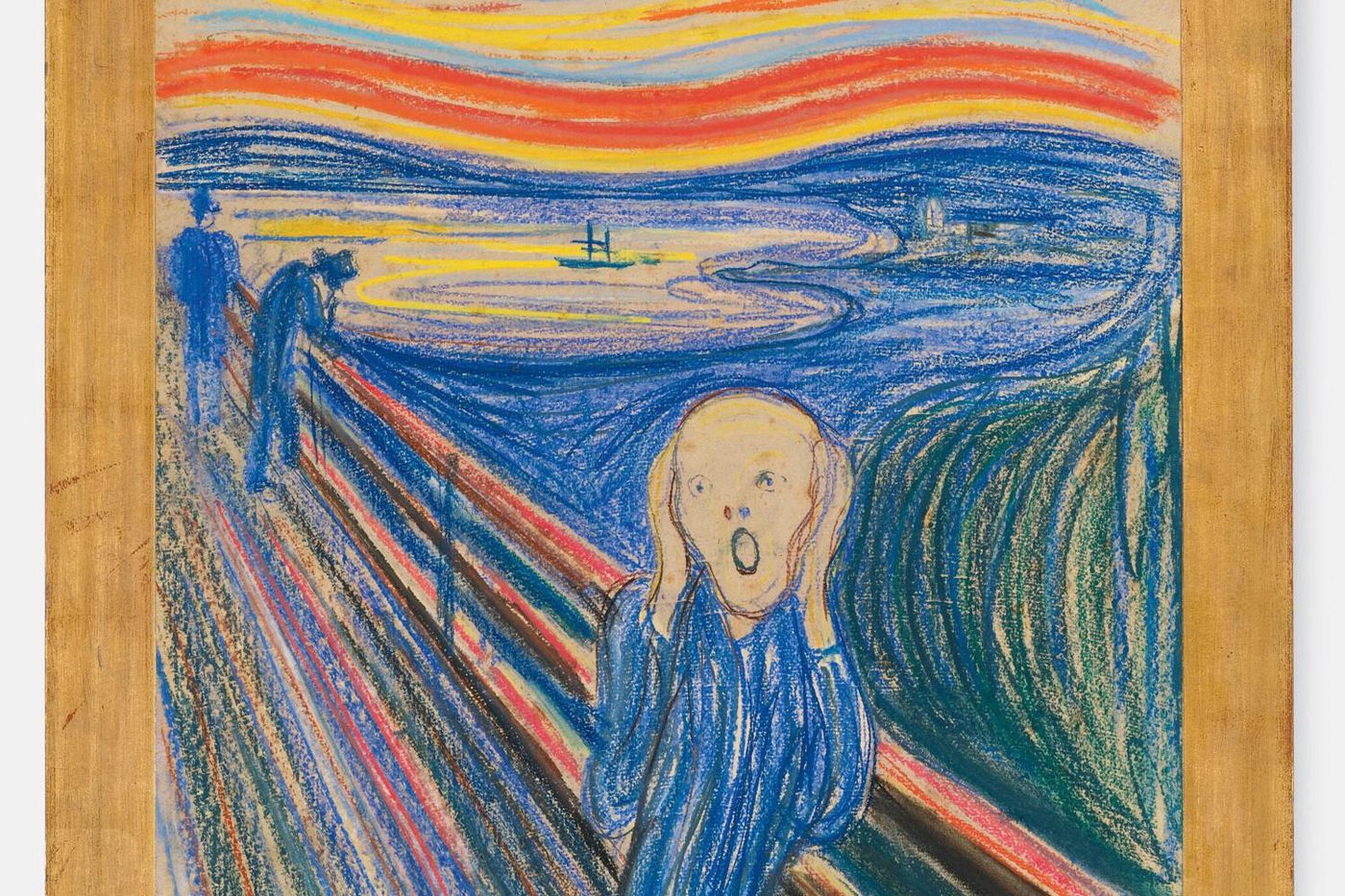
What is Expressionism?
Expressionist artists distorted reality to communicate emotion and psychological tension.
Key Artist: Edvard Munch
The Scream
Features
- Distorted figure.
- Swirling expressive lines.
- Emotional anxiety and fear.
Legacy / influence: Expressionism influenced later art by making emotion, distortion and personal vision central. It shaped Abstract Expressionism, post-war painting, film, graphic art and socially intense modern imagery.
C. Cubism
Context / main ideas: Cubism was influenced by Cézanne, African sculpture and new ideas about perception. Picasso and Braque broke objects into geometric planes and showed multiple viewpoints at once. The major change is the collapse of single-point perspective and the invention of a fragmented modern pictorial space.
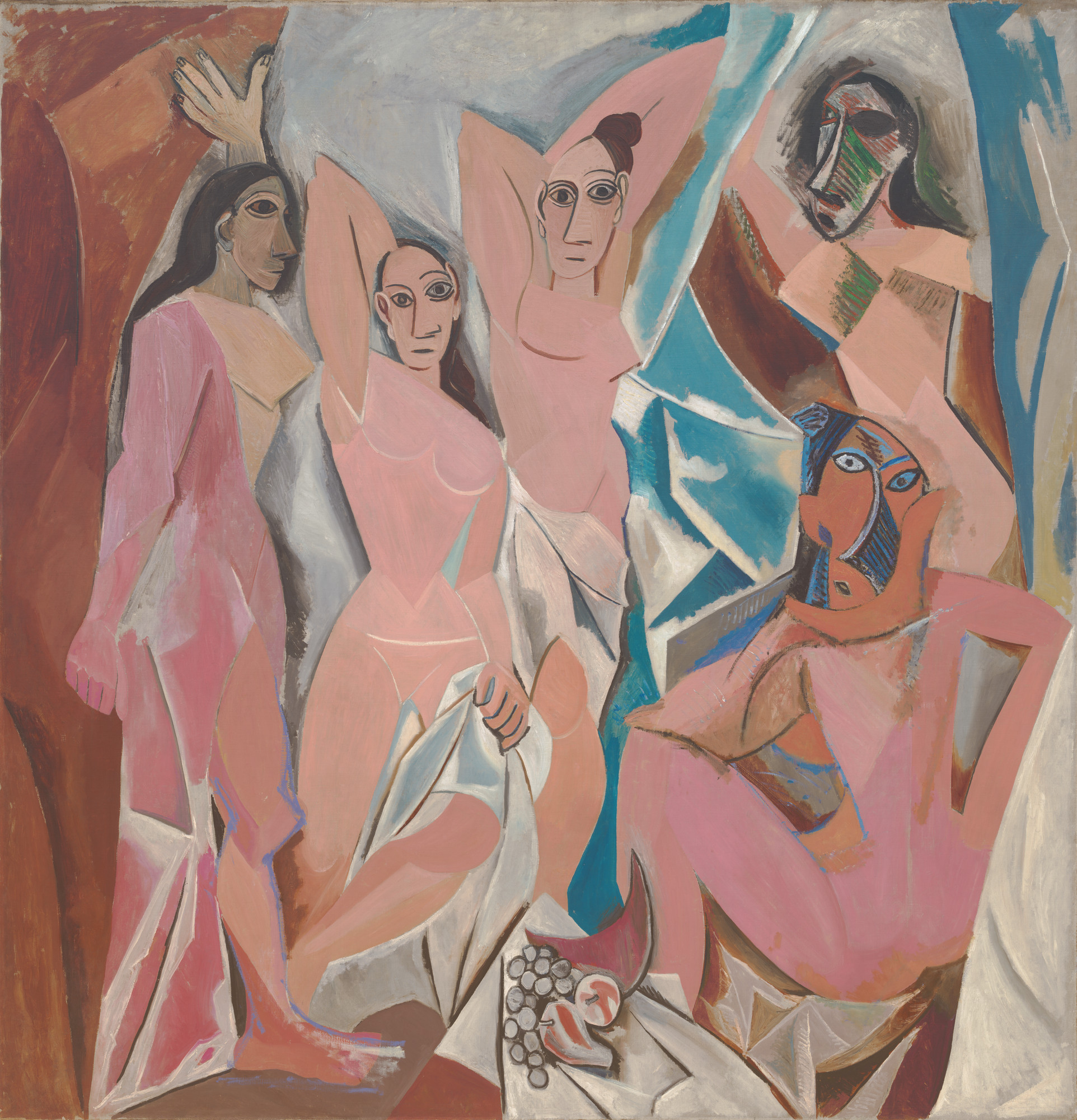
What is Cubism?
Cubism broke objects into geometric forms and showed multiple viewpoints at once.
Key Artists
Pablo Picasso
Georges Braque
Les Demoiselles d'Avignon
Features
- Fragmented forms.
- Multiple perspectives.
- Sharp angular shapes.
Innovation
- Revolutionary break from traditional perspective.
- Black, white and grey colour scheme.
- Fragmented Cubist forms.
- Symbolic figures including the bull, horse, grieving mother and fallen soldier.
- Dramatic contrast, distortion and emotional intensity.
Pablo Picasso’s Guernica is a major modern anti-war painting responding to the bombing of Guernica during the Spanish Civil War.
Guernica
Legacy / influence: Cubism influenced almost all later Modernism, including Futurism, Constructivism, abstraction, design and architecture. It changed how artists thought about space, form and representation.
D. Futurism
Context / main ideas: Futurism responded to machines, speed, cities, movement and modern technology. Artists such as Boccioni tried to show energy moving through time and space. The major change is that motion, industry and the dynamic pace of modern life become central subjects and visual principles.
What is Futurism?
Futurists celebrated:
- speed,
- machines,
- technology,
- modern urban life.
Key Artist: Umberto Boccioni
Unique Forms of Continuity in Space
Features
- Dynamic movement.
- Flowing machine-like forms.
Legacy / influence: Futurism influenced modern graphic design, performance, sculpture and kinetic art by making movement and technology artistic subjects. Later artists also challenged its political violence.
E. Dada
Context / main ideas: Dada developed during World War I as a rejection of logic, tradition and authority. Artists used absurdity, chance, collage, performance and readymades to attack conventional values. The major change is that idea, provocation and anti-art attitudes become more important than beauty or craftsmanship.
What is Dada?
Dada rejected logic and traditional art after World War I.
Artists used:
- absurdity,
- chance,
- satire,
- found objects.
Key Artist: Marcel Duchamp
Fountain
Innovation
- Introduced the “readymade.”
- Challenged definition of art itself.
Legacy / influence: Dada influenced Conceptual Art, performance, Pop Art, Fluxus and contemporary installation by making ideas, humour and found objects legitimate artistic strategies.
F. Surrealism
Context / main ideas: Surrealism was influenced by Freud, dreams and the unconscious mind. Artists such as Dalí combined realistic detail with impossible spaces and irrational imagery. The major change is that fantasy, memory, desire and psychological symbolism become more important than ordinary visible reality.
What is Surrealism?
Surrealists explored:
- dreams,
- the unconscious mind,
- fantasy,
- psychology.
Influenced by Freud’s psychoanalysis.
Key Artist: Salvador Dalí
The Persistence of Memory
Features
- Dream-like imagery.
- Illogical space.
- Hyper-realistic detail.
Legacy / influence: Surrealism influenced later film, photography, advertising, fantasy art, installation and psychological imagery. It made dreams, desire and the unconscious major sources for art.
G. Abstract Art
Context / main ideas: Abstract Art moved away from recognisable subject matter. Artists such as Kandinsky used colour, line, shape and rhythm to express spiritual, musical or emotional ideas. The major change is that form itself becomes the subject, allowing art to communicate without direct representation.
What is Abstract Art?
Abstract artists removed realistic subject matter and focused on:
- colour,
- line,
- shape,
- emotion.
Key Artist: Wassily Kandinsky
Composition VIII
Features
- Geometric abstraction.
- Musical rhythm through colour and line.
Legacy / influence: Abstract Art influenced modern design, architecture, Minimalism and Abstract Expressionism. It changed art by proving that non-representational forms could still carry meaning and emotion.
H. Abstract Expressionism
Context / main ideas: Abstract Expressionism developed after World War II and shifted the centre of avant-garde art to America. Artists such as Pollock used scale, gesture, colour and process to communicate intensity. The major change is that action, spontaneity and the artist’s body become part of meaning.
What is Abstract Expressionism?
Developed in New York after World War II.
Focused on:
- spontaneity,
- gesture,
- emotional energy.
Key Artist: Jackson Pollock
Number 1A, 1948
Innovation
- Drip painting technique.
- Action painting.
Artist, Artwork and Artefact Analysis
Henri Matisse — The Red Room
Key artist note: Henri Matisse was a leading modern artist who used bold colour, flattened space and decorative rhythm. He believed colour could create feeling and structure without strict realism. He is useful for discussing Fauvism, pattern, simplification, interior space and colour as an independent expressive force.
Look closely: Subject: domestic interior with figure and table. Style: Fauvist, flat and decorative. Technique: bold colour, pattern and simplified form. Composition: red surface unifies wall and table. Meaning/Context: colour expresses feeling rather than realistic space.
Matisse used intense colour and flattened space to create emotional harmony rather than realism. The red surface unifies wall and table, challenging traditional depth. Pattern, line and decorative rhythm dominate the composition. The work innovates through expressive colour, inviting viewers to experience painting as sensation, design and visual pleasure.
Edvard Munch — The Scream
Key artist note: Edvard Munch was a Norwegian artist whose work explored anxiety, isolation, illness and emotional intensity. His simplified forms and expressive colour influenced Expressionism. He is useful for discussing mood, symbolism, distortion, psychological subject matter and the modern idea that art can show inner experience.
Look closely: Subject: isolated figure in emotional crisis. Style: Expressionist and distorted. Technique: swirling line and unnatural colour. Composition: diagonal bridge and curves intensify anxiety. Meaning/Context: visualises modern fear, alienation and psychological tension.
Munch’s The Scream visualises anxiety, isolation and modern psychological distress. Distorted lines, unnatural colour and compressed space turn the landscape into emotion. The figure’s open mouth and curving forms create visual sound. The work innovates by making inner experience the subject, leaving viewers unsettled and empathetic.
Pablo Picasso — Les Demoiselles d’Avignon
Key artist note: Pablo Picasso was one of the most influential modern artists, moving through many styles and helping develop Cubism. He constantly reworked the human figure, space and tradition. He is useful for discussing innovation, fragmentation, political art, multiple viewpoints and the break from Renaissance perspective.
Look closely: Angular bodies, mask-like faces and multiple viewpoints break with naturalism and open the way to Cubism.
Picasso shattered traditional beauty, space and the female nude. Angular bodies, mask-like faces and fractured composition show experimentation with African and Iberian sources. The painting rejects Renaissance perspective and soft modelling. Its aggression, distortion and abstraction made it a radical breakthrough toward Cubism and modern visual language.
Pablo Picasso — Guernica
Key artist note: Pablo Picasso was one of the most influential modern artists, moving through many styles and helping develop Cubism. He constantly reworked the human figure, space and tradition. He is useful for discussing innovation, fragmentation, political art, multiple viewpoints and the break from Renaissance perspective.
Look closely: Guernica uses fractured form, monochrome tone and anguished symbols to protest war and civilian suffering.
Guernica uses fractured Cubist forms, grisaille colour and dramatic symbolic figures to condemn the bombing of the Basque town of Guernica during the Spanish Civil War. The horse, bull, grieving mother, fallen soldier and screaming figures create anguish and chaos. Picasso turns political violence into a universal anti-war image through scale, distortion, contrast and symbolism.
Umberto Boccioni — Unique Forms of Continuity in Space
Key artist note: Umberto Boccioni was a leading Italian Futurist interested in speed, machinery and modern energy. His sculpture and painting tried to show movement through space over time. He is useful for discussing dynamism, industrial modernity, fragmented form and the early twentieth-century excitement about technology.
Look closely: Umberto Boccioni — Unique Forms of Continuity in Space
Boccioni’s sculpture expresses Futurist ideas of speed, technology and movement. The bronze figure seems to stride through space, with forms flowing like energy. Traditional anatomy is replaced by force and motion. Its innovation lies in making sculpture dynamic, turning the modern body into a machine-like symbol of progress.
Marcel Duchamp — Fountain
Key artist note: Marcel Duchamp changed modern art by presenting ordinary manufactured objects as art. His readymades questioned skill, taste and originality. He is useful for discussing concept over craft, humour, anti-art attitudes and the huge influence of Dada on conceptual and contemporary practice.
Look closely: Subject: ordinary urinal presented as art. Style: Dada and conceptual. Technique: readymade selection and recontextualisation. Composition: object’s placement changes meaning. Meaning/Context: challenges authorship, taste, institutions and the definition of art.
Duchamp’s Fountain challenged the definition of art by presenting a manufactured urinal as a readymade. Selection, context and idea replaced handcraft. The work questions authorship, taste, institutions and originality. Its plain form and provocative gesture changed modern art by making concept more important than traditional skill.
Salvador Dalí — The Persistence of Memory
Key artist note: Salvador Dalí was a Surrealist known for dream imagery, precise technique and theatrical self-presentation. His work explored memory, desire, fear and the unconscious. He is useful for discussing illusion, symbolism, dream logic, Freudian ideas and the contrast between realistic detail and impossible scenes.
Look closely: Subject: dream landscape with melting clocks. Style: Surrealist and illusionistic. Technique: precise painting of irrational imagery. Composition: empty space and soft forms create unease. Meaning/Context: explores dreams, time, memory and the unconscious.
Dalí used precise painting techniques to depict irrational dream imagery. Melting clocks, barren landscape and strange forms suggest time, memory and the unconscious. The realistic style makes the impossible convincing. Innovative within Surrealism, the painting unsettles viewers by combining clarity with psychological instability and symbolic mystery.
Wassily Kandinsky — Composition VIII
Key artist note: Wassily Kandinsky was a pioneer of abstraction who believed colour, line and shape could communicate spiritual or musical feeling. He moved beyond representation toward visual rhythm and inner necessity. He is useful for discussing non-representational art, composition, colour theory and modernist experimentation.
Look closely: Subject: abstract shapes, lines and colour. Style: geometric abstraction. Technique: painted forms arranged like visual music. Composition: circles, diagonals and grids create rhythm. Meaning/Context: shows modern art moving away from representation toward inner feeling.
Kandinsky believed abstraction could communicate spiritual and musical feeling. Geometric shapes, lines and colours are arranged like visual sound. The painting rejects representation and builds meaning through rhythm, contrast and balance. Its innovation lies in making pure form expressive, inviting viewers to feel rather than identify subject matter.
Jackson Pollock — Number 1A, 1948
Key artist note: Jackson Pollock was an Abstract Expressionist known for drip painting and all-over composition. His process placed the canvas on the floor and used movement as part of the work. He is useful for discussing action painting, gesture, scale, chance and the body in artistic process.
Look closely: Subject: action, movement and paint itself. Style: Abstract Expressionism. Technique: dripping and pouring paint onto canvas. Composition: all-over web of marks. Meaning/Context: makes process, gesture and spontaneity the central meaning of the work.
Pollock used dripping, pouring and bodily movement to create an all-over composition. The process records gesture, chance and physical action. Paint becomes evidence of performance rather than illusion. Its innovation lies in scale, spontaneity and abstraction, surrounding viewers with rhythm, energy and the intensity of the artist’s movement.
Piet Mondrian — Composition with Red, Blue and Yellow
Key artist note: Piet Mondrian developed a reduced abstract language using grids, primary colours, black lines and white space. His work aimed at universal balance rather than personal emotion. He is useful for discussing De Stijl, abstraction, order, design influence and the reduction of art to essentials.
Look closely: Mondrian reduces art to grid, primary colour and balance. The work shows abstraction as order, harmony and pure visual structure rather than representation.
Mondrian reduces painting to grids, primary colours and balanced rectangles. The work is useful for abstraction, De Stijl, harmony and the idea that art can be built from pure visual relationships rather than representation.
Mark Rothko — Seagram Murals / Rothko Chapel
Key artist note: Mark Rothko created large colour-field paintings intended to produce deep emotional and spiritual responses. His soft rectangles and glowing colour invite slow looking. He is useful for discussing scale, atmosphere, abstraction, viewer experience and how minimal form can carry intense feeling.
Look closely: Rothko uses large dark colour fields to create silence, gravity and contemplation. Scale and tone make abstraction feel emotional and spiritual.
Rothko’s large colour fields use scale, tone and soft edges to create atmosphere. Instead of narrative, the viewer experiences mood, silence and contemplation, making the work useful for abstraction, spirituality and viewer response.
Legacy / influence: Abstract Expressionism influenced later painting, performance and installation by emphasising scale, process and the artist’s physical action. It also prompted Minimalism and Pop Art to react against its emotion.
4. Modernism and the Six Frameworks
A. Context
- Industrialisation.
- World Wars.
- Urban growth.
- Technological change.
- Psychology and modern science.
B. Artists and Artworks
Key artists:
- Matisse
- Picasso
- Duchamp
- Dalí
- Kandinsky
- Pollock
Matisse — The Red Room
Picasso — Les Demoiselles d’Avignon / Guernica
Duchamp — Fountain
Dalí — The Persistence of Memory
Kandinsky — Composition VIII
Pollock — Number 1A, 1948
C. Analysis
Focus on:
- abstraction,
- experimentation,
- distortion,
- emotional expression,
- rejection of realism.
D. Art Elements & Design Principles
| Element/Principle | Example |
|---|---|
| Colour | Fauvism expression |
| Line | Expressionist distortion |
| Shape | Cubist geometry |
| Rhythm | Pollock drip painting |
| Contrast | Surrealist imagery |
E. Media & Areas of Practice
| Area | Media |
|---|---|
| Painting | Oil, acrylic |
| Sculpture | Mixed materials |
| Readymades | Found objects |
| Printmaking | Experimental processes |
F. Innovation & Invention
- Abstraction.
- Collage.
- Readymades.
- Action painting.
- Multiple perspectives.
- Psychological imagery.
5. Comparison Table
| Movement | Main Focus |
|---|---|
| Fauvism | Colour |
| Expressionism | Emotion |
| Cubism | Structure and perspective |
| Futurism | Speed and machines |
| Dada | Anti-art |
| Surrealism | Dreams |
| Abstract Art | Pure visual elements |
| Abstract Expressionism | Gesture and spontaneity |
6. Important Terms
| Term | Meaning |
|---|---|
| Abstraction | Non-realistic art |
| Avant-Garde | Experimental innovative art |
| Collage | Artwork made from assembled materials |
| Readymade | Everyday object presented as art |
| Automatism | Unconscious artistic process |
| Expressionism | Emotional distortion |
| Cubism | Multiple viewpoints |
7. Possible Exam Topics
Possible areas to prepare:
- Rejection of tradition.
- Innovation and experimentation.
- Impact of war and technology.
- Development of abstraction.
- Psychological expression.
- Comparison between movements.
Leaving Cert Art Study Guide & Notes
Legacy / influence: Modernism influenced later art by making experimentation the norm. It opened the way for abstraction, installation, performance, conceptual practice, design culture and post-1960s challenges to the art object.
Post-1960s Art
Context / main ideas: Post-1960s art responds to consumer culture, mass media, feminism, civil rights, globalisation, technology and protest. Artists expanded art beyond painting and sculpture into concept, performance, installation, video, public space and participation. The main change is that idea, context and audience became central.
Study structure for this section
Students should understand and be able to describe and discuss the context that informed and led to the chosen period/movement using the six elements listed below.
Students should understand and be able to describe and explain the period/movement using the six elements listed below.
The framework is structured around six elements:
Leaving Cert learning route
Civil rights, feminism, global media, consumer culture, digital technology and public protest.
Use named examples such as Warhol, Kosuth, Abramović, Kusama, Banksy, Judy Chicago, Willie Doherty and Ai Weiwei.
Ask how idea, audience, site, body, installation, video, text, repetition or participation create meaning.
Art expands beyond painting: readymades, performance, installation, street art, video, digital media and activism.
1. What is Post-1960s Art?
This section introduces art after Modernism as plural and experimental. There is no single style. Artists use whatever media best suits the idea, including objects, bodies, text, video, space, digital tools and social action.
Post-1960s art refers to the wide variety of artistic movements and practices that developed after Modernism.
Artists challenged:
- traditional painting and sculpture,
- ideas about originality,
- the role of galleries,
- definitions of art itself.
Contemporary artists often focus on:
- identity,
- politics,
- media,
- consumer culture,
- feminism,
- technology,
- globalisation,
- environmental issues.
Historical Context
Context
Post-1960s art developed during:
- civil rights movements,
- feminism,
- anti-war protests,
- mass media expansion,
- television and digital technology,
- globalisation.
Artists responded to rapid social and cultural change.
Main art centres included:
- New York City
- London
- Berlin
2. Characteristics of Post-1960s Art
- Conceptual thinking.
- Mixed media.
- Installation and performance.
- Political and social themes.
- Use of technology.
- Audience participation.
- Blurring boundaries between art and life.
3. Major Post-1960s Movements
A. Pop Art
Context / main ideas: Pop Art was influenced by advertising, celebrity, packaging, television and mass production. Artists used popular imagery to question taste, consumer culture and repetition. The main change is that everyday commercial images became serious subjects for art.
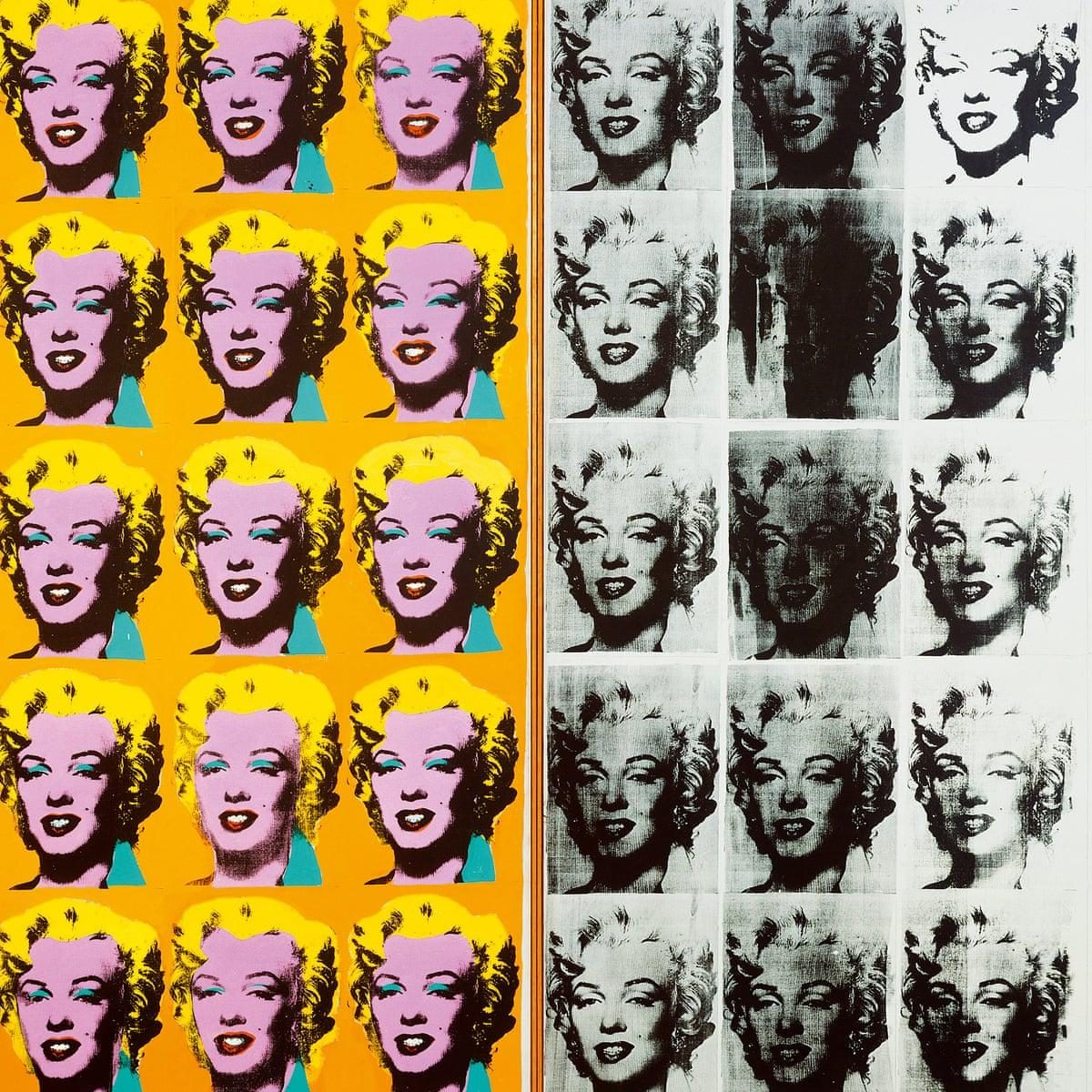
What is Pop Art?
Pop Art used imagery from:
- advertising,
- comics,
- celebrities,
- consumer products,
- mass media.
Artists challenged distinctions between “high” and “popular” culture.
Key Artist: Andy Warhol
Marilyn Diptych
Analysis
- Repeated image of Marilyn Monroe.
- Bright artificial colours.
- Silkscreen printing process.
- Explores celebrity culture and mass production.
Themes
- Fame
- Consumerism
- Media culture
Other Pop Artists
Roy Lichtenstein
Whaam!
Features
- Comic-book style.
- Ben-Day dots.
- Bold graphic lines.
Legacy / influence: Pop Art influenced later design, advertising, street art and postmodern art by collapsing the boundary between high art and popular culture.
B. Minimalism
Context / main ideas: Minimalism reduced art to simple industrial forms, repeated units and clean materials. It rejected personal gesture and illusion. The main change is that object, space, scale and the viewer’s physical experience became more important than narrative or expression.
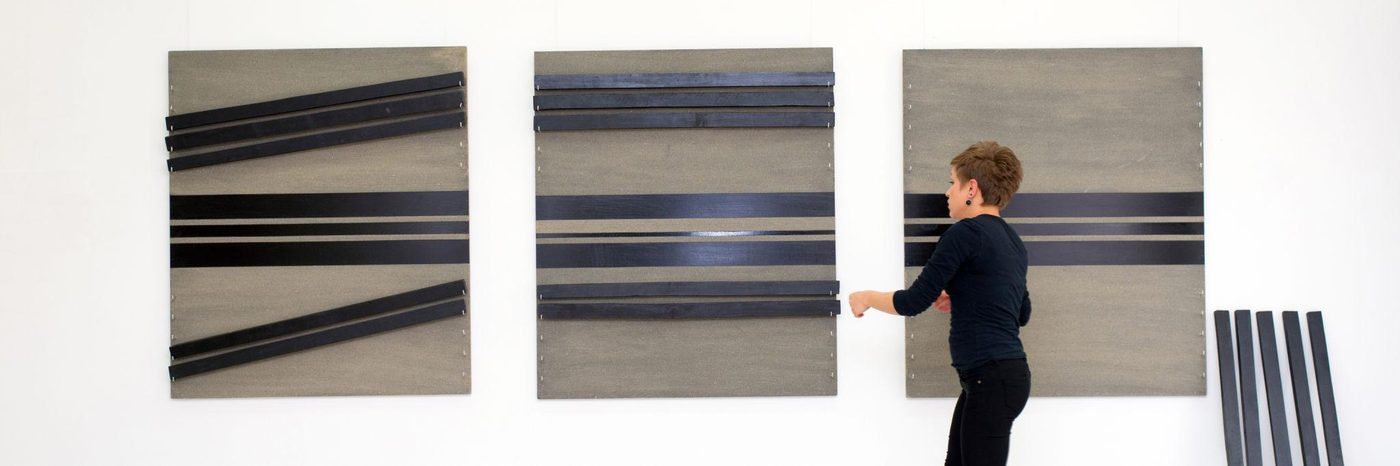
What is Minimalism?
Minimalist artists reduced art to simple geometric forms.
Focus was on:
- shape,
- material,
- space,
- repetition.
Key Artist: Donald Judd
Features
- Industrial materials.
- Clean geometric structures.
- Lack of personal emotion.
Legacy / influence: Minimalism influenced installation, architecture, design and Conceptual Art by valuing clarity, repetition, scale and the viewer’s physical experience of space.
C. Conceptual Art
Context / main ideas: Conceptual Art places the idea before the finished object. Artists used language, documentation, instructions and ordinary objects to question meaning and institutions. The main change is that thinking, definition and context could become the artwork itself.
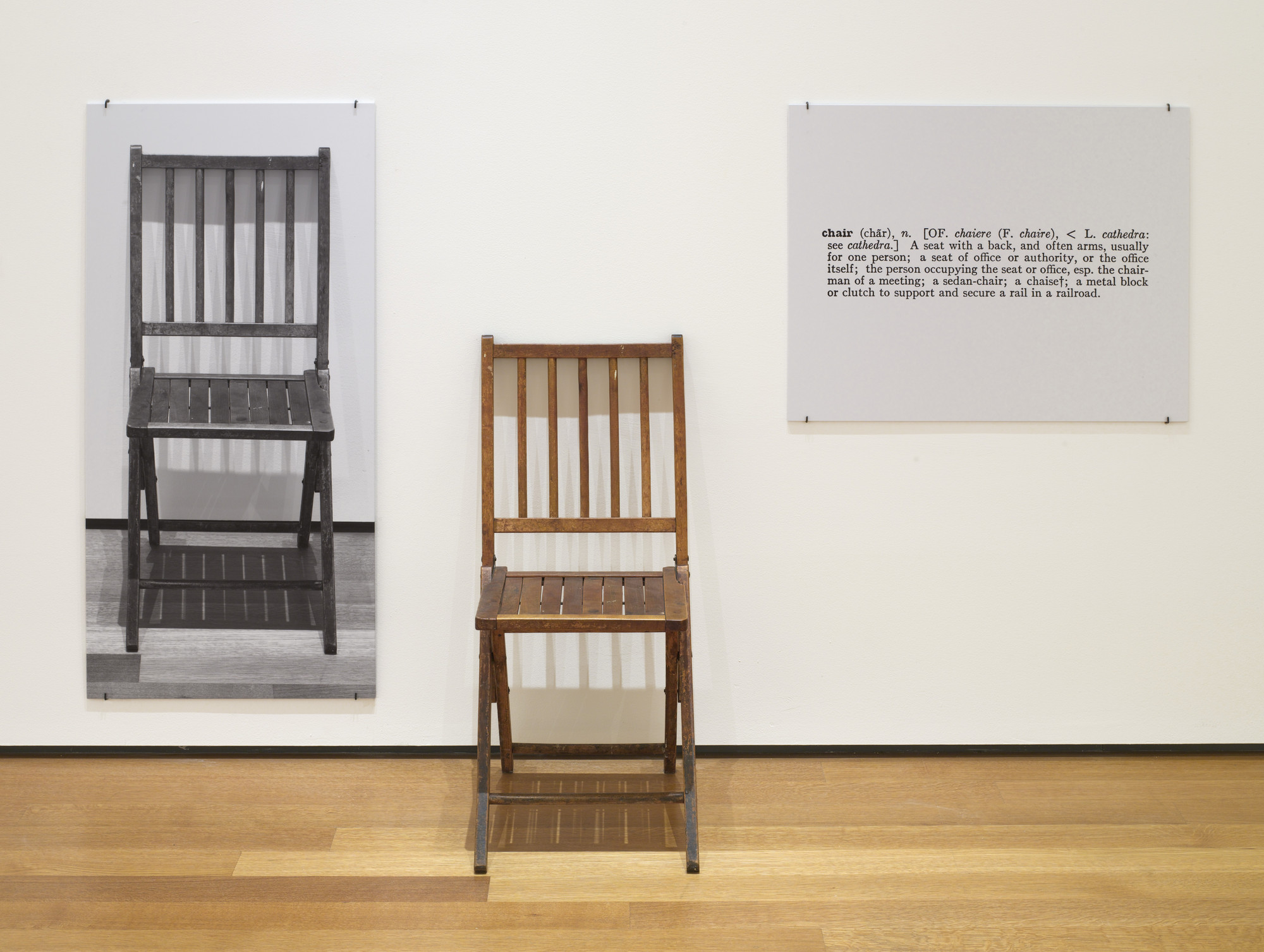
What is Conceptual Art?
The idea behind the artwork became more important than the physical object.
Key Artist: Joseph Kosuth
One and Three Chairs
Analysis
- Real chair, photograph and dictionary definition.
- Questions meaning and representation.
Importance
- Art becomes intellectual investigation.
Legacy / influence: Conceptual Art influenced later contemporary practice by making research, text, documentation and critical thinking central. It shaped installation, performance, digital art and socially engaged art.
D. Performance Art
Context / main ideas: Performance Art uses the body, time and action as artistic material. It can explore endurance, identity, gender, risk and audience presence. The main change is that art becomes a live event rather than a permanent object.
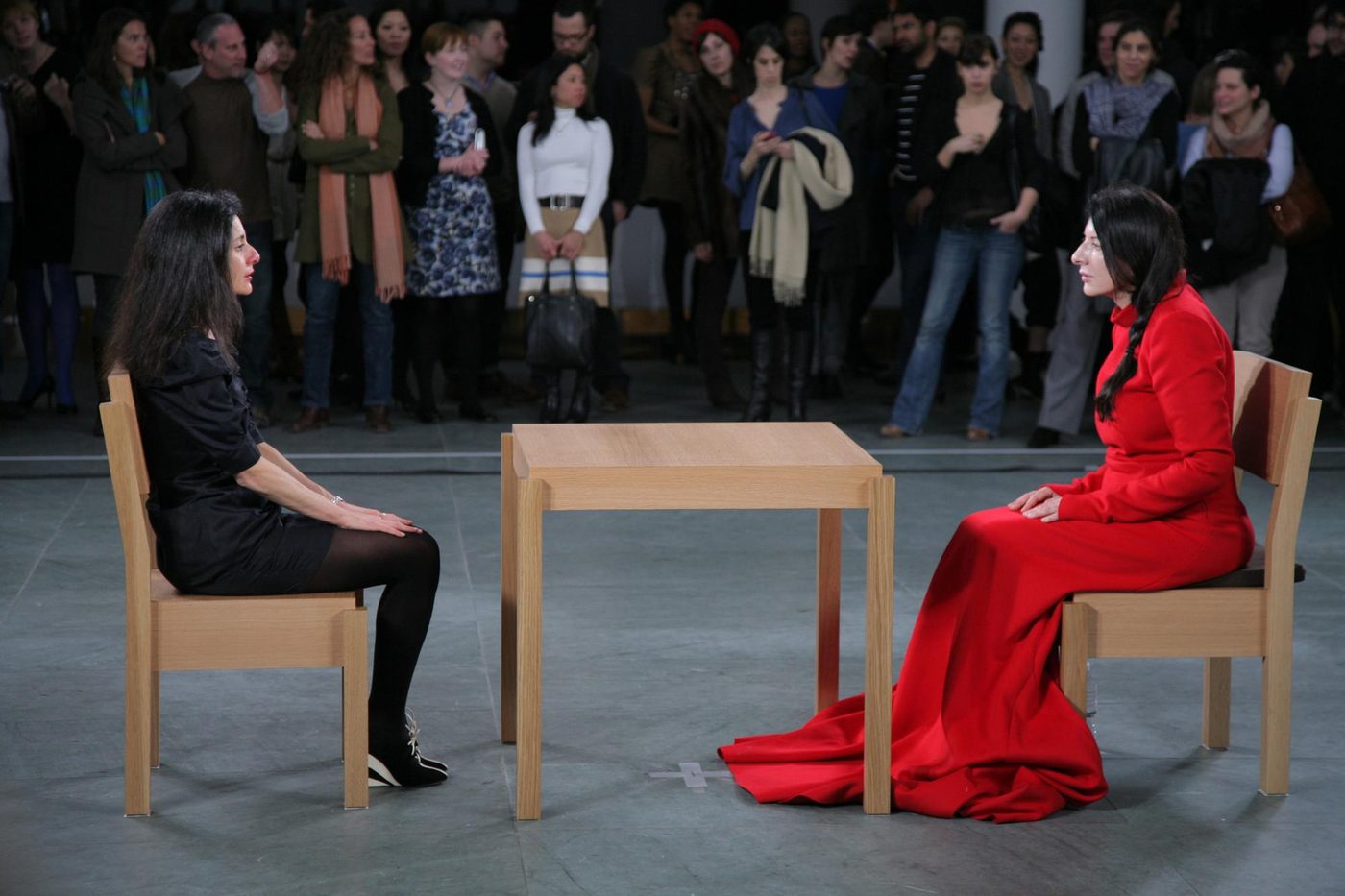
What is Performance Art?
The artist’s actions become the artwork.
Performance art often explores:
- identity,
- body,
- politics,
- endurance.
Key Artist: Marina Abramović
The Artist Is Present
Features
- Audience interaction.
- Emotional intensity.
- Focus on presence and endurance.
Legacy / influence: Performance Art influenced later video, installation, body art and social practice. It made presence, endurance, audience and documentation important parts of contemporary art.
E. Installation Art
Context / main ideas: Installation Art creates an environment for the viewer to enter. Space, light, sound, objects and movement can all shape meaning. The main change is that the viewer’s experience becomes part of the artwork rather than separate from it.
What is Installation Art?
Installation art transforms a space into an immersive experience.
Key Artist: Yayoi Kusama
Infinity Mirror Rooms
Features
- Mirrors and lights create endless illusion.
- Viewer becomes part of artwork.
Legacy / influence: Installation Art influenced museums, public art and immersive digital culture by making the viewer’s movement and perception part of the artwork.
F. Street Art & Graffiti
Context / main ideas: Street Art and Graffiti use public space, walls, text and images to reach audiences outside galleries. Artists often comment on politics, inequality, surveillance, war or consumerism. The main change is that location and public visibility become part of meaning.
Key Artist: Banksy
Features
- Political commentary.
- Public urban spaces.
- Stencil technique.
Legacy / influence: Street Art influenced contemporary visual culture by merging activism, design, public art and online circulation. It changed how art can speak directly in shared urban space.
G. Lens-Based / Video & New Media Art
Context / main ideas: Lens-based, video and new media art respond to television, surveillance, photography, digital culture and changing ways of seeing. Artists use screens, editing, sound and projection. The main change is that time-based media and technology become core artistic tools.
Artists use:
- video,
- computers,
- virtual reality,
- artificial intelligence,
- interactive technology.
Key Artist: Willie Doherty
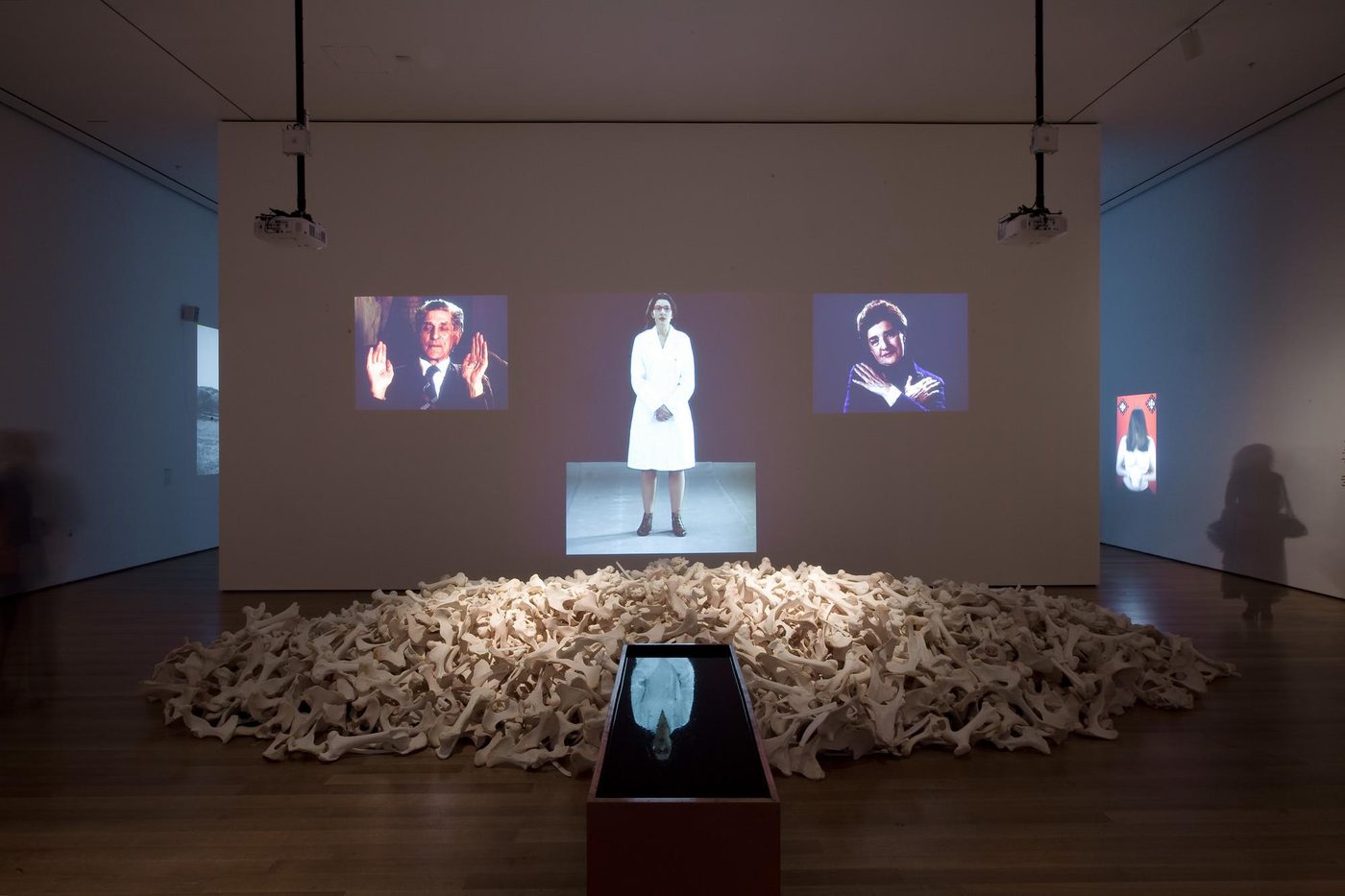
Importance
- Irish artist using photography and video installation.
- Explores place, memory, conflict and how images shape truth.
- Useful for Leaving Cert discussion of lens-based media, narrative, audience and contemporary Irish art.
Legacy / influence: New media art influenced contemporary practice by making technology, networks, duration and interaction central. It links art to cinema, gaming, social media and digital culture.
H. Feminist Art
Context / main ideas: Feminist Art challenged male-dominated art history and questioned representation, power, domestic labour, identity and the body. Artists used performance, installation, craft, text and collaboration. The main change is the demand that women’s experience and history become visible in art.
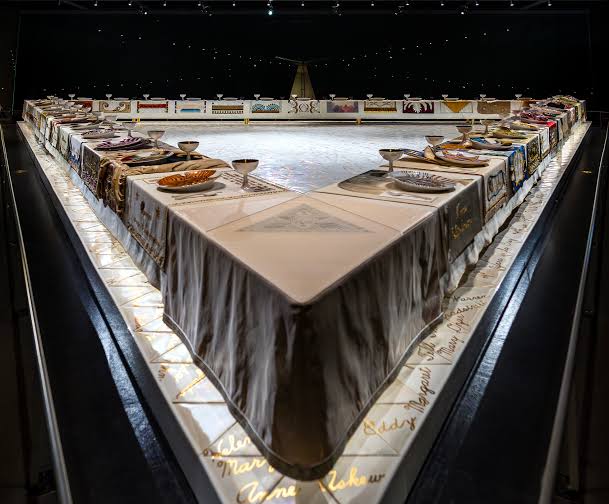
What is Feminist Art?
Feminist artists challenged:
- gender inequality,
- representation of women,
- male dominance in art history.
Key Artist: Judy Chicago
The Dinner Party
Features
- Installation celebrating women’s history.
- Collaborative process.
- Symbolic imagery.
Artist, Artwork and Artefact Analysis: Post-1960s Art
Andy Warhol — Marilyn Diptych
Key artist note: Andy Warhol was a central Pop artist who used screen-printing, repetition and celebrity imagery to examine mass media and consumer culture. His work blurs art, advertising and fame. He is useful for discussing mechanical process, popular culture, branding, death, glamour and reproduction.
Look closely: Subject: Marilyn Monroe as mass-media icon. Style: Pop Art, repeated and mechanical. Technique: silkscreen printing and bright colour/monochrome contrast. Composition: repeated face becomes pattern. Meaning/Context: examines celebrity, consumer culture, reproduction and mortality.
Warhol uses repetition, screen-printing and celebrity imagery to question mass media, fame and consumer culture. Bright colour and fading monochrome panels suggest both glamour and mortality, making the work central to Pop Art analysis.
Ai Weiwei — Sunflower Seeds
Key artist note: Ai Weiwei is a Chinese contemporary artist and activist whose work connects installation, craft, politics and human rights. He often uses repetition and traditional materials to question authority and global systems. He is useful for discussing labour, censorship, audience participation and the political power of contemporary art.
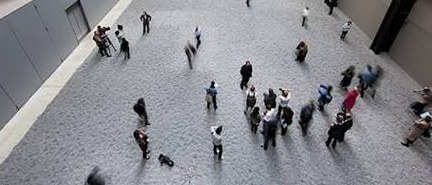
Look closely: Thousands of porcelain seeds turn craft, repetition and scale into a political reflection on labour, production and individuality.
Ai Weiwei’s installation uses thousands of porcelain sunflower seeds to explore mass production, labour, individuality and politics. The work combines craft and contemporary installation, asking viewers to think about scale, globalisation and collective identity.
Joseph Kosuth — One and Three Chairs
Key artist note: Joseph Kosuth is a central Conceptual artist whose work makes language, definition and representation the subject. He is useful for discussing idea over craft and how contemporary art questions meaning.
Look closely: Object, photograph and dictionary definition compare reality, image and language, making the idea the artwork.
One and Three Chairs turns a chair into a question about representation. The physical object, photo and text show that meaning depends on context and language, not just appearance.
Marina Abramović — The Artist Is Present
Key artist note: Marina Abramović is a performance artist who uses endurance, presence and audience interaction. Her work helps students discuss the body as medium and the viewer as participant.
Look closely: Stillness, duration and eye contact turn the artist’s body and the audience encounter into the work.
The Artist Is Present uses time, silence and direct encounter. The viewer completes the artwork by sitting opposite Abramović, making presence, emotion and endurance the main materials.
Yayoi Kusama — Infinity Mirrored Room
Key artist note: Yayoi Kusama uses repetition, dots, mirrors and immersive space. She is useful for discussing installation, audience experience, infinity, identity and sensory impact.
Look closely: Mirrors, lights and repetition create an immersive space where the viewer becomes part of the artwork.
Infinity Mirrored Room transforms space through reflection, pattern and light. The viewer enters the work, experiencing repetition, illusion and infinity rather than only looking at an object.
Banksy — Street Art and Social Commentary
Key artist note: Banksy is a street artist whose stencil works use humour, irony and public space to criticise politics, consumer culture and authority. He is useful for social commentary questions.
Look closely: Stencil technique, public placement and irony make the artwork direct, accessible and politically charged.
Banksy uses simple imagery, text and surprise in public spaces. The work reaches broad audiences outside galleries and turns walls into sites of protest, humour and social critique.
Judy Chicago — The Dinner Party
Key artist note: Judy Chicago is a feminist artist known for collaborative installation and craft. She is useful for discussing women’s history, symbolic imagery, ceramics, textiles and art-world exclusion.
Look closely: A triangular table, symbolic place settings and craft processes celebrate women excluded from traditional art history.
The Dinner Party uses installation, collaboration, embroidery, ceramics and ritual table setting. Its scale and symbolism recover women’s histories and challenge male-dominated art history.
Willie Doherty — Lens-Based / Video Art
Key artist note: Willie Doherty is an Irish artist who uses photography and video to examine place, memory, political conflict and uncertainty. He is useful for contemporary Irish and lens-based media questions.
Look closely: Projected image, sound, darkness and time create an immersive experience rather than a single fixed object.
Doherty’s lens-based practice asks viewers to question place, memory and truth. Video installation changes art into an unfolding experience shaped by time, sound, image and viewer interpretation.
Legacy / influence: Post-1960s art influenced contemporary practice by expanding art into performance, installation, video, social action, digital media and public space. It made ideas, context and audience participation central.
Legacy / influence: Feminist Art influenced later art by transforming debates around identity, equality, authorship and representation. It shaped queer art, social practice, institutional critique and contemporary installation.
4. Post-1960s Art and the Six Frameworks
A. Context
- Civil rights.
- Feminism.
- Technology.
- Globalisation.
- Consumer society.
B. Artists and Artworks
Key artists:
- Andy Warhol — Marilyn Diptych
- Joseph Kosuth — One and Three Chairs
- Marina Abramović — The Artist Is Present
- Yayoi Kusama — Infinity Mirrored Rooms
- Banksy — street art and social commentary
- Judy Chicago — The Dinner Party
- Willie Doherty — lens-based / video art
- Ai Weiwei — Sunflower Seeds
C. Analysis
Focus on:
- ideas and concepts,
- audience interaction,
- media influence,
- political meaning,
- installation and space.
D. Art Elements & Design Principles
| Element/Principle | Example |
|---|---|
| Colour | Pop Art bold colour |
| Space | Installation environments |
| Repetition | Warhol imagery |
| Contrast | Political street art |
| Scale | Large immersive installations |
E. Media & Areas of Practice
| Area | Media |
|---|---|
| Installation | Mixed materials |
| Performance | Body and action |
| Digital Art | Video and technology |
| Street Art | Spray paint and stencil |
F. Innovation & Invention
- Conceptual approaches.
- Audience participation.
- Digital technologies.
- Installation environments.
- Performance as art.
- Expanded definition of art.
5. Comparison Table
| Movement | Main Focus |
|---|---|
| Pop Art | Consumer culture |
| Minimalism | Simplicity and form |
| Conceptual Art | Ideas over objects |
| Performance Art | Body and action |
| Installation Art | Space and experience |
| Feminist Art | Gender and equality |
| Digital Art | Technology and media |
6. Important Terms
| Term | Meaning |
|---|---|
| Installation | Artwork occupying space |
| Conceptual Art | Idea-based art |
| Performance Art | Live artistic action |
| Mixed Media | Multiple materials |
| Consumerism | Mass buying culture |
| Appropriation | Borrowing existing imagery |
| Immersive | Surrounding audience experience |
7. Possible Exam Topics
Possible areas to prepare:
- Expanding definitions of art.
- Art and politics.
- Technology and media.
- Audience participation.
- Feminism and identity.
- Comparison between Modernism and Post-1960s Art.